Battle of the sexes benefits offspring, says research
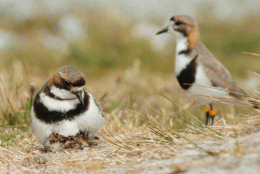
Parents compensate for a lazy partner by working harder to bring up their offspring, but not enough to completely make up for the lack of parenting, says research by bird biologists at the University of Bath.
In nature, it is quite rare for both parents to be involved in raising young, but it is very common in birds, some fish and primates including humans. Researchers therefore wanted to find out why, for some animals, parents stick together.
The study, published in the Journal of Evolutionary Biology, analysed more than 50 previous studies of birds to understand why and how they share their parental duties.
The research was led by Dr Freya Harrison and Professor Tamás Székely at the Biodiversity lab at the University of Bath, in collaboration with researchers from the University of Bristol and the University of Debrecen (Hungary).
Dr Harrison explained: “Caring for offspring is essential for their survival in many species, but it is also very costly in time and effort. Time spent bringing up your young means lost opportunities for remating and having more offspring, so parents face a trade-off between caring for current offspring and creating future offspring.
“This creates a conflict of interest between parents, since each parent would benefit by leaving their partner holding the baby whilst they go off and start a new brood elsewhere.
“This is exactly what happens in most animal species, so we wanted to understand how and why animals like birds and primates have evolved the tendency to share their parental duties.”
The researchers analysed data published over the last 30 years on parenting in birds to see if there was a common pattern in the behaviour of all the species studied.
Dr Harrison said: “In our study we found that if one parent starts slacking off or deserts, its mate works harder to bring up the brood, but not so hard as to completely compensate for their partner’s laziness.
“Some say that marriage is a state of antagonistic cooperation - in this case we found that the secret to a stable pairing was to only partially compensate for your lazy partner’s failings, to make sure that they stick around.”
Professor Innes Cuthill, Professor of Behavioural Ecology at the University of Bristol, added: “Of course, we are not claiming that fish and birds, or even humans, are necessarily making a consciously calculated decision.
“More likely there are innate rules for responding, perhaps modified through learning, that allow successful participation in joint activities without leaving room for being exploited.”
The researchers hope that this work could help scientists better understand how biparental care has evolved in humans.
The study was supported by the European Commission coordination action project: Integrating Cooperation Research Across Europe (INCORE).
More information: Harrison, F., Barta, Z., Cuthill, I. & Székely, T. “How is sexual conflict over parental care resolved? A meta-analysis” is published online ahead of print in the Journal of Evolutionary Biology.
Source: University of Bath (news : web)


