Microscopic 'beads' could help create 'designer' immune cells that ignore transplanted organs
July 6, 2009 Microscopic 'beads' could help create 'designer' immune cells that ignore transplanted organs

Enlarge

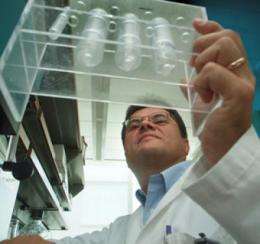
The future of organ transplantation could include microscopic beads that create "designer" immune cells to help patients tolerate their new organ, says Dr. Anatolij Horuzsko, reproductive immunologist at the Medical College of Georgia Center for Molecular Chaperone/Radiobiology and Cancer Virology, who has used the approach successfully in mice with skin grafts. Credit: Phil Jones/MCG Campus Photographer

The future of organ transplantation could include microscopic beads that create "designer" immune cells to help patients tolerate their new organ, Medical College of Georgia researchers say.

"It's absolutely natural," says Dr. Anatolij Horuzsko, reproductive immunologist at the MCG Center for Molecular Chaperone/Radiobiology and Cancer Virology, who has used the approach successfully in mice with skin grafts.

The degradable microparticles deliver the most powerful known form of HLA-G, a natural suppressor of the immune response, straight to dendritic cells, which typically show the immune system what to attack. The microparticles are given right after a transplant, just as dendritic cells are giving the immune system a heads up to get busy attacking the new organ.

Microparticle therapy likely would be needed for just a few weeks, until the dendritic cells have learned instead to ignore it, Dr. Horuzsko says. "It's like a calming effect and once tolerance is established, we don't need it any more."

His lab reported its success with this delivery method in mice with skin grafts last month in Human Immunology. When researchers compared the success of HLA-G microparticles with the dendritic cell marker to those without a marker, those with were much more efficient at getting where needed and acting, he says. Those without direction likely were consumed by garbage eaters called macrophages.

Unlike current anti-rejection drugs that generally suppress the immune system - leaving patients vulnerable to infections, cancer and more - HLA-G offers specific "tolerance." Fetuses, which also use the compound to escape rejection by the mother's immune system, are good examples of the specific tolerance HLA-G affords, Dr. Horuzsko says.

"We want to create in kidney transplant patients, the same tolerance to the new kidney." Within five years, HLA-G microparticles could be doing just that, Dr. Horuzsko says. He presented the patented process along with his other latest HLA-G findings during an opening lecture of the 5th International Conference on HLA-G in Paris, July 6-8.

Marked microparticles also have treatment potential in diseases where the attacks normal tissue, such as arthritis, multiple sclerosis and inflammatory bowel disease, Dr. Horuzsko says. Conversely the method could be used to deliver a compound to block HLA-G activity, which also is heightened in tumors.

The scientist also is working with Dr. Laura Mulloy, chief of the Section of Nephrology, Hypertension and Transplantation Medicine in the MCG School of Medicine, to determine if higher natural levels of HLA-G already are giving some transplant patients an edge by comparing HLA-G expression in those who keep and reject their transplanted kidneys

Dr. Horuzsko reported last year in Proceedings of the National Academy of Sciences that the dimer form of HLA-G was the most powerful of the known forms and now he and many others are searching for the most powerful dimer, hoping the most successful transplant patients will help them make that call.

HLA-G works through inhibitory receptors, ILT2, ILT3 and ILT4, on , triggering a signaling pathway in which several suppressive molecules get activated to help protect the transplanted organ or tissue. Human leukocyte antigen G, or HLA-G, actually is a member of a gene family called major histocompatibility complex that typically provokes an immune response. Like an errant child, HLA-G instead promotes tolerance, Dr. Horuzsko says.

Source: Medical College of Georgia


print this article email this article download pdf blog this article bookmark this article     Stumble it Digg this share on Facebook retweet share on Reddit add to delicious
Rate this story - 5 /5 (2 votes)


July 6, 2009 all stories

Comments: 0

5 /5 (2 votes)
  • Stumble this up

  • Digg this

  • share this

  • hide
  • Related Stories

  • Immune molecule that plays a powerful role in avoiding organ rejection identified
    created Jun 16, 2008 | popularity not rated yet | comments 0
  • Study points to 1 cause of higher rates of transplanted kidney rejection in blacks
    created Aug 29, 2008 | popularity not rated yet | comments 0
  • Improving the quality of laboratory data with computer modeling
    created Feb 29, 2008 | popularity not rated yet | comments 0
  • Modeling pathogen responses
    created Oct 12, 2007 | popularity not rated yet | comments 0
  • Donor-Recipient Genetics and Early Kidney Transplant Complications
    created Nov 25, 2008 | popularity not rated yet | comments 0


  • hide
  • Relevant PhysicsForums posts

  • Obsessive Compulsive Disorder
    created Nov 20, 2009
  • West's zone 2 starling resistor respiratory physiology
    created Nov 18, 2009
  • 50-0-50 rule
    created Nov 18, 2009
  • What is the evidence in support of the anti-vaccine movement?
    created Nov 17, 2009
  • More from Physics Forums - Medical Sciences

Other News

Swine flu vaccine effective despite mutations: experts

Medicine & Health / Diseases

created 8 hours ago | popularity 1 / 5 (1) | comments 1

Swine flu vaccines are still effective despite reported cases of mutations in the A(H1N1) virus, health experts in Europe and North America said Saturday.


Study raises concerns about outdoor second-hand smoke

Medicine & Health / Health

created Nov 18, 2009 | popularity 2 / 5 (4) | comments 21

Indoor smoking bans have forced smokers at bars and restaurants onto outdoor patios, but a new University of Georgia study in collaboration with the Centers for Disease Control and Prevention suggests that these outdoor smoking ...


smoking, cigarette

Vaccine being developed to help smokers quit

Medicine & Health / Medications

created Nov 20, 2009 | popularity 4.3 / 5 (9) | comments 10

(PhysOrg.com) -- Glaxo-SmithKline has joined forces with Nabi Pharmaceuticals to produce a vaccine to help smokers give up their addiction permanently.


GOP: Health test recommendations could affect care (AP)

GOP: Health test recommendations could affect care

Medicine & Health / Health

created 19 hours ago | popularity not rated yet | comments 0

(AP) -- Republicans are seizing on this week's recommendations for fewer Pap smears and mammograms to fuel concern about government-rationed medical care - and to try to chip away support by women for President ...


Pilot study relates phthalate exposure to less-masculine play by boys

Medicine & Health / Research

created Nov 16, 2009 | popularity 4.8 / 5 (9) | comments 9

A study of 145 preschool children reports, for the first time, that when the concentrations of two common phthalates in mothers' prenatal urine are elevated their sons are less likely to play with male-typical toys and games, ...