TV makers hope thin is in for newest sets
July 6, 2009 By BARBARA ORTUTAY , AP Technology Writer
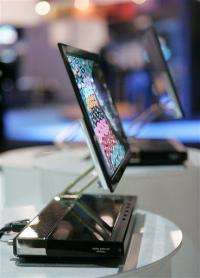
FILE - In this Jan. 7, 2008 file photo, Sony's 11-inch OLED digital televisions are showcased at the Consumer Electronics Show (CES) in Las Vegas. Now that flat-panel TVs have come down from thousands of dollars to as little as $200, manufacturers are pushing high-end alternatives that are slimmer, use less energy and come with other high-end add-ons _ and can carry price tags in the thousands again. (AP Photo/Jae C. Hong, file)
(AP) -- Lee Richman installs high-end home theater systems that can cost as much as $170,000. Lately, he's noticed that some of his clients - or their interior designers - are perking up when they hear about ultra-slim TV sets, which come off the wall only about an inch.
The difference between these thin models and regular flat-panel TVs, which generally are about 3 or 4 inches deep, is pretty small. It's nothing like the aesthetic shock that consumers had when flat panels were introduced to replace fat old cathode ray tube TVs.
But in a certain slice of the market - anyone who has subscribed to more than one home decor magazine, perhaps - super slim TVs make people "very enthused," Richman said.
This is textbook business strategy for TV makers. Now that flat-panel TVs have come down from thousands of dollars to as little as $200, manufacturers are pushing high-end alternatives that are slimmer, use less energy and come with other high-end add-ons - and can carry price tags in the thousands again.
Bulky boob tubes have long been banished from the hippest living rooms, and the vast majority of TVs sold in the U.S. today are flat panels. But competition and the recession have sent prices falling, cutting into profits.
Tweaking with a basic product's look is a classic way to re-ignite demand. Think of jeans: Designers stress a boot cut one year, narrow pant legs the next.
When it comes to TVs, screens can get only so big. So manufacturers are hoping to recoup some of their lost margins by stressing a set's minuscule depth to consumers who still have money.
"You're going to see them marketing the bejesus out of that, because they've maxed out the resolution" and other features that often are used to sell TVs, said Jim Barry, a spokesman for the Consumer Electronics Association.
Thinness is an easy marketing factor to reach for, since it's tangible and easily measured, just like screen size. Manufacturers are also improving picture quality, but the measurements, like contrast ratio and color gamut, are more difficult for a shopper to understand.
Samsung Electronics Co. is pushing ultra-thin design as one of the enhanced features of its latest HDTV line, which starts at $1,600 for a screen 32 inches on the diagonal and costs as much as $4,000 for a 55-inch screen and other features. The company is putting a lot of effort into getting these sets in front of consumers, including by setting up mall kiosks for demonstrations, said Jonas Tanenbaum, vice president of flat-panel marketing for Samsung Electronics America.
Among the selling points: The sets are about 1.2 inches thick. They also are backlit by energy-efficient light-emitting diodes instead of the standard fluorescent tubes. The higher-end models can connect to the Internet and PCs.
Because 1-inch-thick TVs are relatively new and cost so much, it is too early to tell when super-slimness will trickle down to the mass market. Paul Gagnon, an analyst with market researcher DisplaySearch, estimates that ultra-thin sets make up about 2 percent of the overall TV market. In North America, it's about 5 percent.
Toshiba Corp., for one, is not bothering with slim models, at least for now. Its latest flat-panel TV is 4 inches thick.
"We don't believe, especially in this economy, that people are willing to pay extra for ultra-thin," said Scott Ramirez, vice president of TV marketing at Toshiba America Consumer Products. "No one is complaining about their sets being 3 or 4 inches thick."
Making a thicker set helps Toshiba control the way the screen is backlit, yielding deeper black images and better contrast in dark scenes.
Even so, the long-term trend is probably toward skinnier and skinnier sets, perhaps eventually down to less than half an inch. To get significantly thinner than that, the sets probably will need a different display technology, such as organic LEDs, or OLEDs, which generate light on the display's surface and don't have to be illuminated from behind. Sony Corp. has an $2,500 TV that uses OLEDs, a first for the industry, and is just 3 millimeters thick (less than one-eighth of an inch). But for now the screen is only 11 inches on the diagonal.
Gagnon expects ultra-thin models to be at a premium for another year or two, while manufacturers wring as much as possible from customers who are wealthy, or early adopters of gadgets or especially design-conscious.
Of course, after that, once ultra-thin TVs become the norm, manufacturers will once again have to come up with another way to lure big spenders.
©2009 The Associated Press. All rights reserved. This material may not be published, broadcast, rewritten or redistributed.
-
Philips Research reveals ultra-thin backlight technology for TVs
Aug 28, 2008 |
not rated yet |
0
-
LG Electronics Introduces 2 New 'Full LED' LCD TVs
Jun 25, 2009 |
not rated yet |
0
-
Sharp Develops 108V-Inch LCD TV, the World’s Largest
Jan 08, 2007 |
not rated yet |
0
-
Samsung Goes Brave New World With 40-Inch OLED Panel
Oct 30, 2008 |
not rated yet |
0
-
Philips delivers enhanced sound quality and advanced audio power for flat televisions
May 04, 2005 |
not rated yet |
0
-
Engineers build first sub-10-nm carbon nanotube transistor
Feb 01, 2012 |
4.9 / 5 (33) |
30
-
Something old, something new: Evolution and the structural divergence of duplicate genes
Jan 31, 2012 |
4.6 / 5 (7) |
1
-
The hidden nanoworld of ice crystals: Revealing the dynamic behavior of quasi-liquid layers
Jan 30, 2012 |
5 / 5 (4) |
1
-
Stock market network reveals investor clustering
Jan 27, 2012 |
3.9 / 5 (23) |
8
-
Of microchemistry and molecules: Electronic microfluidic device synthesizes biocompatible probes
Jan 26, 2012 |
5 / 5 (2) |
0
-
How to tilt a object
5 hours ago
-
How to calculate total compressibility in liquid porous solid system
10 hours ago
-
Need help reading 3-D
Feb 11, 2012
-
A way to send and receive wireless data
Feb 11, 2012
-
Calling function with no input argument
Feb 10, 2012
-
Force free body diagram problem on gym equipment
Feb 10, 2012
- More from Physics Forums - General Engineering
More news stories
Japan scientist makes 'Avatar' robot
A Japanese-developed robot that mimics the movements of its human controller is bringing the Hollywood blockbuster "Avatar" one step closer to reality.
Feb 10, 2012 |
5 / 5 (9) |
12
Intel packs performance and reliability into its latest SSD 520 series
Intel Corporation announced today its fastest, most robust client/consumer solid-state drive (SSD) to date, the Intel Solid-State Drive 520 Series (Intel SSD 520), a 6 gigabit-per-second (gbps) SATA III SSD ...
Feb 07, 2012 |
5 / 5 (1) |
4
Google rumored to have built Heads-Up-Display glasses prototype
(PhysOrg.com) -- 9to5Google is reporting that they have received a tip from someone they believe to be a reliable source saying that Google is working on a Heads-Up-Display (HUD) pair of eye-glasses. The per ...
New Kindle Touch is an impressive e-reader
When it comes to reading digital books, tablets are all the rage. But there's a lot to like about simple e-readers, which over the past year have become both a lot cheaper and a lot less clunky.
Electronics / Consumer & Gadgets
Feb 09, 2012 |
5 / 5 (4) |
1
Apple to debut 'iPad 3' in March: report
Apple will unveil a new version of its market-ruling iPad table computer in March, according to a report in Dow Jones-owned technology blog All Things D.
Electronics / Consumer & Gadgets
Feb 09, 2012 |
1.9 / 5 (21) |
0
Scientists discover molecular secrets of 2,000-year-old Chinese herbal remedy
For roughly two thousand years, Chinese herbalists have treated Malaria using a root extract, commonly known as Chang Shan, from a type of hydrangea that grows in Tibet and Nepal. More recent studies suggest that halofuginone, ...
New method to examine batteries -- MRI from the inside
There is an ever-increasing need for advanced batteries for portable electronics, such as phones, cameras, and music players, but also to power electric vehicles and to facilitate the distribution and storage of energy derived ...
A mitosis mystery solved: How chromosomes align perfectly in a dividing cell
Although the process of mitotic cell division has been studied intensely for more than 50 years, Whitehead Institute researchers have only now solved the mystery of how cells correctly align their chromosomes during symmetric ...
Google might launch Drive for cloud storage soon
(PhysOrg.com) -- Google's next big move, according to the Wall Street Journal, is a cloud storage service called Drive. Hardly first to the plate, Google is simply catching up to introducing its cloud reposi ...
Lab study raises questions over nano-particle impact
Tests involving chickens have raised questions about the impact on health from engineered nano-particles, the ultra-fine grains commonly used in drugs and processed foods, scientists said on Sunday.
Starve a virus, feed a cure? Findings show how some cells protect themselves against HIV
A protein that protects some of our immune cells from the most common and virulent form of HIV works by starving the virus of the molecular building blocks that it needs to replicate, according to research published online ...
Jul 07, 2009
Rank: 5 / 5 (1)
Jul 13, 2009
Rank: 1 / 5 (1)