Israeli archaeologists discover ancient quarry
July 6, 2009 By JEN THOMAS , Associated Press Writer Israeli archaeologists discover ancient quarry (AP)

Enlarge

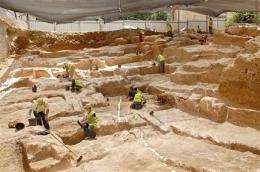
This image made available by Israel's Antiquities Authority Monday, July 6, 2009 shows workers at the excavation site of an ancient quarry in Jerusalem. Archaeologists in Jerusalem have uncovered an ancient quarry where they believe the Bible's King Herod extracted stones for the construction of the Jewish Temple 2,000 years ago, the Israel Antiquities Authority said Monday. (AP Photo/IAA, Assaf Peretz)

(AP) -- Israeli archaeologists have uncovered an ancient quarry where they believe King Herod extracted stones for the construction of the Jewish Temple 2,000 years ago, the Israel Antiquities Authority said Monday. The archaeologists believe the 1,000-square-foot (100-square-meter) quarry was part of a much larger network of quarries used by Herod in the city.

The biggest stones extracted from the quarry would have measured three yards (meters) long, two yards (meters) across, and two yards (meters) high.

The said the size of the stones indicates they could have been used in the of the Temple compound, including the Western Wall, a retaining wall that remains intact and is a Jewish shrine.

"The dimensions of the stones that were produced in the quarry that was revealed are suitable for the Temple walls," said Ofer Sion, the dig's director.

The two-week excavation, which was conducted before construction begins on an apartment complex at the site, also uncovered pottery, coins and what appear to be tools used in the quarry dating to the first century B.C.

"Finding a large quarry related to the largest building project ever undertaken in Jerusalem ... that's more than just another discovery," said archaeologist Aren Maeir of Bar-Ilan University, who was not involved in the excavation. "It's an additional block that slowly reveals the picture of construction in ancient Jerusalem."

Herod was the Roman-appointed king of the Holy Land from 37 B.C. to 4 B.C. and was known for his many major building projects, including the rebuilding of the Jewish Temple. The Second was destroyed in A.D. 70 by Roman legions following a Jewish revolt.

Excavation at the site is almost complete, and the Israel Antiquities Authority says construction of the apartments will begin in the coming weeks.

Because of the amount of ancient remains in Israel, builders are required to carry out a salvage excavation before beginning construction. Such digs regularly turn up important finds.

©2009 The Associated Press. All rights reserved. This material may not be published, broadcast, rewritten or redistributed.


print this article email this article download pdf blog this article bookmark this article     Stumble it Digg this share on Facebook retweet share on Reddit add to delicious
Rate this story - 4 /5 (1 vote)


July 6, 2009 all stories

Comments: 0

4 /5 (1 vote)
  • Stumble this up

  • Digg this

  • share this

  • hide
  • Related Stories

  • Ancient handle with Hebrew text found in Jerusalem
    created May 20, 2009 | popularity not rated yet | comments 0
  • Archaeological excavations uncover Roman temple in Zippori (Sepphoris)
    created Aug 11, 2008 | popularity not rated yet | comments 0
  • 2,000-year-old tunnels found in Israel
    created Mar 14, 2006 | popularity not rated yet | comments 0
  • New ancient Egypt temples discovered in Sinai
    created Apr 21, 2009 | popularity not rated yet | comments 0
  • Brazier found in Iron Age temple in Iran
    created Mar 16, 2007 | popularity not rated yet | comments 0


  • hide
  • Relevant PhysicsForums posts

  • Human Leukocyte Antigen (HLA) typing
    created 7 hours ago
  • Breeding program
    created Nov 20, 2009
  • How does a concentration gradient provide energy?
    created Nov 20, 2009
  • Eyesight and Neural Damage from Electronics
    created Nov 19, 2009
  • More from Physics Forums - Biology

Other News

Museum: Galileo's fingers, tooth are found (AP)

Museum: Galileo's fingers, tooth are found

Other Sciences / Archaeology & Fossils

created 18 hours ago | popularity not rated yet | comments 5

(AP) -- Two fingers and a tooth removed from Galileo Galilei's corpse in a Florentine basilica in the 18th century and given up for lost have been found again and will soon be put on display, an Italian museum ...


Measure to change U. of Neb. stem-cell rule fails (AP)

Measure to change U. of Neb. stem-cell rule fails (Update 2)

Other Sciences / Other

created 18 hours ago | popularity 5 / 5 (1) | comments 0

(AP) -- The University of Nebraska's governing board on Friday voted not to place tighter restrictions on embryonic stem cell research than those outlined under federal guidelines, which were expanded after ...


Researcher: Faint writing seen on Shroud of Turin (AP)

Researcher: Faint writing seen on Shroud of Turin (Update)

Other Sciences / Archaeology & Fossils

created Nov 20, 2009 | popularity 1.9 / 5 (23) | comments 23

(AP) -- A Vatican researcher has rekindled the age-old debate over the Shroud of Turin, saying that faint writing on the linen proves it was the burial cloth of Jesus. Experts say the historian may be reading ...


Three of a kind

Three of a kind: Revealing language’s universal essence

Other Sciences / Social Sciences

created Nov 20, 2009 | popularity 3.9 / 5 (11) | comments 6

(PhysOrg.com) -- On the surface, English, Japanese, and Kinande, a member of the Bantu family of languages spoken in the Democratic Republic of Congo, have little in common. It is not just that the vocabularies ...


Maya

New insights into the life of the Maya

Other Sciences / Archaeology & Fossils

created Nov 16, 2009 | popularity 4.6 / 5 (15) | comments 7

(PhysOrg.com) -- Ancient artifacts are almost always concerned with rich and powerful religious and political leaders, but new excavations of an ancient Maya site have unearthed a pyramid decorated with murals ...