Ancient fossils shed light on anatomical changes accompanying evolution of first land vertebrates
July 6, 2009
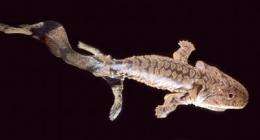
This is a photograph of a museum reconstruction of Acanthostega, an early tetrapod. Acanthostega measured about 2 feet (0.6m) in length. Credit: Photo courtesy of Jennifer Clack
Cartoon depictions of the first animals to emerge from the ocean and walk on land often show a simple fish with feet, venturing from water to land. But according to Jennifer Clack, a paleontologist at the University of Cambridge who has studied the fossils of these extinct creatures for more than two decades, the earliest land vertebrates -- also known as tetrapods -- were more diverse than we could possibly imagine.
"Some looked like crocodiles, some looked like little lizards, some like moray eels, and some were snake-like," said Clack. "They occupied all sorts of niches and habitats. And they varied tremendously in size — from about 10 cm long to 5 meters."
The team's findings will appear in the 16 July 2009 online issue of the Journal of Anatomy.
Long before mammals, birds, and even dinosaurs roamed the Earth, the first four-legged creatures made their first steps onto land, and quickly inhabited a wide range of terrestrial environments. These early land vertebrates varied considerably in size and shape, said Clack.
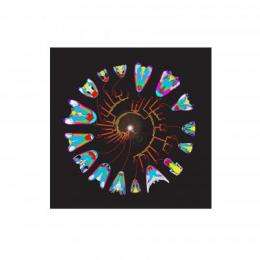
This is an artist's depiction of the tree-of-life for early tetrapods, showing 100 million years of palate evolution and diversification. The outer edges of the diagram represent the diversity of palate size and shape. Artwork by Brian Sidlauskas. Credit: Artwork by Brian Sidlauskas
To understand the anatomical changes that accompanied this diversity, Clack teamed up with two biologists who work on living fishes — Charles Kimmel of the University of Oregon, and Brian Sidlauskas of the National Evolutionary Synthesis Center in North Carolina.The researchers focused on 35 early tetrapods that lived between 385 and 275 million years ago. As a proxy for body size and shape, they examined the dimensions of a number of bones in a region of the skull known as the palate. By tracing changes in the length and width of interlocking bones in this part of the skull, the researchers hoped to get a more fine-grained picture of skeleton evolution as a whole.
"I tend to think the genetic instructions for making a skeleton come from how you make individual bones first, and then how you fit those bones together as a refinement of that," said developmental biologist Charles Kimmel, who was the first author on the paper.
When they mapped the changes in bone length and width onto the tetrapod family tree, the researchers discovered that not all bones changed size at the same rate or in the same direction. This phenomenon can result in an overall reshaping from one lineage to the next, explained Sidlauskas. "Sometimes a change in size can have indirect consequences for the shape of the animal," said Sidlauskas. "When different parts of an animal's body change size at different rates over evolutionary time, that can generate changes in body shape from one species to another."
Moreover, some changes are consistent with an evolutionary quirk known as paedomorphosis, in which species retain in adulthood the youthful dimensions that their ancestors had as juveniles. "Paedomorphosis is definitely there — the descendents of some groups are retaining the proportions that their juveniles had in the past," said Clack.
These results not only help explain why early tetrapods were so diverse in size and shape, but also shed light on an important chapter in the evolution of life on land - the transition from fish to amphibians.
"One of the big questions at the moment is: where did modern amphibians come from?" said Clack. "One of the hypotheses is that they have evolved by paedomorphosis and miniaturization from early tetrapods. This study lends weight to that idea."
More information: Kimmel, C., B. Sidlauskas, and J. Clack. (2009). "Linked morphological changes during palate evolution in early tetrapods." Journal of Anatomy 215(2). doi: 10.1111/j.1469-7580.2009.01108.x. For full data see Dryad Digital Repository: http://hdl.handle. … 55/dryad.488
Source: National Evolutionary Synthesis Center
-
Fossils suggest earlier land-water transition of tetrapod
Apr 17, 2009 |
not rated yet |
0
-
Primordial fish had rudimentary fingers
Sep 22, 2008 |
not rated yet |
0
-
'Fishapod' reveals origins of head and neck structures of first land animals
Oct 15, 2008 |
not rated yet |
0
-
Ancient amphibians evolved a bite before migrating to dry land
Apr 17, 2007 |
not rated yet |
0
-
Did our ancestors breathe through their ears?
Jan 19, 2006 |
not rated yet |
0
-
Engineers build first sub-10-nm carbon nanotube transistor
Feb 01, 2012 |
4.9 / 5 (31) |
30
-
Something old, something new: Evolution and the structural divergence of duplicate genes
Jan 31, 2012 |
4.6 / 5 (7) |
1
-
The hidden nanoworld of ice crystals: Revealing the dynamic behavior of quasi-liquid layers
Jan 30, 2012 |
5 / 5 (3) |
1
-
Stock market network reveals investor clustering
Jan 27, 2012 |
3.9 / 5 (23) |
8
-
Of microchemistry and molecules: Electronic microfluidic device synthesizes biocompatible probes
Jan 26, 2012 |
5 / 5 (1) |
0
-
Protease cleavage
5 hours ago
-
Pertubance in a model
11 hours ago
-
Cancer drugs and Alzheimer's, Oh my!
19 hours ago
-
Squishing cells
20 hours ago
-
Any books/articles for evolutionary stable strategy models in humans?
Feb 09, 2012
-
Science behind the bore feeling?
Feb 09, 2012
- More from Physics Forums - Biology
More news stories
Employers feel no love for unscrupulous practice of 'service sweethearting'
A new study led by two Florida State University marketing professors finds that some frontline service employees who are rewarded for hikes in customer loyalty and satisfaction also may engage in "service ...
Other Sciences / Economics & Business
5 hours ago |
4 / 5 (1) |
4
A frank discussion of the power law and linking correlation to causation
(PhysOrg.com) -- Michael Stumpf a mathematics professor at Imperial College in London, and Mason Porter a lecturer at Oxford have teamed together to write and publish a perspective piece in Science regarding the in ...
The question of life in the ancient world
Theres a general feeling that we dont get the Greeks ancient or modern. Many, including heads of state like Angela Merkel, visibly shake their head in exasperation, rightly or wrongly, at ...
Other Sciences / Archaeology & Fossils
11 hours ago |
1 / 5 (1) |
4
Sonic Cradle lands spot in TED exhibition
A Simon Fraser University graduate student project that melds music, meditation and modern technology has landed a rare spot as an exhibit at TEDActive 2012 in Palm Springs, California this month.
7 hours ago |
not rated yet |
0
Chilean miners' rescue capsule on show in London
The capsule used to rescue Chilean miners trapped underground for two months goes on display Saturday at the Science Museum in London -- the first time it has been seen in Europe.
10 hours ago |
not rated yet |
0
Google users warned of threat to smartphone wallets
Users of Google smartphone wallets were being warned on Friday that there is a way to crack pass codes intended to thwart thieves from going on illicit shopping sprees.
Anonymous knocks CIA website offline (Update)
The website of the Central Intelligence Agency was inaccessible on Friday after the hacker group Anonymous claimed to have knocked it offline.
Complex wiring of the nervous system may rely on a just a handful of genes and proteins
Researchers at the Salk Institute have discovered a startling feature of early brain development that helps to explain how complex neuron wiring patterns are programmed using just a handful of critical genes. ...
NASA sees wide-eyed cyclone Jasmine
Cyclone Jasmine's eye has opened wider on NASA satellite imagery, as it moves through the Southern Pacific Ocean.
NASA sees Giovanna reach cyclone strength, threaten Madagascar
Tropical Storm 12S built up steam and became a cyclone on February 10, 2012 as NASA's Terra satellite passed overhead. Residents of east-central Madagascar should prepare for this cyclone to make landfall ...
Putting the squeeze on planets outside our solar system
(PhysOrg.com) -- Using high-powered lasers, scientists at Lawrence Livermore National Laboratory and collaborators discovered that molten magnesium silicate undergoes a phase change in the liquid state, abruptly ...

Jul 06, 2009
Rank: 5 / 5 (1)