First direct evidence of substantial fish consumption by early modern humans in China
July 6, 2009
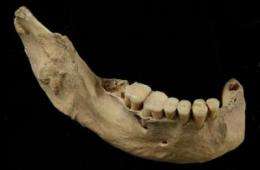
This is the lower mandible of the 40,000-year-old human skeleton, found in the Tianyuan Cave near Beijing. Analyses of collagen extracted from this bone prove that this individual was a regular consumer of fish. Credit: Image: Hong Shang / Chinese Academy of Sciences, Beijing
Freshwater fish are an important part of the diet of many peoples around the world, but it has been unclear when fish became an important part of the year-round diet for early humans.
A new study by an international team of researchers, including Erik Trinkaus, Ph.D., professor of anthropology in Arts & Sciences at Washington University in St. Louis, shows it may have happened in China as far back as 40,000 years ago.
The study will be published online the week of July 6 in the Proceedings of the National Academy of Sciences.
Chemical analysis of the protein collagen, using ratios of the isotopes of nitrogen and sulfur in particular, can show whether such fish consumption was an occasional treat or a regular food item.
Analysis of a bone from one of the earliest modern human in Asia, the 40,000-year-old skeleton from Tianyuan Cave near Beijing, has shown that at least this individual was a regular fish consumer.
This analysis provides the first direct evidence for the substantial consumption of aquatic resources by early modern humans in China.
Since this occurs before there is consistent evidence for effective fishing gear, the shift to more fish in the diet likely reflects greater pressure from an expanding population at the time of modern human emergence across Eurasia.
-
China's earliest modern human
Apr 02, 2007 |
not rated yet |
0
-
The Emerging Fate Of The Neandertals
Apr 25, 2007 |
not rated yet |
0
-
More human-Neandertal mixing evidence uncovered
Nov 09, 2006 |
not rated yet |
0
-
Cave bears from the Carpathians as omnivorous as modern bears
Jan 07, 2008 |
not rated yet |
0
-
Modern Humans, not Neandertals, may be evolutions's 'odd man out'
Sep 08, 2006 |
not rated yet |
0
-
Engineers build first sub-10-nm carbon nanotube transistor
Feb 01, 2012 |
4.9 / 5 (29) |
30
-
Something old, something new: Evolution and the structural divergence of duplicate genes
Jan 31, 2012 |
4.6 / 5 (7) |
1
-
The hidden nanoworld of ice crystals: Revealing the dynamic behavior of quasi-liquid layers
Jan 30, 2012 |
5 / 5 (3) |
1
-
Stock market network reveals investor clustering
Jan 27, 2012 |
3.9 / 5 (23) |
8
-
Of microchemistry and molecules: Electronic microfluidic device synthesizes biocompatible probes
Jan 26, 2012 |
5 / 5 (1) |
0
-
a single mRNA strand is attached to sevaral ribosomes?
21 hours ago
-
Oestrogen and FSH
Feb 07, 2012
-
Linear Blood Vessel Network Examples in Animals or Plants
Feb 07, 2012
-
Neuroscientists: What is a Principal Cell Layer?
Feb 06, 2012
-
How does slime mould grow?
Feb 04, 2012
-
Why are mosquitoes and bedbugs successful?
Feb 04, 2012
- More from Physics Forums - Biology
More news stories
Mexico road project sets up fight over ruins
(AP) -- When neighbors in the hills east of Mexico City saw backhoes ripping up pre-Hispanic relics for a highway, they did something unexpected in a country where building projects often bulldoze through ...
Other Sciences / Archaeology & Fossils
4 hours ago |
5 / 5 (1) |
0
Champagne gases different out of a flute versus coupe
Champagne just isn't champagne without its bubbles, and a study highlights the effects that champagne glass shape and temperature can have on carbonation upon serving and the drinking experience. The full report is published ...
4 hours ago |
4 / 5 (1) |
0
Statistical model unlocks barriers to use of fingerprint evidence in court
Potentially key fingerprint evidence is currently not being considered due to shortcomings in the way it is reported, according to a report published today in Significance, the magazine of the Royal Statistical Society and th ...
11 hours ago |
5 / 5 (1) |
1
Tougher laws to smash green smoke screens
Law reform and tougher legal sanctions to stop greenwashing are critical, according to a leading intellectual property expert from The Australian National University.
Other Sciences / Economics & Business
13 hours ago |
3 / 5 (2) |
0
People with easy to pronounce names win friends and favour
(PhysOrg.com) -- Having a simple, easy-to-pronounce name is more likely to win you friends and favour in the workplace, a study by Dr Simon Laham at the University of Melbourne and Dr Adam Alter at New York University Stern ...
Other Sciences / Social Sciences
16 hours ago |
3 / 5 (2) |
1
Astronomy team discovers nearby dwarf galaxy
(PhysOrg.com) -- A team led by UCLA research astronomer Michael Rich has used a unique telescope to discover a previously unknown companion to the nearby galaxy NGC 4449, which is some 12.5 million light years ...
Amasia: As next supercontinent forms, Arctic Ocean, Caribbean will vanish first
(PhysOrg.com) -- Geologists at Yale University have proposed a new theory to describe the formation of supercontinents, the epic process by which Earths major continental blocks combine into a single ...
Why are there so few fish in the Earth's oceans?
(PhysOrg.com) -- A Stony Brook University researcher has found that, contrary to popular belief, there are not plenty of fish in the sea.
Scientists strengthen memory by stimulating key site in brain
Ever gone to the movies and forgotten where you parked the car? New UCLA research may one day help you improve your memory.
Transparent iron? For the first time, an experiment shows that atomic nuclei can become transparent
At the high-brilliance synchrotron light source PETRA III, a team of DESY scientists headed by Dr. Ralf Röhlsberger has succeeded in making atomic nuclei transparent with the help of X-ray light. At the ...
Physicists build highly efficient 'no-waste' laser
A team of University of California, San Diego researchers has built the smallest room-temperature nanolaser to date, as well as an even more startling device: a highly efficient, "thresholdless" laser that ...