New method may help allocate carbon emissions responsibility among nations
July 6, 2009
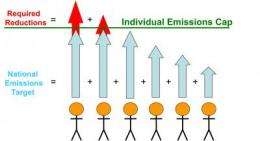
The Princeton proposal establishes a uniform "cap" on emissions that individuals should not exceed (represented by the green line). If, for example, an international treaty caps global emissions at a certain level, the necessary reductions in global emissions could be achieved if no individual's emissions could exceed a certain "cap." By counting the excess emissions of all the individuals who are projected to surpass the "cap" (red arrows), the proposal provides emissions reduction targets for each country (blue arrows). Credit: Courtesy of PNAS
Just months before world leaders are scheduled to meet to devise a new international treaty on climate change, a research team led by Princeton University scientists has developed a new way of dividing responsibility for carbon emissions among countries.
The approach is so fair, according to its creators, that they are hoping it will win the support of both developed and developing nations, whose leaders have been at odds for years over perceived inequalities in previous proposals.
The method is outlined in a paper, titled "Sharing Global CO2 Emissions Among 1 Billion High Emitters," published online in this week's Proceedings of the National Academy of Sciences. According to the authors, the approach uses a new fairness principle based on the "common but differentiated responsibilities" of individuals, rather than nations.
"Our proposal moves beyond per capita considerations to identify the world's high-emitting individuals, who are present in all countries," the team says in the introduction. The authors include Stephen Pacala, the Frederick D. Petrie Professor of Ecology and Evolutionary Biology, and Robert Socolow, a professor of mechanical and aerospace engineering. Pacala and Socolow's concept of "stabilization wedges," a strategy that proposed concrete ways to prevent global emissions of greenhouse gases from rising for the next five decades, was featured in "An Inconvenient Truth," former Vice President Al Gore's 2006 film about climate change. The concept has given the climate change policy community a common unit for discussing how to reduce emissions and for allowing a comparison of different carbon-cutting strategies.
The lead authors on the paper are physicist Shoibal Chakravarty and economist Massimo Tavoni, both research scholars at the Princeton Environmental Institute, which is the University's interdisciplinary center for environmental research, education and outreach.
"The team worked together to formulate a novel approach to a long-standing and intractable problem," said Pacala, who is also director of the institute.
The proposal would use individual emissions as the best, fairest way of calculating a nation's responsibility to curb its output of carbon dioxide, the authors said. The methodology does not mean that individuals would be singled out, only that these calculations would form the basis of a more equitable formula. Some present strategies that employ averages of energy use in a country are widely regarded as unfair, the authors say, because such efforts mask the emissions of wealthy, high polluters.
"Most of the world's emissions come disproportionately from the wealthy citizens of the world, irrespective of their nationality," Chakravarty said, noting that many emissions come from lifestyles that involve airplane flights, car use and the heating and cooling of large homes. "We estimate that in 2008, half of the world's emissions came from just 700 million people."
In the new scheme, emission reduction targets for each country are calculated in a multi-step fashion. The researchers used a strong correlation between income and emissions to estimate the emissions of individuals in every country. Next, they combined these factors to see how individual emissions are distributed globally.
Looking forward to 2030, the researchers estimated first individual emissions and then a global emission total at that future time based on projections of income, population and energy use. They imagined the world's leaders deciding now that the projected global emission total for 2030 is dangerously high, choosing a lower global target and seeking a process by which the work of achieving this new global target could be divided among the world's nations.
The proposal "provides a significant starting point for breaking through the current impasse over the respective mitigation responsibilities of developed and developing countries," said Robyn Eckersley, a professor in the School of Social and Political Sciences at the University of Melbourne in Australia who specializes in environmental politics and political theory.
The researchers believe their new framework is useful in that it establishes a uniform "cap" on emissions that individuals should not exceed. If, for example, world governments agreed to curtail emissions so that carbon levels in 2030 are approximately at present levels, then, according to the researchers' calculations, the necessary reductions in global emissions could be achieved if no individual's emissions could exceed about 11 tons of carbon dioxide a year. By counting the emissions of all the individuals who are projected to exceed that level, the world leaders could provide target emissions reductions for every country. For this specific example, there will be about 1 billion such "high emitters" in 2030 out of 8.1 billion people.
At present, the world average for tons of carbon dioxide emitted a year per individual is about five. Each European produces about 10 tons a year, with each American producing twice that amount.
"These numbers strengthen our conviction that industrialized countries will have to take the lead in reducing their emissions, but that the fight to prevent dangerous climate change can only be won if all countries act together," said Ottmar Edenhofer, the chair of Economics of Climate Change at the Technical University Berlin and co-chair of Working Group III of the Intergovernmental Panel on Climate Change (IPCC). The IPCC was created by the U.N. General Assembly in 1988 to provide objective policy advice in response to the growing concern about the risk of climate change. The working group is assessing options for mitigating climate change through limiting greenhouse gas emissions.
The new research paper shows that it is possible to reduce poverty and cut carbon emission at the same time. The authors calculate that addressing extreme poverty by allowing almost 3 billion people to satisfy their basic energy needs with fossil fuels does not interfere with the goal of fossil fuel emissions reduction. The cap would need to be somewhat lower, and high emitters would need to reduce their energy consumption by a slightly larger percentage to make up the difference.
World leaders are expected to meet in Copenhagen in December 2009 for a conference to negotiate a treaty on global emission reductions to address climate change. The 1992 United Nations Framework Convention on Climate Change called upon the developed nations to reduce carbon emissions and provided the impetus for the binding 1997 Kyoto Protocol, but established no time frame for developing countries to follow. Developing countries now contribute more than half of global emissions, a share that is growing at a fast pace, Chakravarty said.
The paper is designed to address the current stalemate between developed and developing nations, with the developed world calling upon developing nations to share some of the burden of emission reductions, and the developing world pointing to the vast economic benefits already enjoyed by the developed world, with much of that wealth tied to fossil fuel use.
"U.N. rules and customs make it difficult for the international community to examine what is going on inside countries. That's probably why our simple proposal based on individual emissions has not emerged from the diplomats," Socolow said. "Over the next several decades, global environmental rulemaking will need new wisdom to accommodate developing countries whose per capita data belie the presence of both large populations of the very poor and upper and middle classes that are major consumers of resources. Our proposal is a start down this road."
The work is part of the Carbon Mitigation Initiative, which is based at Princeton. Launched in 2000, the project has produced new practical approaches to managing the carbon dioxide emissions that contribute to global warming. The initiative is aimed at supporting fundamental scientific, technological and environmental research that would lead to safe, effective and affordable solutions to climate change.
The authors believe the paper will be of relevance to climate negotiators as well as those forming national policies.
Other authors on the paper are: Ananth Chikkatur at Harvard University; and Heleen de Coninck at the Energy Research Centre of the Netherlands.
"This paper is an example of what Princeton does best," Pacala said. "It represents a collaboration among young people from disparate disciplines -- physics, economics, political science. I've enjoyed being a kibitzer."
Source: Princeton University
-
A new measure of global warming from carbon emissions
Jun 10, 2009 |
not rated yet |
0
-
China to surpass U.S. emissions levels
Nov 07, 2006 |
not rated yet |
0
-
Stabilizing climate change more daunting than thought
Nov 24, 2005 |
not rated yet |
0
-
CO2 emissions booming, shifting east, researchers report
Sep 24, 2008 |
not rated yet |
0
-
Global emissions to leap 39 percent by 2030: US
May 27, 2009 |
not rated yet |
0
-
Engineers build first sub-10-nm carbon nanotube transistor
Feb 01, 2012 |
4.9 / 5 (31) |
30
-
Something old, something new: Evolution and the structural divergence of duplicate genes
Jan 31, 2012 |
4.6 / 5 (7) |
1
-
The hidden nanoworld of ice crystals: Revealing the dynamic behavior of quasi-liquid layers
Jan 30, 2012 |
5 / 5 (3) |
1
-
Stock market network reveals investor clustering
Jan 27, 2012 |
3.9 / 5 (23) |
8
-
Of microchemistry and molecules: Electronic microfluidic device synthesizes biocompatible probes
Jan 26, 2012 |
5 / 5 (1) |
0
-
Do some geologists actually act a lot like Randy Marsh?
22 hours ago
-
Discrepancy between oxygen and carbon-dioxide levels
Feb 09, 2012
-
where gems are found in the world
Feb 09, 2012
-
Wind Waves in Reservoir ~ Wind run-up and Wind set-up
Feb 08, 2012
-
Balance of oxygen in the atmosphere
Feb 01, 2012
-
The case for a methanol-based economy
Jan 30, 2012
- More from Physics Forums - Earth
More news stories
Latin America mining boom clashes with conservation
Latin America is experiencing a mining boom as prices rise fuelled by a hike in global demand, but the region is also being hit by a wave of violent protests, strikes and rallies by environmentalists.
1 hour ago |
not rated yet |
0
Europe stakes billion-dollar bet on new rocket
A pencil-slim rocket is scheduled to lift into space from South America on Monday, carrying a billion-dollar bet that Europe can grab a juicy slice of the market to place satellites in low orbit.
Space & Earth / Space Exploration
21 hours ago |
4 / 5 (3) |
0
Political leaders play key role in how worried Americans are by climate change: study
More than extreme weather events and the work of scientists, it is national political leaders who influence how much Americans worry about the threat of climate change, new research finds.
Feb 06, 2012 |
5 / 5 (6) |
72
NASA budget will axe Mars deal with Europe: scientists
US President Barack Obama's budget proposal to be submitted next week for 2013 will cut NASA's budget by 20 percent and eliminate a major partnership with Europe on Mars exploration, scientists said Thursday.
Space & Earth / Space Exploration
Feb 10, 2012 |
5 / 5 (3) |
55
Humans may have helped the decline of African rainforests 3000 years ago
(PhysOrg.com) -- Large areas of rainforests in Central Africa mysteriously disappeared over three thousand years ago, to be replaced by savannas. The prevailing theory has been that the cause was a change ...
Google might launch Drive for cloud storage soon
(PhysOrg.com) -- Google's next big move, according to the Wall Street Journal, is a cloud storage service called Drive. Hardly first to the plate, Google is simply catching up to introducing its cloud reposi ...
Love a click away in Indonesia's Twitter Republic
He was a geeky kid from Yogyakarta, she a glamorous city girl in Jakarta. In a country with one of the world's most vibrant social networking scenes they fell in love on Twitter.
Walney offshore wind farm is world's biggest (for now)
(PhysOrg.com) -- The Walney wind farm on the Irish Sea--characterized by high tides, waves and windy weather--officially opened this week. The farm is treated in the press as a very big deal as the Walney ...
GPS court ruling leaves US phone tracking unclear
A US Supreme Court decision requiring a warrant to place a GPS device on the car of a criminal suspect leaves unresolved the bigger issue of police tracking using mobile phones, legal experts say.
Europeans protest controversial Internet pact
Tens of thousands of people marched in protests in more than a dozen European cities Saturday against a controversial anti-online piracy pact that critics say could curtail Internet freedom.
Study finds that anti-diabetic medication can prevent the long-term effects of maternal obesity
In a study to be presented today at the Society for Maternal-Fetal Medicine's annual meeting, The Pregnancy Meeting, in Dallas, Texas, researchers will report findings that show that short therapy with the anti-diabetic medication ...
Jul 07, 2009
Rank: 2.7 / 5 (7)
The aim of these measures is to set a sinister precedent for governmental authority over every aspect of human activity. No longer will the limitations of government be delegated by the Constitution, but now will extend to every conceivable activity that humans undertake. All human activity, be it travel, industry, commerce, recreation, heating, cooking, reproduction, or just plain living requires energy. The freedom to accomplish these aspects of life without interference are the foundation of liberty and there cannot be liberty if their terms are dictated by any authority.
Not satisfied with controlling the money supply and the taxation of income, the new goal is to achieve dominance over the full spectrum of human activity and force capitulation to arbitrary, unscientific standards as the basis of new taxation and regulation. There is an example of legislated truth, there is no way to argue against the assumptions made by these laws, even if real science disagrees.
The basis for these climate control measures is absurd on its face. To argue that government can influence planetary climate using bookeeping methods and forcing people to pay more currency for their activities is nonsensical.
These measures only make sense when you consider their only possible effect: To expand governmental authority into all areas of human activity. This enables future measures to be enacted such as rationing, restrictions on energy use, direct taxation for unsubstantiated environmental "impacts" caused by normal human acitivity, and punitive measures against the population such as confiscation, seizure of industrial means, interference in commerce, and perhaps even interference in the freedom to procreate - all based on the government's absolute authority to regulate human activity soley on its interpretation of climate conditions. It is dangerously naieve to think these measures will not be used to enrich the powers behind these regulations, or their chosen allies in industry and commerce, and to insure their power and incomes in perpetuity. I would even say that these measures are designed for this purpose entirely, and have nothing to do with climate or ecology whatsoever.
It goes without saying that to give any government authority to interfere with human activity on this scale based on completely arbitrary standards is dangerous and foolish. There is no solution to "climate change" as there is no way for humans to control climate. There are no proven methods to produce a chosen climate, let alone predict it with any long term accuracy.
These measures are nothing more than a upscaled attempt at planned economics, where industry is planned and distributed according to the will of the planners and their cronies and supplicants, economies are chained to the will of centralized authorities, and populations are directed according to the desire of their masters. The middle classes will be denied the ability to produce freely, at least not if they don't pay into the pockets of the central planners and green apparatiks.
In the USA these measures must be challenged as unconstitutional intrusions of federal power. I must strongly argue that these corruptions of law are a subversion of the limitations set forth by the Constitution. The federal government, through the unelected EPA, arrogantly seeks to set the terms of life for us all. This foreign-sourced ideology must be cut off and its agents purged from our republic. Their goals are obviously hostile to our land, our people, and our liberty.
Jul 07, 2009
Rank: 3.2 / 5 (5)
Jul 07, 2009
Rank: 3 / 5 (6)
Jul 07, 2009
Rank: 3 / 5 (6)
Jul 07, 2009
Rank: 2.3 / 5 (6)
The scientific debate is over.
Big oil fundamentalists, anarcho-capitalists, and free market theologians can keep on preaching their gospel of lies, distortion, and obfuscation to their hearts' content. They can weave as many paranoid schizophrenic delusions of vast scientific conspiracies and government oppression as they like. They can copy & paste religious scriptures from their favorite global warming denialist blogs until the agony of carpal tunnel forces them to stop.
When it's all said and done, global warming denialists are nothing more than a radical fringe minority of ignorant crackpots, just like the young Earth creationists, just like the Holocaust deniers, just like the Moon landing hoaxers.
The rest of us are moving on.
Jul 08, 2009
Rank: 3 / 5 (4)
You keep lumping climate change skeptics in with holocaust denialists and flat earthers.
Last I checked the only reason why holocaust deniers, flat earthers, and moon landing skeptic are all in the same group is because they refuse to hear the other side's evidence.
If anything you belong in that group, warmist.
Feel free to move on to the EU, where your ilk have demolished economies and increased joblessness to record levels while failing to reduce emissions one iota with sweeping and broad based carbon legislation.
Minority, sure thing buddy. Show us the figures.
Jul 08, 2009
Rank: 2.3 / 5 (3)
What sort of governmental system will be required to achieve your stated goals? What methodology will be used? That is the only question that interests me now.
Jul 19, 2009
Rank: not rated yet
Before it was even started.