Robo-bats with metal muscles may be next generation of remote control flyers
July 7, 2009 Robo-bats with metal muscles may be next generation of remote control flyers

Enlarge

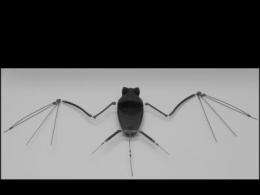
The skeleton of the robotic bat uses shape-memory metal alloy that is super-elastic for the joints, and smart materials that respond to electric current for the muscular system. Credit: Gheorghe Bunget, North Carolina State University

Tiny flying machines can be used for everything from indoor surveillance to exploring collapsed buildings, but simply making smaller versions of planes and helicopters doesn't work very well. Instead, researchers at North Carolina State University are mimicking nature's small flyers - and developing robotic bats that offer increased maneuverability and performance.

Small flyers, or micro-aerial vehicles (MAVs), have garnered a great deal of interest due to their potential applications where maneuverability in tight spaces is necessary, says researcher Gheorghe Bunget. For example, Bunget says, "due to the availability of small sensors, MAVs can be used for detection missions of biological, chemical and nuclear agents." But, due to their size, devices using a traditional fixed-wing or rotary-wing design have low maneuverability and aerodynamic efficiency.

So Bunget, a doctoral student in mechanical engineering at NC State, and his advisor Dr. Stefan Seelecke looked to nature. "We are trying to mimic nature as closely as possible," Seelecke says, "because it is very efficient. And, at the MAV scale, nature tells us that flapping flight - like that of the bat - is the most effective."

The researchers did extensive analysis of bats' skeletal and muscular systems before developing a "robo-bat" skeleton using rapid prototyping technologies. The fully assembled skeleton rests easily in the palm of your hand and, at less than 6 grams, feels as light as a feather. The researchers are currently completing fabrication and assembly of the joints, muscular system and wing membrane for the robo-bat, which should allow it to fly with the same efficient flapping motion used by real .

"The key concept here is the use of smart materials," Seelecke says. "We are using a shape-memory metal alloy that is super-elastic for the joints. The material provides a full range of motion, but will always return to its original position - a function performed by many tiny bones, cartilage and tendons in real bats."

Seelecke explains that the research team is also using smart materials for the muscular system. "We're using an alloy that responds to the heat from an electric current. That heat actuates micro-scale wires the size of a human hair, making them contract like 'metal muscles.' During the contraction, the powerful muscle wires also change their electric resistance, which can be easily measured, thus providing simultaneous action and sensory input. This dual functionality will help cut down on the robo-bat's weight, and allow the to respond quickly to changing conditions - such as a gust of wind - as perfectly as a real bat."

In addition to creating a surveillance tool with very real practical applications, Seelecke says the robo-bat could also help expand our understanding of aerodynamics. "It will allow us to do tests where we can control all of the variables - and finally give us the opportunity to fully understand the aerodynamics of flapping flight," Seelecke says.

More information: Bunget will present the research this September at the American Society of Mechanical Engineers Conference on Smart Materials, Adaptive Structures and Intelligent Systems in Oxnard, Calif.

Source: North Carolina State University (news : web)


print this article email this article download pdf blog this article bookmark this article     Stumble it Digg this share on Facebook retweet share on Reddit add to delicious
Rate this story - 4.5 /5 (11 votes)

Rank Filter

Move the slider to adjust rank threshold, so that you can hide some of the comments.


Display comments: newest first

  • O2L - Jul 07, 2009
    • Rank: 5 / 5 (1)
    Batman's new Bat-Cave surveillance system
  • RFC - Jul 07, 2009
    • Rank: 5 / 5 (1)
    Kudos for the ambitious design. Controlling the thing (if it ever flies) is gonna be a trick.

    (Suddenly I'm reminded of the movie "Firefox".... "Think in bat!")
  • Skepticus - Jul 07, 2009
    • Rank: not rated yet
    Very gant in theory...I hope the researchers will achieve their goal. Goodluck!
  • albert - Jul 07, 2009
    • Rank: not rated yet
    Sheer insanity, born of fear.
  • amos - Jul 07, 2009
    • Rank: not rated yet
    How do you overcome the latency in response? Even shape-memory alloys of one hair's diameter need time to heat from current and re-form from heat. How fast a response time do you get? I guess this is clearly not a hummingbird.
  • PinkElephant - Jul 09, 2009
    • Rank: not rated yet
    ...allow the robot to respond quickly to changing conditions - such as a gust of wind - as perfectly as a real bat."


    hahahahaha

    Yeah, having solved the major issues with skeleton and muscles, all they have to do now is come up with an artificial brain as compact, light-weight, fast, and energy-efficient as that of a real bat. No problem!
  • ciantic - Jul 09, 2009
    • Rank: not rated yet
    How do you overcome the latency in response? Even shape-memory alloys of one hair's diameter need time to heat from current and re-form from heat. How fast a response time do you get? I guess this is clearly not a hummingbird.


    Surely not! But seems like Hummingbird has "been done already" http://singularit...s-video/ Having seen that video, Bat doesn't sound so Utopian, right?
  • ketanco - Jul 15, 2009
    • Rank: not rated yet
    This AI may seem far away but it is not, I had read a news about an AI program running a helicopter in robotic magazine.

July 7, 2009 all stories

Comments: 8

4.5 /5 (11 votes)
  • Stumble this up

  • Digg this

  • share this

  • hide
  • Related Stories

  • Bat flight generates complex aerodynamic tracks
    created May 10, 2007 | popularity not rated yet | comments 0
  • Bats in flight reveal unexpected aerodynamics
    created Jan 18, 2007 | popularity not rated yet | comments 0
  • Leading edge vortex allows bats to stay aloft
    created Feb 28, 2008 | popularity not rated yet | comments 0
  • Some bat numbers up in Britain
    created Dec 31, 2006 | popularity not rated yet | comments 0
  • Birds, bats and insects hold secrets for aerospace engineers
    created Feb 04, 2008 | popularity not rated yet | comments 0


  • hide
  • Relevant PhysicsForums posts

  • System PDEs - Comsol
    created 5 hours ago
  • Making 4'x8' sign inkjet printer - need nozzles - help?
    created 21 hours ago
  • Calculating Velocity
    created Nov 06, 2009
  • shear stress distribution in triangular steel profile
    created Nov 06, 2009
  • More from Physics Forums - General Engineering

Other News

Samsung launches a new vacuuming robot

Samsung launches a new vacuuming robot

Electronics / Consumer & Gadgets

created Nov 06, 2009 | popularity 4.4 / 5 (7) | comments 7

(PhysOrg.com) -- Samsung Electronics has launched its latest autonomous robot vacuum cleaner, the Tango, which is capable of vacuuming hardwood floors, carpets, and even beds without human assistance.


new iphone

Touchscreen smartphones being snatched up in US

Electronics / Consumer & Gadgets

created Nov 03, 2009 | popularity 2.7 / 5 (3) | comments 3

US smartphone buyers can't wait to get their hands on touchscreen devices, according to figures released Tuesday by industry tracker comScore.


Robot fish could monitor water quality

Robot fish could monitor water quality

Electronics / Robotics

created Nov 02, 2009 | popularity not rated yet | comments 2

Nature inspires technology for an engineer and an ecologist teamed up at Michigan State University. They're developing robots that use advanced materials to swim like fish to probe underwater environments.


Review: Motorola's Droid is a serious smart phone (AP)

Review: Motorola's Droid is a serious smart phone

Electronics / Consumer & Gadgets

created Nov 04, 2009 | popularity 4.6 / 5 (5) | comments 0

(AP) -- Since its debut in 2007, millions of people have gravitated toward Apple's iPhone, wooed by its sleek hardware, simple user interface and abundance of applications.


UCI robot to aid brain research

UCI robot to aid brain research

Electronics / Robotics

created Nov 04, 2009 | popularity 5 / 5 (1) | comments 0

(PhysOrg.com) -- A robot powered by a computerized model of a rodent brain will help researchers from UC Irvine and UC San Diego understand how people recognize and adapt to change.