Coralline algae in the Mediterranean lost their tropical element between 5 and 7 million years ago
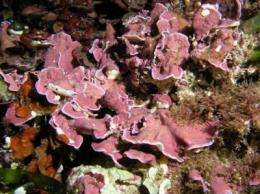
An international team of researchers has studied the coralline algae fossils that lived on the last coral reefs of the Mediterranean Sea between 7.24 and 5.3 million years ago. Mediterranean algae and coral reefs began to resemble present day reefs following the isolation of the Mediterranean from the Indian Ocean and global cooling 15 and 20 million years ago respectively.
The research team from the University of Granada (UGR) and the University of Modena and Reggio Emilia (Italia) show coralline algae distribution patterns in the west and centre of the Mediterranean Sea (in Salento, Italy and Almería, Spain) by way of a fossil register of 21 species collected in the two areas.
"Coralline algae are calcareous algae that are very common nowadays, although unknown to the general public, including naturalists, and quite often in fossil form, particularly in relatively modern rocks", Juan C. Braga, the chief author and a researcher at the Stratigraphy and Paleontology Department of the UGR explained to SINC.
The study, which was published recently in Palaeogeography Palaeoclimatology Palaeoecology, describes and interprets the disappearance of the last Messinian coral reefs (between 7.24 and 5.3 million years ago) in the Mediterranean Sea. "In subsequent, more recent eras, this sea has not had the right oceanographic conditions (above all a high enough temperature) to house coral reefs," Braga added.
When Tropical Coral Reefs Became Atlantic
During the period studied by the scientists through the coralline algae fossils found in the Mediterranean, the last few reefs boasted very little coralline diversity. "This is the result of the long history of global cooling over the last 20 million years and the isolation (separation) of the Mediterranean from the Indian Ocean, some 15 million years ago," the research says.
According to the results of the research, the relative abundance of coralline algae in reefs and slope deposits is 1-5% and 18% lower respectively in the Sorbas basin (Almería) than in Salento (Italy). Furthermore, the main components of the coralline algae assemblages found in shallow water are extant species that are very common in the Mediterranean.
Other species, such as Spongites fruticulosus and Phymatolithon calcareum, have lived in the western Mediterranean for more than 25 million years. However, the typical components of present-day coral reefs, such as Hydrolithon species with thick thalli, which were no longer present in the western region of the Mediterranean 7 million years ago.
"Just like reef corallines, algae flora reflects the cooling of the Mediterranean and its isolation from the Indian Ocean, and only a few tropical biotas existed in the Messinian era. Moreover, most of them already had Atlantic affinities and resembled the algae that still inhabits our coasts today", Braga states.
The Mediterranean-Atlantic characteristics of Messinian reef corallines therefore reflect the decrease in tropical biotas that occurred during the Miocene (around 20 million years ago). According to the research team, the widespread decline of this type of algae was due to global cooling and the isolation of the Mediterranean during the middle Miocene.
More information: Braga, Juan C.; Vescogni, Alessandro; Bosellini, Francesca R.; Aguirre, Julio. "Coralline algae (Corallinales, Rhodophyta) in western and central Mediterranean Messinian reefs" Palaeogeography Palaeoclimatology Palaeoecology 275(1-4): 113-128, 1 de mayo de 2009.
Source: FECYT - Spanish Foundation for Science and Technology


