New portrait of Omega Nebula's glistening watercolors
July 7, 2009 New portrait of Omega Nebula's glistening watercolors

Enlarge

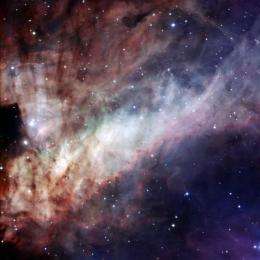
This is a three-color composite image of the Omega Nebula (Messier 17), based on images obtained with the EMMI instrument on the ESO 3.58-meter New Technology Telescope at the La Silla Observatory. North is down and East is to the right in the image. It spans an angle equal to about one third the diameter of the Full Moon, corresponding to about 15 light-years at the distance of the Omega Nebula. Credit: ESO

The Omega Nebula, sometimes called the Swan Nebula, is a dazzling stellar nursery located about 5500 light-years away towards the constellation of Sagittarius (the Archer). An active star-forming region of gas and dust about 15 light-years across, the nebula has recently spawned a cluster of massive, hot stars. The intense light and strong winds from these hulking infants have carved remarkable filigree structures in the gas and dust.

When seen through a small telescope the nebula has a shape that reminds some observers of the final letter of the Greek alphabet, omega, while others see a swan with its distinctive long, curved neck. Yet other nicknames for this evocative cosmic landmark include the Horseshoe and the Lobster Nebula.

Swiss astronomer Jean-Philippe Loys de Chéseaux discovered the nebula around 1745. The French comet hunter Charles Messier independently rediscovered it about twenty years later and included it as number 17 in his famous catalogue. In a small telescope, the Omega Nebula appears as an enigmatic ghostly bar of light set against the star fields of the Milky Way. Early observers were unsure whether this curiosity was really a cloud of gas or a remote cluster of stars too faint to be resolved. In 1866, William Huggins settled the debate when he confirmed the Omega Nebula to be a cloud of glowing gas, through the use of a new instrument, the astronomical spectrograph.

In recent years, astronomers have discovered that the Omega Nebula is one of the youngest and most massive star-forming regions in the Milky Way. Active star-birth started a few million years ago and continues through today. The brightly shining gas shown in this picture is just a blister erupting from the side of a much larger dark cloud of molecular gas. The dust that is so prominent in this picture comes from the remains of massive hot stars that have ended their brief lives and ejected material back into space, as well as the cosmic detritus from which future suns form.

The newly released image, obtained with the EMMI instrument attached to the ESO 3.58-metre New Technology Telescope (NTT) at La Silla, Chile, shows the central region of the Omega Nebula in exquisite detail. In 2000, another instrument on the NTT, called SOFI, captured another striking image of the nebula in the near-infrared, giving astronomers a penetrating view through the obscuring dust, and clearly showing many previously hidden stars. The NASA/ESA Hubble Space has also imaged small parts of this nebula (heic0305a - http://www.spacetelescope.org/images/html/heic0305a.html - and heic0206d - http://www.spacetelescope.org/images/html/heic0206d.html ) in fine detail.

At the left of the image a huge and strangely box-shaped cloud of dust covers the glowing gas. The fascinating palette of subtle colour shades across the image comes from the presence of different gases (mostly hydrogen, but also oxygen, nitrogen and sulphur) that are glowing under the fierce ultraviolet light radiated by the hot young stars.

Source: ESO (news : web)


print this article email this article download pdf blog this article bookmark this article     Stumble it Digg this share on Facebook retweet share on Reddit add to delicious
Rate this story - 4.2 /5 (5 votes)

Rank Filter

Move the slider to adjust rank threshold, so that you can hide some of the comments.


Display comments: newest first

  • omatumr - Jul 07, 2009
    • Rank: 1 / 5 (2)
    THANKS!

    Thanks for this beautiful new photograph of the Omega Nebula.

    What observations convinced ESO scientists that the Omega Nebula is "an active star-forming region" . . . that "has recently spawned a cluster of massive, hot stars."

    Isn't the time required to form a star much greater than the lifespan of ESO observers?

    With kind regards,
    Oliver K. Manuel
    http://www.omatumr.com
  • Nicto - Jul 07, 2009
    • Rank: 4 / 5 (1)
    the hubble photos are better at showing the young star and protostellar knots

July 7, 2009 all stories

Comments: 2

4.2 /5 (5 votes)
  • Stumble this up

  • Digg this

  • share this

  • hide
  • Related Stories

  • A sparkling spray of stars
    created Dec 16, 2008 | popularity not rated yet | comments 0
  • AKARI's view on birth and death of stars
    created Aug 28, 2006 | popularity not rated yet | comments 0
  • Spitzer Reveals New Wonders in the Familiar Orion Nebula
    created Aug 15, 2006 | popularity not rated yet | comments 0
  • Strong winds over the keel
    created Feb 12, 2009 | popularity not rated yet | comments 0
  • The Last Confessions of a Dying Star
    created Mar 04, 2008 | popularity not rated yet | comments 0


  • hide
  • Relevant PhysicsForums posts

  • Above or Below the Line of Nodes
    created 4 hours ago
  • Supernova vs. Nova?
    created 11 hours ago
  • Supernova's Gamma Rays and Comets
    created Nov 06, 2009
  • Our Moon
    created Nov 06, 2009
  • More from Physics Forums - General Astronomy

Other News

Seattle team wins $900,000 in Space Elevator Games (AP)

Seattle team wins $900,000 in Space Elevator Games

Space & Earth / Space Exploration

created 13 hours ago | popularity 5 / 5 (6) | comments 4

(AP) -- A Seattle team has collected a $900,000 prize in a NASA-backed competition to develop the concept of an elevator to space - an idea spurred by science fiction novels.


Russian rocket to launch from French Guiana in 2010

Space & Earth / Space Exploration

created 13 hours ago | popularity 5 / 5 (1) | comments 0

A Russian rocket will next year for the first time blast off from a European launch pad in South America, officials said Saturday, as the first rockets headed for the site on board a ship.


Success in 'space elevator' competition (AP)

Success in 'space elevator' competition (Update 3)

Space & Earth / Space Exploration

created Nov 05, 2009 | popularity 4.3 / 5 (31) | comments 51

(AP) -- A robot powered by a ground-based laser beam climbed a long cable dangling from a helicopter on Wednesday to qualify for prize money in a $2 million competition to test the potential reality of the ...


Space hotel taking bookings for 2012 opening

Space hotel taking bookings for 2012 opening

Space & Earth / Space Exploration

created Nov 05, 2009 | popularity 4.3 / 5 (19) | comments 11

(PhysOrg.com) -- The first orbiting space hotel is on track to open for its first customers in 2012, but hurry, as bookings are filling fast.


'Dropouts' pinpoint earliest galaxies

'Dropouts' pinpoint earliest galaxies

Space & Earth / Astronomy

created Nov 06, 2009 | popularity 4 / 5 (8) | comments 11

Astronomers, conducting the broadest survey to date of galaxies from about 800 million years after the Big Bang, have found 22 early galaxies and confirmed the age of one by its characteristic hydrogen signature ...