Playing it safe
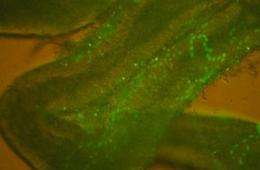
Kinarm Ko and Hans Schöler's team at the Max Planck Institute for Molecular Biomedicine in Münster have succeeded for the first time in culturing a clearly defined cell type from the testis of adult mice and converting these cells into pluripotent stem cells without introduced genes, viruses or reprogramming proteins.
These stem cells have the capacity to generate all types of body tissue. The culture conditions alone were the crucial factor behind the success of the reprogramming process. (Cell Stem Cell, July 2, 2009)
The testis is a sensitive organ and an astonishing one at that. Even at the age of 70, 80 or 85, men have cells that constantly produce new sperm. Therefore, they can conceive embryos and become fathers at almost any age - assuming they can find a sufficiently young female partner. Based on this, researchers have long assumed that cells from the testis have a similar potential as in embryonic stem cells: that is, a pluripotency that enables them to form over 200 of the body's cell types.
In fact, a number of researchers have recently stumbled on the multiple talents in the male gonads of humans and mice. It all began with the work of Takashi Shinohara's team in 2004. The Japanese scientists discovered that, like embryonic stem cells, certain cells in the testis of newborn mice are able to develop into different kinds of tissue. In 2006, scientists working with Gerd Hasenfuß and Wolfgang Engel in Göttigen reported that such adaptable cells can also be found in adult male mice. Additionally, Thomas Skutella and his colleagues at the University of Tübingen recently made headlines when they cultured comparable cells from human testis tissue.
A bewildering variety of cells
"At first glance, it would appear that it has long been established that pluripotent cells exist in the testis of adult humans and mice," says Schöler. "However, it is often unclear as to exactly which cells are being referred to in the literature and what these cells can actually do." (See *Background Information)
This is not only due to the fact that the testis contains a multitude of different cells. Scientists who dismantle tissue in the laboratory must carefully separate and analyse the cells to establish which cell type they have under the microscope. The question of potency is a controversial one among stem cell researchers, as binding benchmarks have yet to be defined. What some scientists would define as "pluripotent" is just about deemed "multi-potent", that is, as having a limited capacity for differentiation, by others. Greater certainty can be provided by carrying out the relevant tests. These include, among other things, a test to establish whether, after injection into early embryos, the cells are able to contribute to the development of the new organism and gamete formation, and to pass on their genes to further generations. However, not every team carries out all of these tests and important questions are left unanswered, even in articles published in renowned journals.
Stable original cell line
With their work, Ko and his colleagues wanted to establish clarity from the outset. To this end, they started by culturing a precisely defined type of cell, so-called germline stem cells (GSCs), from the testis of adult mice. In their natural environment, these cells can only do one thing: constantly generate new sperm. Moreover, their own reproduction is an extremely rare occurrence. Only two or three of them will be found among the 10,000 cells in the testis tissue of a mouse. However, they can be isolated individually and reproduced as cell lines with stable characteristics. Under the usual cell culturing conditions, they retain their unipotency for weeks and years. Consequently, all they can do is reproduce or form sperm.
What nobody had guessed until now, however, was that a simple trick is enough to incite these cells to reprogramme. If the cells are distributed on new petri dishes, some of them revert to an embryonic state once they are given sufficient space and time. "Each time we filled around 8000 cells into the individual wells of the cell culture plates, some of the cells reprogrammed themselves after two weeks," reports Ko. And when the switch in these germline-derived pluripotent stem cells (gPS) has been reversed, they start to reproduce rapidly.
The researchers have proven that the "reignition" of the cells has actually taken place with the aid of numerous tests. Not only can the reprogrammed cells be used to generate heart, nerve or endothelial cells, as is the case with embryonic stem cells, the scientists can also use them to produce mice with mixed genotypes, known as chimeras, from the new gPs, and thus demonstrate that cells obtained from the testis can pass their genes on to the next generation.
Whether this process can also be applied to humans remains an open question. There is much to suggest, however, that gPS cells exceed all previously artificially reprogrammed cells in terms of the simplicity of their production and their safety.
More information:
Kinarm Ko, Natalia Tapia, Guangming Wu, Jeong Beom Kim, Marcos J Araúzo-Bravo, Philipp Sasse, Tamara Glaser, David Ruau, Dong Wook Han, Boris Greber, Kirsten Hausdörfer, Vittorio Sebastiano, Martin Stehling, Bernd K. Fleischmann, Oliver Brüstle, Martin Zenke and Hans R. Schöler; Induction of pluripotency in adult unipotent germline stem cells; Cell Stem Cell, July 2, 2009, doi:10.1016/j.stem.2009.05.025
Mito Kanatsu-Shinohara und Takashi Shinohara; The germ of pluripotency; Nature Biotechnology 24(6), June 2006, doi: 10.1038/nbt0606-663
Source: Max-Planck-Gesellschaft


