Scientists closer to developing salt-tolerant crops
July 7, 2009 Scientists closer to developing salt-tolerant crops

Enlarge

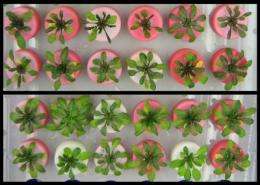
This is a comparison of genetically modified plants and non-GM plants grown in saline conditions: (above) non-GM plants struggling to grow in saline conditions; (below) GM plants thriving in the same conditions. Credit: Image courtesy of the Australian Centre for Plant Functional Genomics (ACPFG)/University of Adelaide

An international team of scientists has developed salt-tolerant plants using a new type of genetic modification (GM), bringing salt-tolerant cereal crops a step closer to reality.

The research team - based at the University of Adelaide's Waite Campus in Australia - has used a new GM technique to contain salt in parts of the plant where it does less damage.

Salinity affects agriculture worldwide, which means the results of this research could impact on world food production and security.

The work has been led by researchers from the Australian Centre for Plant Functional Genomics and the University of Adelaide's School of Agriculture, Food and Wine, in collaboration with scientists from the Department of Plant Sciences at the University of Cambridge, UK.

The results of their work are published today in the top international plant science journal, 'The Plant Cell'.

"Salinity affects the growth of worldwide, particularly in irrigated land where one third of the world's food is produced. And it is a problem that is only going to get worse, as pressure to use less water increases and quality of water decreases," says the team's leader, Professor Mark Tester, from the School of Agriculture, Food and Wine at the University of Adelaide and the Australian Centre for Plant Functional Genomics (ACPFG).

"Helping plants to withstand this salty onslaught will have a significant impact on world food production."

Professor Tester says his team used the technique to keep salt - as sodium ions (Na+) - out of the leaves of a model plant species. The researchers modified genes specifically around the plant's water conducting pipes (xylem) so that salt is removed from the transpiration stream before it gets to the shoot.

"This reduces the amount of toxic Na+ building up in the shoot and so increases the plant's tolerance to salinity," Professor Tester says.

"In doing this, we've enhanced a process used naturally by plants to minimize the movement of Na+ to the shoot. We've used to amplify the process, helping plants to do what they already do - but to do it much better."

The team is now in the process of transferring this technology to crops such as rice, wheat and barley.

"Our results in rice already look very promising," Professor Tester says.

Source: University of Adelaide (news : web)


print this article email this article download pdf blog this article bookmark this article     Stumble it Digg this share on Facebook retweet share on Reddit add to delicious
Rate this story - 5 /5 (3 votes)


July 7, 2009 all stories

Comments: 0

5 /5 (3 votes)
  • Stumble this up

  • Digg this

  • share this

  • hide
  • Related Stories

  • Australian scientists identify crucial barley gene
    created Nov 29, 2007 | popularity not rated yet | comments 0
  • Salt-tolerant gene found in simple plant nothing to sneeze at
    created Apr 07, 2008 | popularity not rated yet | comments 0
  • Ancient genes used to produce salt-tolerant wheat
    created Feb 01, 2007 | popularity not rated yet | comments 0
  • Waxy plant substance key for absorption of water, nutrients
    created May 22, 2009 | popularity not rated yet | comments 0
  • Benefits outweigh risks from genetically modified plants
    created Jan 23, 2008 | popularity not rated yet | comments 0


  • hide
  • Relevant PhysicsForums posts

Other News

UK starts study on using human DNA in animals

Biology / Biotechnology

created 29 minutes ago | popularity not rated yet | comments 0

(AP) -- British scientists begin a new study on Tuesday to consider how human DNA is used in animal experiments and to determine what the boundaries of such controversial science might be.


Scientists successfully reprogram blood cells

Biology / Cell & Microbiology

created 3 hours ago | popularity 5 / 5 (1) | comments 0

Researchers have transplanted genetically modified hematopoietic stem cells into mice so that their developing red blood cells produce a critical lysosomal enzyme -preventing or reducing organ and central nervous system damage ...


New discovery allows scientists for the first time to experimentally annotate genomes

New discovery allows scientists for the first time to experimentally annotate genomes

Biology / Biotechnology

created 2 hours ago | popularity 5 / 5 (3) | comments 0

Over the last 20 years, the sequencing of the human genome, along with related organisms, has represented one of the largest scientific endeavors in the history of mankind. The information collected from genome ...


Wasp

Well-traveled wasps provide hope for vanishing species

Biology / Plants & Animals

created 3 hours ago | popularity not rated yet | comments 0

They may only be 1.5mm in size, but the tiny wasps that pollinate fig trees can travel over 160km in less than 48 hours, according to research from scientists at the University of Leeds. The fig wasps are transporting ...


Study shows that some malignant tumors can be shut down after all

Biology / Cell & Microbiology

created 7 hours ago | popularity 5 / 5 (3) | comments 1

Oncologists have had their hands tied because more than half of all human cancers have mutations that disable a protein called p53. As a critical anti-cancer watchdog, p53 masterminds several cancer-fighting operations within ...