Remote-control closed system invented for inserting radio-active atoms inside fullerenes
July 7, 2009
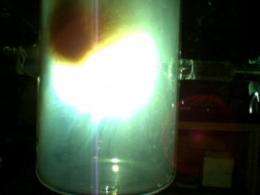
Lead rods, which are infused with the material to be encapsulated in hollow carbon molecules known as fullerenes, are blasted with a plasma arc. The resulting soot contains the filled carbon molecules. The remote-control process was invented to insert radio-labeled materials into fullerenes for use in diagnosing and treating tumors. Brain tumors are the target of the NIH-funded research being carried out by a Virginia Tech-Virginia Commonwealth University team. Credit: Harry Dorn
Virginia Tech chemistry Professor Harry C. Dorn, Emory and Henry College chemistry Professor James Duchamp, and Panos Fatouros, professor and chair of the Division of Radiation Physics and Biology at the Virginia Commonwealth University School of Medicine have co-invented a hands-off process for filling fullerenes with radio-active material.
Fullerenes are hollow carbon molecules. Dorn has created new materials by filling them with atoms of various metals. An important example is a fullerene that encases a sensitive contrast agent (gadolinium) for MRI applications, including as a diagnostic and therapeutic agent for brain tumors. Dorn and Fatouros at VCU have funding from the National Institutes of Health's National Cancer Institute (NCI) to further develop, produce, and test fullerene nanoparticles that can identify brain tumor cells and selectively target them for radiation therapy.
What if the radioactive material could also be encased in a carbon cage? Dorn asked himself several years ago. With more funding from NCI and Virginia's Commonwealth Technology Research Fund (CTRF), he set out to do it.
Now Dorn and Duchamp have invented a generator that makes the new material by remote control. "The new materials come out the bottom like a beer product," Dorn said. The golden liquid is not dispensed into an open cup, of course.
Basically, rods about three times the size of a pencil lead that are made up of graphite and lutetium (Lu) are inserted into big jar through a tube on one side and moved slowly toward a source of electricity on the other side. The jolted rod burns dramatically and the inside of the jar is coated with ash. A nozzle kind of like a miniature carwash wand is lowered from the top to rinse the soot to the bottom and out through a filter. The soot is trapped and the resulting beer-colored solution contains Lu atoms bound to nitrogen inside of fullerenes. This radiolabeled nanomaterial is then further purified by passage through a column that traps the empty-cage fullerenes. The resulting liquid is evaporated and hydroxyl atoms are attached to the molecules so they will be soluble in biofluids.
All of the steps of the process are managed remotely and the purified product is decanted into a shielded container.
Dorn and Duchamp have used non-radioactive Lu to produce the trimetallic nitride endohedral metallofullerenes (Lu3N@C80) - in other words, three atoms of Lu attached to a nitrogen atom inside an 80-atom carbon molecule cage. Once the apparatus is at VCU, Fatouros will use isotope 177Lu, which is used to treat cancer. Although other details need to be worked out, Dorn is confident the generator will work just as well with the radiolabeled product and will produce (177Lu3N@C80).
It all takes less than a day, which is important because 177Lu has a half life of six and one-half days. "So we can't take 30 days to make the product," said Duchamp.
It will be the first time that 177Lu has been encapsulated in a fullerene and the first time any radioactive metal has been encapsulated under remote control with direct purification to a pure product.
"The advantage of the metal cage is we can control where it goes biologically," Dorn said.
"We believe it will mean fewer side effects with better targeted localization, but that remains to be tested," said Fatouros.
"Another advantage is we can deliver other materials inside the fullerene with the 177Lu - such as a targeting agent (interleukin-13) and an MRI contrast agent," said Dorn.
Creation of such a multi-modality material for use on brain tumors is a specific goal of Fatouros and Dorn's NCI-funded research project, "Metallofullerene imaging and targeting of glioma." "The MRI agent lets you see where you are going and the 177Lu lets you treat an exact region," said Dorn. "The imaging ability also lets you see if the tumor is shrinking or getting larger."
An earlier stage of the research was presented at the NCI Alliance for Nanotechnology in Cancer Investigators Meeting in September 2008 and a patent application has been filed.
Dorn points out that the new device will also allow the production of other kinds of radio-labeled fullerenes that can be used for environmental studies, such as to track fullerene nanomaterials.
-
Carbon molecule with a charge could be tomorrow's semiconductor
Sep 08, 2008 |
not rated yet |
0
-
Nanoparticle created as diagnostic, therapeutic agent; brain tumors targeted
Oct 18, 2005 |
not rated yet |
0
-
Fullerenes Yield Stable, Powerful MR Imaging Agent
Jul 24, 2006 |
not rated yet |
0
-
Improbable 'buckyegg' hatched
Sep 28, 2006 |
not rated yet |
0
-
Rice student wins award for revolutionary MRI research
Jan 18, 2005 |
not rated yet |
0
-
Engineers build first sub-10-nm carbon nanotube transistor
Feb 01, 2012 |
4.9 / 5 (33) |
30
-
Something old, something new: Evolution and the structural divergence of duplicate genes
Jan 31, 2012 |
4.6 / 5 (7) |
1
-
The hidden nanoworld of ice crystals: Revealing the dynamic behavior of quasi-liquid layers
Jan 30, 2012 |
5 / 5 (4) |
1
-
Stock market network reveals investor clustering
Jan 27, 2012 |
3.9 / 5 (23) |
8
-
Of microchemistry and molecules: Electronic microfluidic device synthesizes biocompatible probes
Jan 26, 2012 |
5 / 5 (2) |
0
-
polymer nanocomposites
Feb 10, 2012
-
Corrosion Tests on Magnesium
Feb 09, 2012
-
polyethylene copper nanocomposite
Feb 09, 2012
-
Output of xrd analysis
Feb 08, 2012
-
Transport phenomena problem based on problems 18.B11 and 19B.6 from Bird, stewart, lw
Feb 06, 2012
-
Help with material selection - Car Piston
Feb 05, 2012
- More from Physics Forums - Materials & Chemical Engineering
More news stories
Lab study raises questions over nano-particle impact
Tests involving chickens have raised questions about the impact on health from engineered nano-particles, the ultra-fine grains commonly used in drugs and processed foods, scientists said on Sunday.
Nanotechnology / Bio & Medicine
9 hours ago |
5 / 5 (5) |
0
New kind of solar cell could capture significantly more energy than current cells
New solar cells could increase the maximum efficiency of solar panels by over 25%, according to scientists from the University of Cambridge.
Feb 08, 2012 |
4.5 / 5 (13) |
14
|
Nanoshell whispering galleries improve thin solar panels
Visitors to Statuary Hall in the U.S. Capitol Building may have experienced a curious acoustic feature that allows a person to whisper softly at one side of the cavernous, half-domed room and for another on ...
Nanotechnology / Nanomaterials
Feb 07, 2012 |
4.4 / 5 (7) |
6
|
'Dark plasmons' transmit energy
Microscopic channels of gold nanoparticles have the ability to transmit electromagnetic energy that starts as light and propagates via "dark plasmons," according to researchers at Rice University.
Feb 09, 2012 |
4.8 / 5 (10) |
1
|
Revealing how a battery material works
Since its discovery 15 years ago, lithium iron phosphate (LiFePO4) has become one of the most promising materials for rechargeable batteries because of its stability, durability, safety and ability to deliver ...
Nanotechnology / Nanomaterials
Feb 08, 2012 |
5 / 5 (6) |
0
|
Scientists discover molecular secrets of 2,000-year-old Chinese herbal remedy
For roughly two thousand years, Chinese herbalists have treated Malaria using a root extract, commonly known as Chang Shan, from a type of hydrangea that grows in Tibet and Nepal. More recent studies suggest that halofuginone, ...
New method to examine batteries -- MRI from the inside
There is an ever-increasing need for advanced batteries for portable electronics, such as phones, cameras, and music players, but also to power electric vehicles and to facilitate the distribution and storage of energy derived ...
Google might launch Drive for cloud storage soon
(PhysOrg.com) -- Google's next big move, according to the Wall Street Journal, is a cloud storage service called Drive. Hardly first to the plate, Google is simply catching up to introducing its cloud reposi ...
A mitosis mystery solved: How chromosomes align perfectly in a dividing cell
Although the process of mitotic cell division has been studied intensely for more than 50 years, Whitehead Institute researchers have only now solved the mystery of how cells correctly align their chromosomes during symmetric ...
Starve a virus, feed a cure? Findings show how some cells protect themselves against HIV
A protein that protects some of our immune cells from the most common and virulent form of HIV works by starving the virus of the molecular building blocks that it needs to replicate, according to research published online ...
Researchers find extensive RNA editing in human transcriptome
In a new study published online in Nature Biotechnology, researchers from BGI, the world's largest genomics organization, reported the evidence of extensive RNA editing in a human cell line by analysis of RNA-seq data, demons ...
Jul 08, 2009
Rank: 1 / 5 (2)
If this is an advancement in medicine then
we have a long way to go in medical research
before we reach anything intelligent.