New NASA Satellite Survey Reveals Dramatic Arctic Sea Ice Thinning
July 7, 2009
New NASA Satellite Survey Reveals Dramatic Arctic Sea Ice Thinning

Enlarge

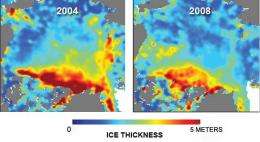
ICESat measurements of the distribution of winter sea ice thickness over the Arctic Ocean in 2004 and 2008. Click link for measurements between 2004 and 2008, along with the corresponding trends in overall, multi-year and first-year winter ice thickness. Credit: Ron Kwok, NASA/JPL.

(PhysOrg.com) -- Arctic sea ice thinned dramatically between the winters of 2004 and 2008, with thin seasonal ice replacing thick older ice as the dominant type for the first time on record. The new results, based on data from a NASA Earth-orbiting spacecraft, provide further evidence for the rapid, ongoing transformation of the Arctic's ice cover.

Scientists from and the University of Washington in Seattle conducted the most comprehensive survey to date using observations from NASA's , Cloud and land Elevation Satellite, known as ICESat, to make the first basin-wide estimate of the thickness and volume of the Arctic Ocean's ice cover. Ron Kwok of NASA's Jet Propulsion Laboratory in Pasadena, Calif., led the research team, which published its findings July 7 in the Journal of Geophysical Research-Oceans.

The Arctic ice cap grows each winter as the sun sets for several months and intense cold ensues. In the summer, wind and ocean currents cause some of the ice naturally to flow out of the Arctic, while much of it melts in place. But not all of the Arctic ice melts each summer; the thicker, older ice is more likely to survive. Seasonal sea ice usually reaches about 2 meters (6 feet) in thickness, while multi-year ice averages 3 meters (9 feet).

Using ICESat measurements, scientists found that overall ice thinned about 0.17 meters (7 inches) a year, for a total of 0.68 meters (2.2 feet) over four winters. The total area covered by the thicker, older "multi-year" ice that has survived one or more summers shrank by 42 percent.

Previously, scientists relied only on measurements of area to determine how much of the is covered in ice, but ICESat makes it possible to monitor ice thickness and volume changes over the entire Arctic Ocean for the first time. The results give scientists a better understanding of the regional distribution of ice and provide better insight into what is happening in the Arctic.

"Ice volume allows us to calculate annual ice production and gives us an inventory of the freshwater and total ice mass stored in ," said Kwok. "Even in years when the overall extent of sea ice remains stable or grows slightly, the thickness and volume of the ice cover is continuing to decline, making the ice more vulnerable to continued shrinkage. Our data will help scientists better understand how fast the volume of Arctic ice is decreasing and how soon we might see a nearly ice-free Arctic in the summer."

In recent years, the amount of ice replaced in the winter has not been sufficient to offset summer ice losses. The result is more open water in summer, which then absorbs more heat, warming the ocean and further melting the ice. Between 2004 and 2008, multi-year ice cover shrank 1.54 million square kilometers (595,000 square miles) -- nearly the size of Alaska's land area.

During the study period, the relative contributions of the two ice types to the total volume of the Arctic's ice cover were reversed. In 2003, 62 percent of the Arctic's total ice volume was stored in multi-year ice, with 38 percent stored in first-year seasonal ice. By 2008, 68 percent of the total ice volume was first-year ice, with 32 percent multi-year ice.

"One of the main things that has been missing from information about what is happening with sea ice is comprehensive data about ice thickness," said Jay Zwally, study co-author and ICESat project scientist at NASA's Goddard Space Flight Center in Greenbelt, Md. "U.S. Navy submarines provide a long-term, high-resolution record of ice thickness over only parts of the Arctic. The submarine data agree with the ICESat measurements, giving us great confidence in satellites as a way of monitoring thickness across the whole Arctic Basin."

The research team attributes the changes in the overall thickness and volume of Arctic Ocean sea ice to the recent warming and anomalies in patterns of sea ice circulation.

"The near-zero replenishment of the multi-year ice cover, combined with unusual exports of ice out of the Arctic after the summers of 2005 and 2007, have both played significant roles in the loss of Arctic sea ice volume over the ICESat record," said Kwok.

For more information about ICESat, visit: http://icesat.gsfc.nasa.gov .

Provided by JPL/NASA (news : web)

4.7 /5 (66 votes)  

Filter


Move the slider to adjust rank threshold, so that you can hide some of the comments.


Display comments: newest first

vanderMerwe
Jul 08, 2009

Rank: 1.7 / 5 (6)
"Arctic sea ice thinned dramatically between the winters of 2004 and 2008, with thin seasonal ice replacing thick older ice as the dominant type for the first time on record."

And how long is the "record". Talk about misleading bullshit!
omatumr
Jul 09, 2009

Rank: 2 / 5 (4)
WILL IT GET MORE FUNDS FOR NASA'S NASA EARTH-ORBITING SPACECRAFT?

"Arctic sea ice thinned dramatically between the winters of 2004 and 2008, with thin seasonal ice replacing thick older ice as the dominant type for the first time on record."

And how long is the "record". Talk about misleading bullshit!


Unfortunately, you are right!

The science is lousy, but this kind of news release will probably get more funds for NASA's Earth-orbiting spacecraft.

With kind regards,
Oliver K. Manuel
http://www.omatumr.cim
Canman
Jul 11, 2009

Rank: 2.3 / 5 (3)
Excellent discussion. When discussing the "record", this article should have given some more details. It turns out that sea-ice thickness data has been traditionally gathered as a fluke of the cold war. The earliest known date that I can find on this data is 1958. That means the "record" is at least 51 years old. (See Inter-Comparison and Assessment of Sea Ice Thickness Estimates Obtained From Satellites Using Submarines and Other In-Situ Observations) It turns out that the NASA scientists involved in this project didn't want to produce a bunch of "misleading bu*****t", so they validated their data by comparing that satellite data to the submarine data. Turns out that those quacks at NASA were actually pretty darn close; imagine that.
Another record that may impress you is that kept by the Norwegian Polar Institute. They started keeping theirs in 1972. They notice that on August 21, 2007 the Northwest Passage was open to passage for non-icebreakers for the first time since they started keeping that record. If you really want to see something crazy, do a search for "Cryosphere Today" and look at the Arctic Ice actually melting over the decades in time-lapse photography. Pretty creepy watching the ice-box of the world disintegrating from the comfort of your own home.
omatumr
Jul 11, 2009

Rank: 2.3 / 5 (4)
WISDOM FOR WORLD CLIMATE LEADERS

Interesting, Canman, that world leaders kept the information on Arctic Ice Thinning hidden when they were pursuing the "Cold War."

Do you think the truthfulness of world leaders has improved now that they are pursuing a "Carbon War"?

The Wall Street Journal yesterday (10 July 2009) offered a few historical words of wisdom to world climate leaders gathered in Italy for the G(8) Conference:

Once upon a time King Canute set his throne by the seashore and commanded the tides to roll out.

After failing to stop the rising tide, King Canut told the assembled crowd:

"Let all men know how empty and worthless is the power of kings, for there is none worthy of the name, but He whom heaven, earth and sea obey by eternal laws."

Can sophisticated world leaders of the 21st-century grasp this lesson?

With kind regards,
Oliver K. Manuel
http://www.omatumr.com
Canman
Jul 11, 2009

Rank: 3 / 5 (2)
King Canute at the G8 is a very good article about the types of resistance that the solutions to anthropogenic global warming is encountering. The business world is quagmired in a colossal cost-benefit analysis at the moment. (We cannot afford to fix global warming right now). The political world is stuck in near impossible face-saving situation. Most public opinion is shouting for a global warming fix, but the economic toll from the fix is sure to destroy the career of any politician who enacts it. There is a simple formula which will determine when we will enact true anti-global warming policy. When public alarm about global warming outweighs public resistance to global warming solutions, then meaningful action will begin. In the meantime, we are in waiting in this zone of angst, uncertainty, and very minimal action.
Nartoon
Jul 12, 2009

Rank: 1 / 5 (1)
The Arctic winds and currents have been proven to have basically moved the ice closest to Canada (the thickest) down the west coast of Greenland where it melted when further south. These years, especially the earlier ones were the years of least seasonal ice. Notice a co-incidence? It will take years to thicken up again, but since there is more ice now, and it isn't melting as fast as a few years ago it's guaranteed to be thick again in a couple of years!
Rank 4.7 /5 (66 votes)
Related Stories
Relevant PhysicsForums posts
  • Discrepancy between oxygen and carbon-dioxide levels
    created6 hours ago
  • where gems are found in the world
    created10 hours ago
  • Wind Waves in Reservoir ~ Wind run-up and Wind set-up
    createdFeb 08, 2012
  • Balance of oxygen in the atmosphere
    createdFeb 01, 2012
  • The case for a methanol-based economy
    createdJan 30, 2012
  • Weather in a rotating cylinder
    createdJan 25, 2012
  • More from Physics Forums - Earth

More news stories

New views show old NASA Mars landers

(PhysOrg.com) -- The High Resolution Imaging Science Experiment (HiRISE) camera on NASA's Mars Reconnaissance Orbiter recorded a scene on Jan. 29, 2012, that includes the first color image from orbit showing ...

Space & Earth / Space Exploration

created 20 hours ago | popularity 4.9 / 5 (7) | comments 8 | with audio podcast

Deconstructing a mystery: What caused Snowmaggedon?

In the quiet after the storms, streets and cars had all but disappeared under piles of snow. The U.S. Postal Service suspended service for the first time in 30 years. Snow plows struggled to push the evidence ...

Space & Earth / Earth Sciences

created 12 hours ago | popularity 4.7 / 5 (3) | comments 1 | with audio podcast

Black holes and star formation

(PhysOrg.com) -- It has long been recognized that galaxy mergers or even close interactions can play a vital role in shaping the morphology of galaxies. One way they can do so, it is thought, is by triggering ...

Space & Earth / Astronomy

created 19 hours ago | popularity 4.1 / 5 (7) | comments 5 | with audio podcast

Ocean microbe communities changing, but long-term environmental impact is unclear

As oceans warm due to climate change, water layers will mix less and affect the microbes and plankton that pump carbon out of the atmosphere – but researchers say it's still unclear whether these processes ...

Space & Earth / Earth Sciences

created 14 hours ago | popularity 5 / 5 (2) | comments 2 | with audio podcast

Researchers create 3-D laser maps that show how earthquake changes landscape

Geologists have a new tool to study how earthquakes change the landscape down to a few inches, and it's giving them insight into how earthquake faults behave. In the Feb. 10 issue of the journal Science, a team ...

Space & Earth / Earth Sciences

created 14 hours ago | popularity 5 / 5 (4) | comments 0 | with audio podcast


'Dark plasmons' transmit energy

Microscopic channels of gold nanoparticles have the ability to transmit electromagnetic energy that starts as light and propagates via "dark plasmons," according to researchers at Rice University.

FDA-approved drug rapidly clears amyloid from the brain, reverses Alzheimer's symptoms in mice

Neuroscientists at Case Western Reserve University School of Medicine have made a dramatic breakthrough in their efforts to find a cure for Alzheimer's disease. The researchers' findings, published in the journal Science, show t ...

Hydrogen from acidic water: Researchers develop potential low cost alternative to platinum for splitting water

A technique for creating a new molecule that structurally and chemically replicates the active part of the widely used industrial catalyst molybdenite has been developed by researchers with the Lawrence Berkeley ...

Ultraviolet protection molecule in plants yields its secrets

Lying around in the sun all day is hazardous not just for humans but also for plants, which have no means of escape. Ultraviolet (UV) radiation from the sun can damage proteins and DNA inside cells, leading ...

Soraa LED light may dim 50-watt halogen rivals

(PhysOrg.com) -- Soraa, a Fremont, California company founded in 2008, this week launched its first product, a light that uses LEDS (light emitting diodes). The "Soraa LED MR16 lamp" is the "perfect" replacement ...

Anyone can learn to be more inventive, cognitive researcher says

There will always be a wild and unpredictable quality to creativity and invention, says Anthony McCaffrey, a cognitive psychology researcher at the University of Massachusetts Amherst, because an "Aha moment" is rare and ...