Light-absorbing nanowires may make better solar panels
July 7, 2009 BY DAVID ORENSTEIN
Light-absorbing nanowires may make better solar panels

Enlarge

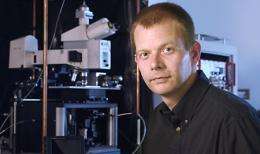
Mark Brongersma

(PhysOrg.com) -- A century after German physicist Gustav Mie derived the math to explain why the colors in some stained glass windows look especially resplendent in the sunlight, a team of Stanford engineers has built upon his work to potentially improve a means of harvesting energy from the sun.

In 1907 Mie realized that tiny in stained glass scattered in ways that produced beautiful colors. Now, a related interplay between light and matter explains why incredibly thin "" made of semiconductors like germanium may prove to be effective components for solar cells. Combining Mie's work with more recent theory, the Stanford team has discerned how to tune and improve the light absorption efficiency of the wires. Their research appears in the July 5 online edition of the journal .

"For many solar cells if you can get just a couple of percent improvement in energy conversion efficiency, people are very happy," said Mark Brongersma, an associate professor of materials science and engineering and a senior author on the paper. "Here we show that we can boost the light absorption by a factor of 10 for some wires at some wavelengths of light. Researchers around the world are already investigating the use of nanowires in solar cells and there is a potential to get significant boosts in their efficiencies."

Because the work explains how to improve light absorption with germanium, a material compatible with computer chips, it may also have applications in improving data communications by bridging optical and electronic signals, even in the smallest spaces on densely packed chips. (With a similar goal, a separate team of Stanford researchers recently demonstrated a way of producing strong light signals using a combination of silicon and germanium. Their research appeared in the June 8 edition of the journal Optics Express.)

In the work by Brongersma's team, the germanium nanowires were as thin as 10 nanometers in radius (1 nanometer is a billionth of a meter). They were grown by Joon-Shik Park, a visiting researcher from the Korea Electronics Technology Institute in the group of materials science and engineering Professor Bruce Clemens. Brongersma doctoral student Linyou Cao, the lead author on the paper and main driver of the research, hooked the germanium wires up electrically and showed that in the presence of visible and infrared light they act like wispy antennas, capturing particularly resonant wavelengths of the light and bouncing them around inside the wire. Because the resonant light bounces around for a while, it has a larger chance to be absorbed in the semiconducting material. When it is absorbed, it excites electrical charges in the material that can be measured as an electrical current from the wire. In a solar panel, that current is the electricity the panel generates.

The crux of the team's discovery is that different sizes of wire will absorb different frequencies of light more efficiently. The experimental results matched theory developed by Cao and simulations by doctoral student and co-author Justin White. The thinnest wires, say 10 billionths of a meter across, are good for absorbing red-orange light. Larger wires absorb longer wavelengths, stretching into the infrared part of the spectrum. To make optimal solar panels with germanium nanowires, it may be necessary to use a variety of nanowire diameters, or perhaps a specialized type of nanowire that shows resonances at several different wavelengths.

Engineers have become increasingly capable of making nanowires of different sizes, Brongersma says.

"Nanotechnology has provided us with an ever-increasing control over nanostructure dimensions and this control can now be used to engineer desired absorption spectra for specific applications," the authors wrote in the paper.

Also in the paper, the team figured out another parameter for tuning absorption: the angle at which light strikes the nanowires. Depending on the diameter of the wire, some angles will yield better absorption at some frequencies and other angles will yield better absorption at other frequencies.

Brongersma said the team's next goal is to build prototype that make use of the tuning guidelines established in the Nature Materials paper.

Provided by Stanford University (news : web)

4.2 /5 (10 votes)  

Filter


Move the slider to adjust rank threshold, so that you can hide some of the comments.


Display comments: newest first

mongander
Jul 07, 2009

Rank: 5 / 5 (2)
Remember the old days, when we only had one earth shaking solar breakthrough per week? Now we get 2
or 3 per week. I love progress.
malapropism
Jul 08, 2009

Rank: 5 / 5 (2)
Boosting the absorption of some wavelengths by a factor of 10 is an astonishing achievement. I hope that this will help lead to cheap, high output photovoltaic cells relatively soon.
finitesolutions
Jul 08, 2009

Rank: 4 / 5 (1)
The germans are taking their own medicine : they are the leaders in manufacture of solar panels and in their consumption. Hopefuly the panels are affordable and available in other countries on this planet.
Soylent
Jul 08, 2009

Rank: 4 / 5 (2)
The germans are taking their own medicine : they are the leaders in manufacture of solar panels and in their consumption.


Yes, and they're importing ever more natural gas from russian Gazprom as a result of their wind and solar nonsense.

They're compounding the idiocy by phasing out nuclear power in favour of 26 new coal plants burning lignite(brown coal). These plants will cause more deaths from particulate pollution every single year than Chernobyl accident ever will; this is a breathtakingly stupid policy.
iknow
Jul 08, 2009

Rank: 3.7 / 5 (3)
Only the French are sensible (and brave enough to sock it Greenpeace and other eco-looneys) to stake their leccy future on nuclear power.

Stupid UK gov is phasing out nuclear too, but at least its windy in UK most of the time, no hope for solar tho.

I am going into solar power in a few years, my country has 8 months of sunshine a year, so any progress in cells is only good.
sender
Jul 13, 2009

Rank: not rated yet
i want ZnO doped brewster array panelling
Rank 4.2 /5 (10 votes)
Relevant PhysicsForums posts
  • polymer nanocomposites
    created13 hours ago
  • Corrosion Tests on Magnesium
    createdFeb 09, 2012
  • polyethylene copper nanocomposite
    createdFeb 09, 2012
  • Output of xrd analysis
    createdFeb 08, 2012
  • Transport phenomena problem based on problems 18.B11 and 19B.6 from Bird, stewart, lw
    createdFeb 06, 2012
  • Help with material selection - Car Piston
    createdFeb 05, 2012
  • More from Physics Forums - Materials & Chemical Engineering

More news stories

What lies beneath: Mapping hidden nanostructures

The ability to diagnose and predict the properties of materials is vital, particularly in the expanding field of nanotechnology. Electron and atom-probe microscopy can categorize atoms in thin sheets of material, ...

Nanotechnology / Nanophysics

created 5 hours ago | popularity 5 / 5 (1) | comments 1

'Dark plasmons' transmit energy

Microscopic channels of gold nanoparticles have the ability to transmit electromagnetic energy that starts as light and propagates via "dark plasmons," according to researchers at Rice University.

Nanotechnology / Nanophysics

created 22 hours ago | popularity 5 / 5 (6) | comments 1 | with audio podcast

New kind of solar cell could capture significantly more energy than current cells

New solar cells could increase the maximum efficiency of solar panels by over 25%, according to scientists from the University of Cambridge.

Nanotechnology / Nanophysics

created Feb 08, 2012 | popularity 4.5 / 5 (12) | comments 14 | with audio podcast

Nanoshell whispering galleries improve thin solar panels

Visitors to Statuary Hall in the U.S. Capitol Building may have experienced a curious acoustic feature that allows a person to whisper softly at one side of the cavernous, half-domed room and for another on ...

Nanotechnology / Nanomaterials

created Feb 07, 2012 | popularity 4.3 / 5 (6) | comments 6 | with audio podcast

Nanotube therapy takes aim at breast cancer stem cells

Wake Forest Baptist Medical Center researchers have again proven that injecting multiwalled carbon nanotubes (MWCNTs) into tumors and heating them with a quick, 30-second laser treatment can kill them.

Nanotechnology / Bio & Medicine

created Feb 09, 2012 | popularity 5 / 5 (1) | comments 0 | with audio podcast


Human cognitive performance suffers following natural disasters, researchers find

Not surprisingly, victims of a natural disaster can experience stress and anxiety, but a new study indicates that it might also cause them to make more errors - some serious - in their daily lives. In their upcoming Human Fa ...

The power of estrogen -- male snakes attract other males

A new study has shown that boosting the estrogen levels of male garter snakes causes them to secrete the same pheromones that females use to attract suitors, and turned the males into just about the sexiest ...

New error-correcting codes guarantee the fastest possible rate of data transmission

Error-correcting codes are one of the triumphs of the digital age. They’re a way of encoding information so that it can be transmitted across a communication channel — such as an optical fiber o ...

Putting the squeeze on planets outside our solar system

(PhysOrg.com) -- Using high-powered lasers, scientists at Lawrence Livermore National Laboratory and collaborators discovered that molten magnesium silicate undergoes a phase change in the liquid state, abruptly ...

Both maternal and paternal age linked to autism

Older maternal and paternal age are jointly associated with having a child with autism, according to a recently published study led by researchers at The University of Texas Health Science Center at Houston (UTHealth).

Curry spice component may help slow prostate tumor growth

Curcumin, an active component of the Indian curry spice turmeric, may help slow down tumor growth in castration-resistant prostate cancer patients on androgen deprivation therapy (ADT), a study from researchers ...