Human sperm created from embryonic stem cells (Update)
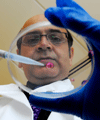
(PhysOrg.com) -- Human sperm have been created using embryonic stem cells for the first time in a scientific development which will lead researchers to a better understanding of the causes of infertility.
Researchers led by Professor Karim Nayernia at Newcastle University and the NorthEast England Stem Cell Institute (NESCI) have developed a new technique which has made the creation of human sperm possible in the laboratory.
The work is published today (8th July 2009) in the academic journal Stem Cells and Development.
The NorthEast England Stem Cell Institute (NESCI) is a collaboration between Newcastle and Durham Universities, Newcastle NHS Foundation Trust and other partners.
Professor Nayernia says: "This is an important development as it will allow researchers to study in detail how sperm forms and lead to a better understanding of infertility in men - why it happens and what is causing it. This understanding could help us develop new ways to help couples suffering infertility so they can have a child which is genetically their own."
"It will also allow scientists to study how cells involved in reproduction are affected by toxins, for example, why young boys with leukaemia who undergo chemotherapy can become infertile for life - and possibly lead us to a solution."
The team also believe that studying the process of forming sperm could lead to a better understanding of how genetic diseases are passed on.
In the technique developed at Newcastle, stem cells with XY chromosomes (male) were developed into germline stem cells which were then prompted to complete meiosis - cell division with halving of the chromosome set. These were shown to produce fully mature, sperm called scientifically, In Vitro Derived sperm (IVD sperm).
In contrast, stem cells with XX chromosomes (female) were prompted to form early stage sperm, spermatagonia, but did not progress further. This demonstrates to researchers that the genes on a Y chromosome are essential for meiosis and for sperm maturation.
IVD sperm
The IVD sperm will not and cannot be used for fertility treatment. As well as being prohibited by UK law, the research team say fertilization of human eggs and implantation of embryos would hold no scientific merit for them as they want to study the process as a model for research.
"While we can understand that some people may have concerns, this does not mean that humans can be produced 'in a dish' and we have no intention of doing this. This work is a way of investigating why some people are infertile and the reasons behind it. If we have a better understanding of what's going on it could lead to new ways of treating infertility," adds Professor Nayernia.
Technique
The Newcastle University team have developed a method for establishing early stage sperm from human embryonic stem cells in the laboratory.
The embryonic stem cells were cultured in a new medium containing vitamin A derivative (retinoic acid), in a new technique established by the team. Based on this technique, the cells differentiated into germline stem cells.
These expressed a protein which was stained with a green fluorescent marker and they were separated out by FACSTM (Fluorescence-activated cell sorting) using a laser.
After further differentiation, these in vitro derived germline stem cells expressed markers which are specific to primordial germ cells, spermatogonial stem cells, meiotic (spermatocytes) and post meiotic germ cells (spermatids and sperm).
These results indicated maturation of the primordial germ cells to haploid male gametes - called IVD sperm - characterised by containing half a chromosome set (23 chromosomes).
Your questions answered: Human sperm created from embryonic stem cells
Researchers led by Professor Karim Nayernia at Newcastle University and the NorthEast England Stem Cell Institute (NESCI) answer some of the most common questions about in vitro derived (IVD) sperm.
Will you be making babies from this sperm?
No. The IVD sperm will not and cannot be used for fertility treatment. This is prohibited by UK law.
This work is not being done to make babies. The research is being done to investigate why some people are infertile. It could also lead to a better understanding of how genetic diseases are passed on from one generation to the next.
Could you make a baby from this sperm?
In theory this might be possible as the IVD sperm show all the characteristics of sperm - that is they act and look like sperm. However, this work is not being done to make a baby which is prohibited by law.
Does this mean an end to men?
No. In this technique IVD sperm could only be produced from an embryo containing a male (Y) chromosome.
However, researchers believe that the issue does need to be debated and legislated for. As work progresses and results improve at Newcastle and elsewhere, it may, in theory, be possible to develop IVD sperm from embryonic stem lines which have been stored.
How long before this will be available as a treatment?
Sperm developed from embryonic stem cells cannot be used as a fertility treatment.
This work is in early stages and much more investigation needs to be done on understanding the process and for testing the suitability and safety of IVD sperm as a possible fertility treatment. However, Professor Nayernia believes that in 10 years this could be a treatment offered for example, to young boys who have to undergo chemotherapy which currently often leaves them infertile.
When combined with other pioneering stem cell techniques, specifically somatic cell nuclear transfer, it could also allow men who are currently infertile the chance to have a child which is genetically their own but again, this will be many years away - at least a decade.
The researchers do believe that given the speed of progress in this area of work, legislation needs to be put in place sooner rather than later to allow for the technique to be licensed as a treatment in the future for infertile men.
Why have you called them IVD sperm?
IVD sperm is the name researchers have adopted to show the sperm are developed in a lab rather than in a human. It comes from In Vitro Derived (similar to IVF - in vitro fertilised).
Source: Newcastle University


