Kenya's national parks not free from wildlife declines
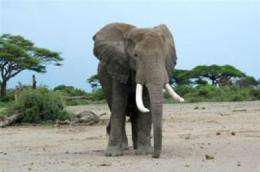
Long-term declines of elephants, giraffe, impala and other animals in Kenya are occurring at the same rates within the country's national parks as outside of these protected areas, according to a study released this week.
"This is the first time we've taken a good look at a national park system in one country, relative to all of the wildlife populations across the whole country," said David Western, an adjunct professor of biology at UC San Diego and the founding executive director of the African Conservation Center in Nairobi, who headed the study published in the July 8 issue of the journal PLoS One. "And we found that wildlife populations inside and outside of the parks are declining at much the same rate."
Western said this finding, while surprising to those who regard national parks as sanctuaries where wildlife populations are protected, illustrates the problems that maintaining these protected areas can create on wildlife and ecosystems inside as well as outside of the parks.
"What we're now beginning to understand is that the pressures around the parks are also affecting the wildlife in the parks," said Western, a former director of the Kenyan Wildlife Service, which commissioned the study two years ago. His research team—which included Samantha Russell, a research scientist at the African Conservation Center, and Innes Cuthill, a biologist at Britain's Bristol University—compiled data from more than 270 counts of wildlife in Kenya over a period of 25 years.
"Many of the population changes that occur are drought-driven, occurring over a 5 to 10 year period," said Western. "These data cover a long period of time and overcome that seasonal periodic drought-driven effect on wildlife."
The scientists noted in their paper that many of Kenya's 23 national park and 26 national reserve boundaries do not take into account the seasonal migrations of animals. So when land surrounding the parks is allowed to be developed for agriculture and other uses, migratory routes and important sources of food for wildlife are destroyed.
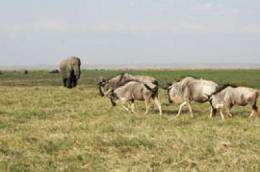
"Parks in Kenya were set aside in areas where people saw large aggregations of animals and typically these were the areas where animals congregated during the dry seasons," said Western. "They ignored seasonal migrations because people didn't know where these animals migrated to, in many cases."
To protect elephants and other endangered species from poachers, the national parks confined these animals within park boundaries. But the researchers found that this practice over time has changed the ecology of many Kenyan parks.
"Elephants need a lot of space," Western said. "They move around. But now that they have been limited to smaller areas, they're taking out the woody vegetation and reducing the overall biodiversity in the national parks. We're seeing throughout our parks in Kenya a change from woody habitats to grassland habitats. As a result, we're losing the species that thrive in woody areas, such as giraffe, lesser kudu and impala."
The researchers said in their paper that wildlife populations throughout Kenya—inside as well as outside the national parks—declined by 40 percent from 1977 to 1997. But the populations underwent ups and downs during those years. "The combined wildlife populations show considerable fluctuation in parks and adjoining areas, with numbers rising in the late 1970s, falling through to the mid-1980s, rising again more slowly in the late 1980s and falling steeply in the 1990s," the researchers wrote in their paper.
Western said a third contributing reason for declines in some species, such as elephants, has been the antagonism created by the parks within surrounding communities. Forced to settle in land outside the parks, some local tribes view the parks as threats to their survival.
"What happens is that wildlife now becomes a threat to their agriculture and their pastoral way of life," Western said. "So they willingly invite poachers to get rid of the wildlife."
"The most disturbing finding from our study is that the biggest parks do not provide insulation from wildlife losses," he added. "In fact, the biggest losses are occurring in the big parks, rather than the smaller ones. A very big park is much more difficult to protect from poachers. Furthermore, in the biggest parks there isn't an intimate connection between the park and the surrounding community, so there are no benefits going back. The small parks, such Nairobi National Park, Amboseli, and Nakuru, are surrounded by people who are more educated and better off financially, so they don't see the parks with the same antagonism as the others and they're more amenable to conservation."
Western said that to protect Kenyan wildlife from further declines, the Kenyan government needs to set policies to share the profits of ecotourism with local communities so that they can reap the economic benefits of protecting the wildlife and ecosystems within and surrounding the national parks.
"We now have streams of visitors into the parks and at the moment the revenues are going to the tour operators, hoteliers and the government and nothing to the customary users of that land. We need to create 'parks beyond parks' in which we encourage communities to become closely aligned with their own wildlife sanctuaries, their own lodges, their own scouts and their own conservation efforts."
Western added that he and his colleagues found in a separate study, soon to be published, that "where we have community based conservation linked to a national park, the losses of wildlife are much, much less."
He said those lessons apply not only to national parks in Kenya, but to those in other countries, including the United States.
"We're not likely to increase the number of national parks or increase parkland," he added. "But we can create parks beyond parks in local communities that double as grazing land for livestock during droughts and become drought refuges for wildlife. This obviates the need to create new parkland."
"The combination of local involvement with national parks makes a very good fit," he said.
Source: University of California - San Diego (news : web)


