One-finger exercise reveals unexpected limits to dexterity
July 8, 2009
One-finger exercise reveals unexpected limits to dexterity

Enlarge

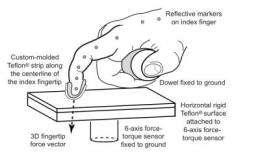
Adult volunteers wearing a close-fitting Teflon cover on their forefingers applied fingertip pressure on a slippery Teflon surface linked to a force-measuring sensor. Credit: University of Southern California

"Push your finger as hard as you can against the surface. Now as hard as you can but move it slowly - follow the ticking clock. Now faster. Now faster."

These were the commands for volunteers in a simple experiment that casts doubt on old ideas about mechanisms to control hand muscles. Complete understanding of the result may help explain why manual dexterity is so vulnerable to aging and disease, and even help design more versatile robotic graspers.

A research team led by Francisco Valero-Cuevas of the University of Southern California reports the paradoxical result in the .

"We expected to find," says the report, "that maximal voluntary downward force would scale with movement speed…. Surprisingly, maximal force was independent of movement speed."

The observation challenges theories that date back nearly seventy years about how the properties of muscles influence their everyday function, and how "redundant" our bodies are.

According to Valero-Cuevas, who holds a joint appointment in the USC Viterbi School of Engineering's department of biomedical engineering and the USC Division of Biokinesiology and Physical Therapy, in many tasks muscle force is affected by physiological "force-velocity" properties that weaken muscles as they move faster.

"That is why your bicycle has gears, and why as a child you could not speed up much on level ground," he explains.

Valero-Cuevas and his collaborators set up a simple experiment to characterize how finger velocity made a difference in the force produced during the common manipulation task similar to rubbing a surface, using a computer track pad or iphone. Adult volunteers wearing a closefitting Teflon cover on their forefingers applied fingertip pressure on a slippery Teflon surface linked to a force-measuring sensor.

First, the volunteers simply pressed as hard as they could without moving. Then, still pressing as hard as they could they moved their fingers against the surface to the beat of a metronome.

"As expected, maximal downward force diminished when motion was added to the task," the researchers wrote. "But remarkably, there were no significant differences … between slow, and fast movement speeds… even though the movement speeds varied 36-fold."

The paper, "Maximal Voluntary Fingertip Force Production is Not Limited by Movement Speed in Combined Motion and Force Tasks," goes on to discuss and rule out several possible explanations for the result, including differing levels of dexterity by the subjects, non-linear responses by muscles, and finger-muscle asymmetries.

The explanation proposed by Valero-Cuevas and collaborators (and former students) Kevin G. Keenan of the University of Wisconsin/Milwaukee, Veronica J. Santos of Arizona State University, and Madhusudhan Venkadesan of Harvard University, is that the universe of possible commands sent by the brain to the muscles is severely limited by the mechanical nature of the task, even for ordinary manipulation tasks.

That is, say the scientists, that even for seemingly-simple real-world tasks where we must control both force and motion, the neuromuscular system can be pushed to its limits of performance.

This complements other recent work by Valero-Cuevas showing how other ordinary tasks like tapping a surface are extremely challenging to the nervous system.

Together these results begin to identify the mechanical pressures that could have driven the evolutionary specializations of our brains and bodies that make our hands so dexterous.

"These apparently esoteric results have tremendous implications for both humans and robots," Valero-Cuevas says. "For one, they bring together basic research and clinical reality by helping explain the high vulnerability of dexterous everyday function to disease and injury in spite of the many muscles and joints we have.

"In addition, they suggest to engineers that adding redundant motors to robots may actually be the key to making them dexterous."

The detailed interactions among muscles and body mechanics are complex and defy easy mathematical modeling at this time, he adds, but further study may offer clues.

Source: University of Southern California (news : web)

Filter


Move the slider to adjust rank threshold, so that you can hide some of the comments.


Display comments: newest first

mikehevans
Jul 08, 2009

Rank: not rated yet
Pat your head and rub your tummy. Now rub your head and pat your tummy. Duh.
Soylent
Jul 08, 2009

Rank: not rated yet
Pat your head and rub your tummy. Now rub your head and pat your tummy. Duh.


What am I missing? Is this supposed to be difficult somehow?
VOR
Jul 09, 2009

Rank: not rated yet
Pat your head and rub your tummy. Now rub your head and pat your tummy. Duh.


What am I missing? Is this supposed to be difficult somehow?

its funny becuase you cant do it unless you stop and rethink about doing the opposite task. The funny part is the feeling you get, or 'feedback' when it doesnt switch easily or smoothly.
Rank 3 /5 (8 votes)
Related Stories
Relevant PhysicsForums posts
  • Is Everyday Technology Killing Us?
    createdFeb 08, 2012
  • Exercise and weight loss
    createdFeb 08, 2012
  • Why do we have head aches? Our brains can't feel anything.
    createdFeb 07, 2012
  • "The end of diseases" by David Agus, interview from Daily Show with Jon Stewart
    createdFeb 04, 2012
  • Oncolytic adenovirus
    createdFeb 04, 2012
  • Nutrition label stuffs and diets
    createdFeb 02, 2012
  • More from Physics Forums - Medical Sciences

More news stories

Human cognitive performance suffers following natural disasters, researchers find

Not surprisingly, victims of a natural disaster can experience stress and anxiety, but a new study indicates that it might also cause them to make more errors - some serious - in their daily lives. In their upcoming Human Fa ...

Medicine & Health / Psychology & Psychiatry

created 1 hour ago | popularity not rated yet | comments 0

Both maternal and paternal age linked to autism

Older maternal and paternal age are jointly associated with having a child with autism, according to a recently published study led by researchers at The University of Texas Health Science Center at Houston (UTHealth).

Medicine & Health / Psychology & Psychiatry

created 4 hours ago | popularity not rated yet | comments 0 | with audio podcast

Curry spice component may help slow prostate tumor growth

Curcumin, an active component of the Indian curry spice turmeric, may help slow down tumor growth in castration-resistant prostate cancer patients on androgen deprivation therapy (ADT), a study from researchers ...

Medicine & Health / Cancer

created 5 hours ago | popularity 5 / 5 (3) | comments 0 | with audio podcast

Team isolates nerve cells involved in storing long term memory and gene proteins associated with them

(Medical Xpress) -- A research team in Taiwan has succeeded in isolating two nerve cells in fruit fly brains that are believed to be the major players in allowing for the formation of long term memories. Furthermore, ...

Medicine & Health / Neuroscience

created 6 hours ago | popularity 5 / 5 (4) | comments 1 | with audio podcast report

Seeing colors in music, tasting flavors in shapes may happen in life's early months

Famed violinist Itzhak Perlman sees a deep forest green whenever he plays a B-flat on his Stradivarius' G string. The A on the E string is red.

Medicine & Health / Psychology & Psychiatry

created 7 hours ago | popularity 4.5 / 5 (2) | comments 1 | with audio podcast


The power of estrogen -- male snakes attract other males

A new study has shown that boosting the estrogen levels of male garter snakes causes them to secrete the same pheromones that females use to attract suitors, and turned the males into just about the sexiest ...

New error-correcting codes guarantee the fastest possible rate of data transmission

Error-correcting codes are one of the triumphs of the digital age. They’re a way of encoding information so that it can be transmitted across a communication channel — such as an optical fiber o ...

Putting the squeeze on planets outside our solar system

(PhysOrg.com) -- Using high-powered lasers, scientists at Lawrence Livermore National Laboratory and collaborators discovered that molten magnesium silicate undergoes a phase change in the liquid state, abruptly ...

Humans may have helped the decline of African rainforests 3000 years ago

(PhysOrg.com) -- Large areas of rainforests in Central Africa mysteriously disappeared over three thousand years ago, to be replaced by savannas. The prevailing theory has been that the cause was a change ...

Fool's gold may prove an unlikely alternative to overexploited catalytic materials

Catalytic materials, which lower the energy barriers for chemical reactions, are used in everything from the commercial production of chemicals to catalytic converters in car engines. However, with current catalytic materials ...

Could Venus be shifting gear?

(PhysOrg.com) -- ESA’s Venus Express spacecraft has discovered that our cloud-covered neighbour spins a little slower than previously measured. Peering through the dense atmosphere in the infrared, the ...