Faster, more cost-effective DNA test for crime scenes, disease diagnosis
July 8, 2009 Faster, more cost-effective DNA test for crime scenes, disease diagnosis

Enlarge

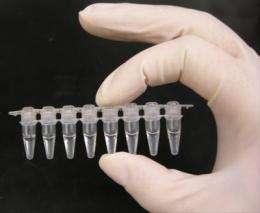
Scientists in Japan have developed a faster, more cost-effective PCR test to analyze DNA for criminal investigations, disease diagnosis, and other applications. Credit: Wikipedia Commons

Scientists in Japan are reporting development of a faster, less expensive version of the fabled polymerase chain reaction (PCR) a DNA test widely used in criminal investigations, disease diagnosis, biological research and other applications. The new method could lead to expanded use of PCR in medicine, the criminal justice system and elsewhere, the researchers say. Their study is scheduled for the July 15 issue of Analytical Chemistry, a semi-monthly journal.

In the new study, Naohiro Noda and colleagues note that PCR works by "amplifying" previously undetectable traces of DNA almost like photocopiers produce multiple copies of documents. With PCR, crime scene investigators can change traces of DNA into amounts that can be identified and linked to a suspect. Biologists can produce multiple copies of individual genes to study gene function, evolution, and other topics. Doctors can amplify the DNA from microbes in a patient's blood to diagnose an infection. Current PCR methods, however, are too expensive and cumbersome for wide use.

The scientists describe development and testing of a new PCR method, called the universal QProbe system, that overcomes these problems. Existing PCR processes require several "fluorescent probes" to seek out DNA. QProbe substitutes a single "fluorescent probe" that can detect virtually any target, saving time and cutting costs. The new method also is more specific, accurately detecting DNA even in the presence of unfavorable PCR products in the samples that may interfere with quantification results.

More information: "Universal Quenching Probe System: Flexible, Specific, and Cost-Effective Real-Time Method," .

Source: American Chemical Society (news : web)


print this article email this article download pdf blog this article bookmark this article     Stumble it Digg this share on Facebook retweet share on Reddit add to delicious
Rate this story - 4 /5 (1 vote)


July 8, 2009 all stories

Comments: 0

4 /5 (1 vote)
  • Stumble this up

  • Digg this

  • share this

  • hide
  • Related Stories


  • hide
  • Relevant PhysicsForums posts

Other News

Toward home-brewed electricity with 'personalized solar energy'

Toward home-brewed electricity with 'personalized solar energy'

Chemistry / Materials Science

created Nov 04, 2009 | popularity 3.4 / 5 (9) | comments 4

New scientific discoveries are moving society toward the era of "personalized solar energy," in which the focus of electricity production shifts from huge central generating stations to individuals in their ...


Scientists Reproduce a Building Block of Life in Laboratory

Scientists Reproduce a Building Block of Life in Laboratory

Chemistry / Biochemistry

created Nov 06, 2009 | popularity 4.8 / 5 (23) | comments 0

(PhysOrg.com) -- NASA scientists studying the origin of life have reproduced uracil, a key component of our hereditary material, in the laboratory.


Newly Discovered Fat Molecule: An Undersea Killer with an Upside

Newly Discovered Fat Molecule: An Undersea Killer with an Upside

Chemistry / Biochemistry

created Nov 05, 2009 | popularity 4.8 / 5 (9) | comments 0

(PhysOrg.com) -- A chemical culprit responsible for the rapid, mysterious death of phytoplankton in the North Atlantic Ocean has been found by collaborating scientists at Rutgers University and the Woods Hole ...


CU-Boulder map of human bacterial diversity shows wide interpersonal differences

Map of Human Bacterial Diversity Shows Wide Interpersonal Differences

Chemistry / Biochemistry

created Nov 05, 2009 | popularity 4.7 / 5 (11) | comments 0

(PhysOrg.com) -- A University of Colorado at Boulder team has developed the first atlas of bacterial diversity across the human body, charting wide variations in microbe populations that live in different ...


Mimicking nature, scientists can now extend redox potentials

Mimicking nature, scientists can now extend redox potentials

Chemistry / Biochemistry

created Nov 04, 2009 | popularity 4.8 / 5 (5) | comments 0

(PhysOrg.com) -- New insight into how nature handles some fundamental processes is guiding researchers in the design of tailor-made proteins for applications such as artificial photosynthetic centers, long-range ...