Researcher looking for nano environmental footprint
July 8, 2009 By Brian Murphy Researcher looking for nano environmental footprint

Enlarge

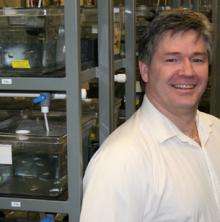
Greg Goss

(PhysOrg.com) -- University of Alberta biological sciences professor Gregg Goss is on the front line of a new effort to monitor the effects of nanomaterials on the environment.

Goss will help lead a team of 19 researchers from across the country in a three-year study of the toxicity of nanomaterials in aquatic environments.

Nanomaterials are the microscopic bits of material that help strengthen products or make them more efficient. Silver nanoparticles, woven into sweat socks to kill bacteria, are a nanotechonology product on the market right now. But no one knows what effect those silver nanoparticles will have on the when they come out in the wash.

"Everything winds up in the water eventually," said Goss.

Goss explains that nanomaterials are very different from mainstream technology. "Today, if a company releases a chemical, we can go out there and measure it," said Goss. "But with nanomaterials, once they're released, we can't measure it."

To get out in front of the analysis of nanomaterials Goss says the research team will work with companies as they produce new products. "The problem with nanomaterials is that classic toxicity tests may not be appropriate," he said. "We have to figure out what existing tests work, and develop some new tests."

Goss expects government regulatory agencies will be adjusting their rules as the nanomaterials industry grows and he sees a role for his research group as communicators.

"We'd like to see a co-ordinated response where one set of toxicity tests can be shared by Canada, the United States, Europe and other producing nations."

Goss shares the leadership role in the program with researcher Geoffrey Sunahara at the National Research Council's biotechnology lab in Montreal. The $3.39 million program is funded by the U of A, NRC, Natural Sciences and Engineering Research Council of Canada, the National Institute for Nanotechnology and Environment Canada. Private sector companies involved include VIVE Nano, Golder Associates and HydroQual Laboratories.

Goss says it's difficult to imagine what nanotechnology won't be used for. He uses an old television commercial produced by a multinational chemical company to describe the future of nanomaterials. "Remember those BSAF ads that said, 'We don't make things. We make things better,'" said Goss. "That's essentially what nanotechnology is going to do."

Goss predicts many areas of daily life will benefit from nanomaterials, which includes more sustainable world travel. "It's going to make stronger steel so commercial aircraft are lighter and fly further on less fuel."

Fortunately Goss believes 99.9 per cent of nanomaterial products will be found to be completely benign. Finding the downside will be the challenge. "We're set to identify problem and prevent them from getting out into the market. That's our job."

Provided by University of Alberta (news : web)


print this article email this article download pdf blog this article bookmark this article     Stumble it Digg this share on Facebook retweet share on Reddit add to delicious
Rate this story - 5 /5 (3 votes)


July 8, 2009 all stories

Comments: 0

5 /5 (3 votes)
  • Stumble this up

  • Digg this

  • share this

  • hide
  • Related Stories

  • Canadian researchers set to study impact of nanomaterials on aquatic ecosystems
    created Jul 06, 2009 | popularity not rated yet | comments 0
  • As nanotech goes mainstream, 'toxic socks' raise concerns
    created Apr 07, 2008 | popularity not rated yet | comments 0
  • CIDETEC and IBM to Develop Nanomaterials for Microelectronic
    created Sep 07, 2004 | popularity not rated yet | comments 0
  • Nanomaterial hazard
    created Sep 04, 2005 | popularity not rated yet | comments 0
  • Nanomaterials Are Showing Promise In Nanotechnology Applications
    created Sep 11, 2004 | popularity not rated yet | comments 0


  • hide
  • Relevant PhysicsForums posts

  • What is transpulmonary pressure?
    created Nov 24, 2009
  • Is there a gay gene?
    created Nov 23, 2009
  • Super quick question about Starling forces?
    created Nov 22, 2009
  • Questions about diffusion
    created Nov 22, 2009
  • More from Physics Forums - Biology

Other News

Fast, easy, and highly sensitive arsenic detection with gold nanoparticles

Nanotechnology / Nanomaterials

created 15 hours ago | popularity 5 / 5 (1) | comments 0

(PhysOrg.com) -- Mention of arsenic poisoning usually brings to mind underhanded murder. However, the danger of arsenic poisoning from contaminated drinking water is far greater. Low concentrations of arsenic are found in ...


Water droplets direct self-assembly process in thin-film materials

Nanotechnology / Nanomaterials

created Nov 23, 2009 | popularity 5 / 5 (4) | comments 2

You can think of it as origami - very high-tech origami. Researchers at the University of Illinois have developed a technique for fabricating three-dimensional, single-crystalline silicon structures from thin films by coupling ...


Nanotube defects equal better energy and storage systems

Nanotube defects equal better energy and storage systems

Nanotechnology / Nanomaterials

created Nov 19, 2009 | popularity 4.4 / 5 (10) | comments 2

(PhysOrg.com) -- Most people would like to be able to charge their cell phones and other personal electronics quickly and not too often. A recent discovery made by UC San Diego engineers could lead to carbon ...


Nanotech in Space: Experiment To Weather the Trials of Orbit

Nanotech in Space: Experiment To Weather the Trials of Orbit

Nanotechnology / Nanomaterials

created Nov 24, 2009 | popularity 4 / 5 (2) | comments 0

Novel nanomaterials developed at Rensselaer were sent into orbit on Nov. 16 aboard Space Shuttle Atlantis.


Peptides control crystal growth with 'switches, throttles and brakes'

Peptides control crystal growth with 'switches, throttles and brakes'

Nanotechnology / Bio & Medicine

created Nov 23, 2009 | popularity 5 / 5 (3) | comments 0

(PhysOrg.com) -- By producing some of the highest resolution images of peptides attaching to mineral surfaces, scientists have a deeper understanding how biomolecules manipulate the growth crystals. This research ...