Explosive growth of life on Earth fueled by early greening of planet
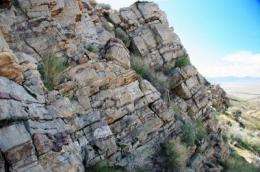
Earth's 4.5-billion-year history is filled with several turning points when temperatures changed dramatically, asteroids bombarded the planet and life forms came and disappeared. But one of the biggest moments in Earth's lifetime is the Cambrian explosion of life, roughly 540 million years ago, when complex, multi-cellular life burst out all over the planet.
While scientists can pinpoint this pivotal period as leading to life as we know it today, it is not completely understood what caused the Cambrian explosion of life. Now, researchers led by Arizona State University geologist L. Paul Knauth believe they have found the trigger for the Cambrian explosion.
It was a massive greening of the planet by non-vascular plants, or primitive ground huggers, as Knauth calls them. This period, roughly 700 million years ago virtually set the table for the later explosion of life through the development of early soil that sequestered carbon, led to the build up of oxygen and allowed higher life forms to evolve.
Knauth and co-author Martin Kennedy, of the University of California, Riverside, report their findings in the July 8 advanced on-line version of Nature. Their paper, "The Precambrian greening of Earth," presents an alternative view of published data on thousands of analyses of carbon isotopes found in limestone that formed in the Neoproterozoic period, the time interval just prior to the Cambrian explosion.
"An explosive and previously unrecognized greening of the Earth occurred toward the end of the Precambrian and was an important trigger for the Cambrian explosion of life," said Knauth, a professor in Arizona State's School of Earth and Space Exploration.
"During this period, Earth became extensively occupied by photosynthesizing organisms," he added. "The greening was a key element in transforming the Precambrian world - which featured low oxygen levels and simple, bacteria dominant life forms - into the kind of world we have today with abundant oxygen and higher forms of plant and animal life."
Knauth calls the work "isotope geology of carbonates 101."
In order to understand what happened on Earth such a long time ago, researchers have studied the isotopic composition of limestone that formed during that period. Researchers have long studied these rocks, but Knauth said many focused only on the carbon isotopes of Neoproterozoic limestones.
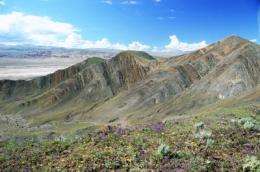
Knauth and Kennedy's study looked at a bigger picture.
"There are three atoms of oxygen for every atom of carbon in limestone," Knauth says. "We looked at the oxygen isotopes as well, which allowed us to see that the peculiar carbon isotope signature previously interpreted in terms of catastrophes was always associated with intrusions of coastal ground waters during the burial transformation of initial limestone muds into rock. It's the same as we see in limestones forming today."
Brave new world
By gathering all of these published measurements and carefully plotting carbon isotopic data against oxygen isotopic data, a process Knauth said took three years, the researchers began to formulate a very different type of scenario for what led to complex life on Earth. Rather than a world subject to periods of life-altering catastrophes, they began to see a world that first greened up with primitive plants.
"The greening of Earth made soils which sequestered carbon and allowed oxygen to rise and get dissolved into sea water," Knauth explained. "Early animals would have loved breathing it as they expanded throughout the ocean of this new world."
A key element to this scenario is not so much what the researchers saw in the data, but what was missing. When they plotted the data for various areas from which it was derived they kept noticing an area on the plots that contained little or no data. They dubbed it the "forbidden zone."
"If previous interpretations of carbon isotope data were correct, there would be no forbidden zone on these cross plots," Knauth said. "The forbidden zone would be full of Neoproterozoic data."
"These zones show that the isotopic fingerprints in limestone we see today started in the late Precambrian and must have involved the simultaneous influx of rain water that fell on vegetated areas, infiltrated into coastal ground waters and mixed with marine pore fluids. During sea level drops, these coastal mixing zones are dragged over vast geographic regions of the flooded continents of the Neoproterozoic," Knauth said. "Vast areas of limestone can form in these mixed pore fluids."
All of which points to an environmental trigger of the Cambrian explosion of life.
"Our work presents a simple, alternative view of the thousands of carbon isotope measurements that had been taken as evidence of geochemical catastrophes in the ocean," Knauth explained. "It requires that there was an explosive greening of Earth's land surfaces with pioneer vegetation several hundred million years prior to the evolution of vascular plants, but it explains how a massive increase in Earth's oxygen could happen, which has been long postulated as necessary for animals to evolve big time."
"The isotopes are screaming that this happened in the Neoproterozoic," he added.
Source: Arizona State University (news : web)


