Transform a ball into a rock -- or make it invisible -- using transformation optics
July 9, 2009 By Miranda Marquit Transform a ball into a rock -- or make it invisible -- using transformation optics

Enlarge

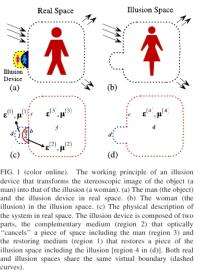
Image from Phys. Rev. Lett. 102, 253902 (2009). (c)2009 APS. Reprinted with permission.

(PhysOrg.com) -- Science fiction and fantasy tales are full of the ability to "cloak" characters with invisibility. Whether it is a spaceship with a cloaking device, or a young wizard with an invisibility cloak, the interest in rendering someone or something invisible captures our fancy. Scientists have succeeded in creating the illusion of invisibility by bending light around a region for concealment. These types of devices have limitations, however; one of these limitation that the device normally has to be touching the object to be rendered invisible - or in very close proximity.

Instead of bending light, though, what if transformation optics was used to create invisibility - or even give an object the appearance of a completely different object? A team of theorists at the Hong Kong University of Science and Technology propose a technique that might be able to accomplish just that, with a remote device. The group’s proposal appears in : “ Optics: The Optical Transformation of an Object into Another Object.”

“Right now, invisibility devices bend light, steering it around an object to make it appear transparent, as if it weren’t there,” Che Ting Chan tells PhysOrg.com. Chan is one of the scientists who proposed the idea of a device that would use illusion optics to transform objects within a confined space. “Our proposed device would have special properties. It would employ a type of illusion that makes an object look exactly like another object.”

, which are manmade with special properties, would be used. A “complementary medium” would be employed to optically cancel a specified area. Then, a “restoring medium” would be used to make the cancelled space “reappear” as something else. For invisibility, the restored area would look like air. “If it looks like air,” Chan explains, “then it is transparent. You can see through it. It is like making something .” This method could also, theoretically, be used to “transform” objects. “You could make a ball look like a rock,” Chan says. “You could hide something in plain sight, as something else.”

In addition to transforming the way an object looks to others, this device would have another advantage over current invisibility devices. “You wouldn’t have to need the device to touch the object being hidden,” Chan insists. “You could remotely control a particular area to entirely exclude a specific wave without having to be as close.”

While the device sounds promising, Chan admits that there are difficulties involved in building such a cloak. “In addition to positive refractive material, which is not a big problem, we would require a negative refractive index.” Positive refractive materials are easily made, but something with a negative refractive index would require special design. “Some sort of structure to create a phase delay would be needed,” Chan says.

Chan and the Hong Kong team are working on interesting experimentalists in the concept. “We are dealing with electromagnetic waves,” Chan explains, “but there are those who are doing similar experiments with acoustic waves. Maybe if our idea was applied to acoustic waves first, it would be easier to see how to extend it to include light.”

More Information: Yun Lai, Jack Ng, HuanYang Chen, DeZhuan Han, JunJun Xiao, Zhao-Qing Zhang, and C.T. Chan, “Illusion Optics: The Optical Transformation of an Object into Another Object,” Physical Review Letters (2009). Available online: http://link.aps.org/doi/10.1103/PhysRevLett.102.253902 .

Copyright 2009 PhysOrg.com.
All rights reserved. This material may not be published, broadcast, rewritten or redistributed in whole or part without the express written permission of PhysOrg.com.


print this article email this article download pdf blog this article bookmark this article     Stumble it Digg this share on Facebook retweet share on Reddit add to delicious
Rate this story - 3.2 /5 (13 votes)

Rank Filter

Move the slider to adjust rank threshold, so that you can hide some of the comments.


Display comments: newest first

  • TheBigYin - Jul 10, 2009
    • Rank: 5 / 5 (5)
    This is another case of some scientists describing a mechanism for doing something with absolutely no idea how they would do it in reality. Yeh man, we'd like, cancel out the light waves, we could like turn a man into a woman. Yeh man, pass the munchies.
  • Nik_2213 - Jul 10, 2009
    • Rank: 2 / 5 (1)
    Sorry, TBY.

    Like they say, it just needs 'meta-materials', which is stuff patterned 'tighter' than the wavelengths involved.

    Per Clarke's Law, 'sufficiently advanced technology is indistinguishable from magic'. Go Google...
  • TheBigYin - Jul 10, 2009
    • Rank: 5 / 5 (3)
    I have a letter from ACC himself when he replied to something I'd written to him in the early 1980s. May even be worth something now.

    My point was that "just needs meta-materials" is a bit like saying "in order to fly you 'just' need to be able to suppress gravity" - the clever bit is not describing what you need to do, it's doing it.

    There are lots of quaotation marks around the words in the article, which leads me to think it's more speculative than any new discovery.
  • bluehigh - Jul 10, 2009
    • Rank: not rated yet
    Oh, I get it! This isn't science, it is "magic" and therefore is justifiable reportage.

    "speculative" is being generous.

    Try - "a load of foolish babble".

  • IlyaStavinsky - Jul 15, 2009
    • Rank: not rated yet
    If to create a full invisibility of the subject by using metamaterials, one can still notice its presence
    when the subject starts to move. Its movement will create different index of refraction for
    observer in relation to the subjects that can be seen through the invisible moving subject.
    For this reasons those subjects will start to blink. I noticed that effect by observing AFOs (Aliens Flying Object) that using the same technique,
    in the night sky at altitude 20 - 40 miles. AFOs are invisible but when they move under the star the latter start to blink and their invisible bodies
    surrounded by weak signal lights creating a circle. That is how I know that the reason for the existence of blinking stars is not only
    different layers of atmosphere but also the presence of the moving AFOs.
    sites.google.com/site/socialcapital1/Home
  • Hatmon - Jul 19, 2009
    • Rank: not rated yet
    I propose a new technology that will enable me to pull money out of my posterior. There is one stumbling block I have to overcome first, it is completely impossible.
  • gwrede - Jul 21, 2009
    • Rank: not rated yet
    This article is not worthy of appearing on PhysOrg. It should (at most) be in a childrens' book, or a gossip weekly.

    Either Chan had something, and the PhysOrg editor missed it, or Chan is just waving his hands in the air.

    Whatever the case, this article is a waste of PhysOrg's readers' time.


July 9, 2009 all stories

Comments: 7

3.2 /5 (13 votes)
  • Stumble this up

  • Digg this

  • share this

  • hide
  • Related Stories

  • New invisibility cloak allows object to 'see' out through the cloak
    created Mar 13, 2009 | popularity not rated yet | comments 0
  • Invisibility undone: Chinese scientists demonstrate how to uncloak an invisible object
    created Sep 03, 2008 | popularity not rated yet | comments 0
  • Visualising invisibility
    created Jul 31, 2006 | popularity not rated yet | comments 0
  • Scientists one more step closer to realising invisible technology
    created May 09, 2007 | popularity not rated yet | comments 0
  • Spanish scientists bring us closer to making the dream of invisibility true
    created Jul 07, 2009 | popularity not rated yet | comments 0


  • hide
  • Relevant PhysicsForums posts

  • avoidance of admitting that we dont know somethin
    created 5 hours ago
  • Speed of light : missing energy
    created 8 hours ago
  • Can light produce darkness and can noise procude quiteness 4
    created 10 hours ago
  • Magnetic Oscillation Equations
    created 17 hours ago
  • More from Physics Forums - General Physics

Other News

Restored machine to explore mysteries of Big Bang (AP)

Restored machine to explore mysteries of Big Bang

Physics / General Physics

created 8 hours ago | popularity 4.4 / 5 (12) | comments 6

(AP) -- Scientists are preparing the world's largest atom smasher to explore the depths of matter after successfully restarting the $10 billion machine following more than a year of repairs.


nuclear power plant

Doubts raised on nuclear industry viability

Physics / General Physics

created Nov 19, 2009 | popularity 3.2 / 5 (19) | comments 18

(PhysOrg.com) -- The investment in nuclear power has been growing around the world over the last few years, being viewed as a means for countries to control their energy security, avoid the price fluctuations ...


Researchers Find Innate Correlations Among Different Power Law Phenomena

Researchers Find Innate Correlations Among Different Power Law Phenomena

Physics / General Physics

created Nov 17, 2009 | popularity 4.3 / 5 (15) | comments 12

(PhysOrg.com) -- Studying the patterns that emerge in natural and social phenomena is a popular area of research, although usually individual phenomena are studied separately from each other. In a recent study, ...


Scientists demonstrate 'universal' programmable quantum processor

Scientists demonstrate 'universal' programmable quantum processor

Physics / Quantum Physics

created Nov 15, 2009 | popularity 4.6 / 5 (21) | comments 11

Physicists at the National Institute of Standards and Technology have demonstrated the first "universal" programmable quantum information processor able to run any program allowed by quantum mechanics -- th ...


Proton's party pals may alter its internal structure

Proton's party pals may alter its internal structure

Physics / General Physics

created Nov 18, 2009 | popularity 4.6 / 5 (18) | comments 9

A recent experiment at the DOE's Thomas Jefferson National Accelerator Facility has found that a proton's nearest neighbors in the nucleus of the atom may modify the proton's internal structure.