Reduced diet thwarts aging, disease in monkeys

July 9, 2009 by Terry Devitt Reduced diet thwarts aging, disease in monkeys

Enlarge

Rhesus monkeys, left to right, Canto, 27, on a restricted diet, and Owen, 29, a control subject on an unrestricted diet, are pictured at the Wisconsin National Primate Research Center. The two are among the oldest surviving subjects in a pioneering long-term study of the links between diet and aging in Rhesus macaque monkeys, which have an average life span of about 27 years in captivity. Photo: Jeff Miller

(PhysOrg.com) -- The bottom-line message from a decades-long study of monkeys on a restricted diet is simple: Consuming fewer calories leads to a longer, healthier life.

Writing today in the journal Science, a team of researchers at the University of Wisconsin-Madison, the Wisconsin National Primate Research Center and the William S. Middleton Memorial Veterans Hospital reports that a nutritious but reduced-calorie diet blunts aging and significantly delays the onset of such age-related disorders as cancer, diabetes, cardiovascular disease and brain atrophy.

"We have been able to show that can slow the aging process in a primate species," says Richard Weindruch, a professor of medicine in the UW-Madison School of Medicine and Public Health who leads the National Institute on Aging-funded study. "We observed that caloric restriction reduced the risk of developing an age-related disease by a factor of three and increased survival."

During the 20-year course of the study, half of the animals permitted to eat freely have survived, while 80 percent of the monkeys given the same diet, but with 30 percent fewer calories, are still alive.

Begun in 1989 with a cohort of 30 monkeys to chart the health effects of the reduced-calorie diet, the study expanded in 1994 with the addition of 46 more rhesus macaques. All of the animals in the study were enrolled as adults at ages ranging from 7 to 14 years. Today, 33 animals remain in the study. Of those, 13 are given free rein at the dinner table, and 20 are on a calorie-restricted diet. Rhesus macaques have an average life span of about 27 years in captivity. The oldest animal currently in the study is 29 years.

The new report details the relationship between diet and aging, according to Weindruch and lead study author Ricki Colman, by focusing on the "bottom-line indicators of aging: the occurrence of age-associated disease and death."

In terms of overall animal health, Weindruch notes, the restricted diet leads to longer lifespan and improved quality of life in old age. "There is a major effect of caloric restriction in increasing survival if you look at deaths due to the diseases of aging," he says.

The incidence of cancerous tumors and cardiovascular disease in animals on a restricted diet was less than half that seen in animals permitted to eat freely. Remarkably, while diabetes or impaired glucose regulation is common in monkeys that can eat all they want, it has yet to be observed in any animal on a restricted diet. "So far, we've seen the complete prevention of diabetes," says Weindruch.

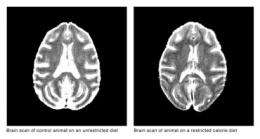
In addition, the brain health of animals on a restricted diet is also better, according to Sterling Johnson, a neuroscientist in the UW-Madison School of Medicine and Public Health. "It seems to preserve the volume of the brain in some regions. It's not a global effect, but the findings are helping us understand if this dietary treatment is having any effect on the loss of neurons" in aging.
Reduced diet thwarts aging, disease in monkeys
Enlarge

The brain scan on the left shows the brain of a Rhesus macaque allowed free rein at the dinner table (control), while the image on the right shows the brain of a monkey that for two decades has been on a nutritious but reduced-calorie diet. The brain of the animal allowed to eat freely has less tissue volume and more fluid (bright areas) than the brain of a monkey on the low-cal diet. The images suggest less brain atrophy or cell loss with aging for animals that consume a diet with 30 percent fewer calories than if they were permitted to eat as much as they like. Photo: courtesy Sterling C. Johnson

In particular, the regions of the brain responsible for motor control and executive functions such as working memory and problem solving seem to be better preserved in animals that consume fewer calories.

"Both motor speed and mental speed slow down with aging," Johnson explains. "Those are the areas which we found to be better preserved. We can't yet make the claim that a difference in diet is associated with functional change because those studies are still ongoing. What we know so far is that there are regional differences in brain mass that appear to be related to diet."

Such an observation, however, is novel, according to Weindruch. "The atrophy or loss of brain mass known to occur with aging is significantly attenuated in several regions of the brain. That's a completely new observation."

Since the first studies of caloric restriction in rodents in the1930s, scientists have been intrigued by evidence that reducing calories can effectively extend lifespan. Such studies have been undertaken in a number of different animal species ranging from spiders to humans

The Wisconsin rhesus macaque study, however, is likely to provide the most detailed insight into the phenomenon and its potential application to human health as it has tracked in greatest detail the diets and life histories of an animal that closely resembles humans. Because people are much longer lived than rhesus monkeys, and no similar comprehensive study with human subjects is under way, conclusive evidence of the effects of the diet on human lifespan and disease may never be known.

Source: University of Wisconsin-Madison (news : web)


print this article email this article download pdf blog this article bookmark this article     Stumble it Digg this share on Facebook retweet share on Reddit add to delicious
Rate this story - 4.6 /5 (9 votes)

Rank Filter

Move the slider to adjust rank threshold, so that you can hide some of the comments.


Display comments: newest first

  • SmartK8 - Jul 09, 2009
    • Rank: 5 / 5 (2)
    I hope, we all agree, that the one on the right is looking much happier.
  • diva4d - Jul 10, 2009
    • Rank: not rated yet
    we do.
  • Birger - Jul 10, 2009
    • Rank: 5 / 5 (1)
    Since the caloric restriction diet is quite drastic compared to the normal human menu, only a few humans will ever be sufficiently motivated to endure this diet thorough their whole lives.
    Therefore, researchers are busy learning the deatails of how caloric restriction affects the body on a molecular level, so the effects can be emulated medically, without constant hunger.
  • magpies - Jul 10, 2009
    • Rank: not rated yet
    starving monkeys for science.
  • Ethelred - Jul 10, 2009
    • Rank: 5 / 5 (1)
    The one on the right looks fat. Happier I cannot say. But maybe the one on the left looks more alert.

    Only humans have the muscles for smiling so that is something we won't see from either.

    Ethelred
  • Ethelred - Jul 10, 2009
    • Rank: 5 / 5 (1)
    Therefore, researchers are busy learning the deatails of how caloric restriction affects the body on a molecular level, so the effects can be emulated medically, without constant hunger.


    Its not that bad. I haven't checked my caloric intake but its WAY down from when I was in my twenties and I simply am hungry for an hour or so before my meals. I eat slower so I have time to feel a bit full.

    Of course I was a runner in my twenties so my food intake was considerable.

    You can get used to less food. The key is to NOT think about dieting all the bloody time. That way lies pigging out. Don't talk about, don't plan it, just do it. Then do things that interest you so your thinking about food from boredom.

    Like arguing here and annoying people.

    Ethelred
  • rubberman - Jul 10, 2009
    • Rank: not rated yet
    The human race has proven this in our own way, "healthy" skinny people live longer than "healthy" (if there is such a thing) fat people
  • Bob_Kob - Jul 13, 2009
    • Rank: not rated yet
    Therefore, researchers are busy learning the deatails of how caloric restriction affects the body on a molecular level, so the effects can be emulated medically, without constant hunger.


    You fat american, compare your diet to those elsewhere on the planet and you will see they live happy with a diet much less than yours.
  • TheBigYin - Jul 13, 2009
    • Rank: not rated yet
    And once again, the one remaining socially acceptable prejudice (fat-ism) finds its way onto a purportedly academic forum. I expect 100 years ago we'd get people here commenting how black people are 'obviously' inferior. Roll on climate change, we don't deserve to live.
  • Asheesh - Jul 13, 2009
    • Rank: not rated yet
    Hmm.. here's my conculsion...

    The monkeys on diet live longer unsatisfiying lives, while the monkeys not on diet live short but satisfying lives ;) Which one would you prefer?
  • Ethelred - Jul 14, 2009
    • Rank: not rated yet
    A longer more satisfying life. Rather than a life with a stomach that pushes back at me every time I sit down.

    Feeling a bit hungry part of the day is not a tragedy.

    Ethelred
  • SmartK8 - Jul 14, 2009
    • Rank: not rated yet
    Asheesh: It's better to burn out (eating) than to fade away (starving), if you ask me. ;-)

    Ethelred: I've dedicated this live to feel satisfied all the time. I'll be starving in the next one.
  • smiffy - Jul 15, 2009
    • Rank: not rated yet
    These animals are lab animals and have probably been kept in cages/small enclosures all their lives. This will result in the full-diet monkeys eating in order to alleviate boredom and other more negative effects of isolation. This type is bound to overeat, probably resulting in all the attendant health problems we know go with obesity. I would guess that the reduced-diet monkey will be eating at a level that is likely to be similar to the eating patterns which it would engage in the wild.

    Eating in the wild generally involves some risk and the animal would therefore wait until it was hungry enough to seek out food, meaning that a period of hunger before a meal was normal and healthy. Having food constantly and easily available is bound to result in a pattern of overeating, if indulged. Always being satisfied means never having an edge or direction to your appetite and, apart from anything else, actually detracts from the pleasure of eating. You're not gaining anything (except posssible long-term poor health) from being constantly sated.


    "All animals are individually housed to allow accurate assessment of daily food intake" - taken from

    http://biomed.ger...63/6/556

July 9, 2009 all stories

Comments: 13

4.6 /5 (9 votes)
  • Stumble this up

  • Digg this

  • share this

  • hide
  • Related Stories


  • hide
  • Relevant PhysicsForums posts

  • Sleep / REM Sleep and homeostasis
    created 10 hours ago
  • The Biceps Reflex
    created Nov 05, 2009
  • Consequenses of striking a Vein and an artery?
    created Nov 05, 2009
  • computing with real neurons
    created Nov 05, 2009
  • Priapism & Viagra
    created Oct 31, 2009
  • Antioxidants bad for your health?
    created Oct 31, 2009
  • More from Physics Forums - Medical Sciences

Other News

Decision day for health care in the House (AP)

Decision day for health care in the House

Medicine & Health / Health

created 6 hours ago | popularity not rated yet | comments 0

(AP) -- President Barack Obama is trying to close the deal in the House on his health care overhaul, facing a make-or-break vote that's certain to be seen as a test of his presidency.


Island village hit by suspected swine flu (AP)

Island village hit by suspected swine flu

Medicine & Health / Diseases

created 7 hours ago | popularity 5 / 5 (1) | comments 1

(AP) -- Suspected swine flu is sweeping a traditional Eskimo whaling village on a remote Alaska island - prompting an urgent medical mission to deliver help.


Higher carotid arterial stenting rates associated with poorer clinical outcomes

Medicine & Health / Other

created 7 hours ago | popularity not rated yet | comments 0

Among eligible Medicare beneficiaries, increased use of carotid arterial stenting (CAS) procedures to treat carotid stenosis--the narrowing of the carotid artery--is associated with higher rates of mortality and adverse clinical ...


Obesity causes 100,000 US cancers every year: study

Medicine & Health / Cancer

created 23 hours ago | popularity 1 / 5 (1) | comments 0

Obesity causes more than 100,000 incidents of cancer in the US every year, the American Institute for Cancer Research said in estimates published Friday.


Chocolate

Chocolate rich in flavanols may protect the skin from UV

Medicine & Health / Health

created Nov 06, 2009 | popularity 5 / 5 (8) | comments 3

(PhysOrg.com) -- A new study has discovered for the first time that dark chocolate rich in flavanols may provide significant protection from the harmful effects of ultraviolet light.