Astrophysicists solve mystery in Milky Way galaxy
July 9, 2009
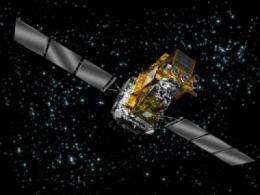
This is the European satellite INTEGRAL. Credit: ESA
A team of astrophysicists has solved a mystery that led some scientists to speculate that the distribution of certain gamma rays in our Milky Way galaxy was evidence of a form of undetectable "dark matter" believed to make up much of the mass of the universe.
In two separate scientific papers, the most recent of which appears in the July 10 issue of the journal Physical Review Letters, the astrophysicists show that this distribution of gamma rays can be explained by the way "antimatter positrons" from the radioactive decay of elements, created by massive star explosions in the galaxy, propagate through the galaxy. Thus, the scientists said, the observed distribution of gamma rays is not evidence for dark matter.
"There is no great mystery," said Richard Lingenfelter, a research scientist at UC San Diego's Center for Astrophysics and Space Sciences who conducted the studies with Richard Rothschild, a research scientist also at UCSD, and James Higdon, a physics professor at the Claremont Colleges. "The observed distribution of gamma rays is in fact quite consistent with the standard picture."
Over the past five years, gamma ray measurements from the European satellite INTEGRAL have perplexed astronomers, leading some to argue that a "great mystery" existed because the distribution of these gamma rays across different parts of the Milky Way galaxy was not as expected.
To explain the source of this mystery, some astronomers had hypothesized the existence of various forms of dark matter, which astronomers suspect exists—from the unusual gravitational effects on visible matter such as stars and galaxies—but have not yet found.
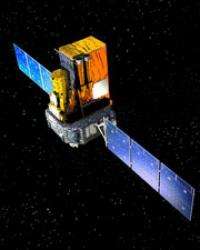
This is the European satellite INTEGRAL. Credit: ESA
What is known for certain is that our galaxy—and others—are filled with tiny subatomic particles known as positrons, the antimatter counterpart of typical, everyday electrons. When an electron and positron encounter each other in space, the two particles annihilate and their energy is released as gamma rays. That is, the electron and positron disappear and two or three gamma rays appear."These positrons are born at nearly the speed of light, and travel thousands of light years before they slow down enough in dense clouds of gas to have a chance of joining with an electron to annihilate in a dance of death," explains Higdon. "Their slowing down occurs from the drag of other particles during their journey through space. Their journey is also impeded by the many fluctuations in the galactic magnetic field that scatter them back and forth as they move along. All of this must be taken into account in calculating the average distance the positrons would travel from their birthplaces in supernova explosions."
"Some positrons head towards the center of the Galaxy, some towards the outer reaches of the Milky Way known as the galactic halo, and some are caught in the spiral arms," said Rothschild. "While calculating this in detail is still far beyond the fastest supercomputers, we were able to use what we know about how electrons travel throughout the solar system and what can be inferred about their travel elsewhere to estimate how their anti-matter counterparts permeate the galaxy."
The scientists calculated that most of the gamma rays should be concentrated in the inner regions of the galaxy, just as was observed by the satellite data, the team reported in a paper published last month in the Astrophysical Journal.
"The observed distribution of gamma rays is consistent with the standard picture where the source of positrons is the radioactive decay of isotopes of nickel, titanium and aluminum produced in supernova explosions of stars more massive than the Sun," said Rothschild.
In their companion paper in this week's issue of Physical Review Letters, the scientists point out that a basic assumption of one of the more exotic explanations for the purported mystery—dark matter decays or annihilations—is flawed, because it assumes that the positrons annihilate very close to the exploding stars from which they originated.
"We clearly demonstrated this was not the case, and that the distribution of the gamma rays observed by the gamma ray satellite was not a detection or indication of a 'dark matter signal'," said Lingenfelter.
-
Integral discovers the galaxy’s antimatter cloud is lopsided
Jan 09, 2008 |
not rated yet |
0
-
Clemson astronomers to study mysterious antimatter in the Milky Way
Feb 16, 2009 |
not rated yet |
0
-
Proposed Particle Help Explains Odd Galactic Photons
Jul 25, 2008 |
not rated yet |
0
-
Is Dark Matter a Source of High Energy Gamma Rays?
Dec 08, 2006 |
not rated yet |
0
-
High Energy Mystery lurks at the Galactic Centre
Sep 22, 2004 |
not rated yet |
0
-
Engineers build first sub-10-nm carbon nanotube transistor
Feb 01, 2012 |
4.9 / 5 (31) |
30
-
Something old, something new: Evolution and the structural divergence of duplicate genes
Jan 31, 2012 |
4.6 / 5 (7) |
1
-
The hidden nanoworld of ice crystals: Revealing the dynamic behavior of quasi-liquid layers
Jan 30, 2012 |
5 / 5 (3) |
1
-
Stock market network reveals investor clustering
Jan 27, 2012 |
3.9 / 5 (23) |
8
-
Of microchemistry and molecules: Electronic microfluidic device synthesizes biocompatible probes
Jan 26, 2012 |
5 / 5 (1) |
0
-
Scale of the Universe
11 hours ago
-
Titan's lack of impact craters
Feb 09, 2012
-
Real pictures of black hole eating a star?
Feb 08, 2012
-
Hypothetical way to travel faster than light, but not technically exceed lightspeed
Feb 06, 2012
-
How do scientists monitor the Sun's activity?
Feb 05, 2012
-
Search patterns in observational studies
Feb 05, 2012
- More from Physics Forums - General Astronomy
More news stories
Humans may have helped the decline of African rainforests 3000 years ago
(PhysOrg.com) -- Large areas of rainforests in Central Africa mysteriously disappeared over three thousand years ago, to be replaced by savannas. The prevailing theory has been that the cause was a change ...
Could Venus be shifting gear?
(PhysOrg.com) -- ESAs Venus Express spacecraft has discovered that our cloud-covered neighbour spins a little slower than previously measured. Peering through the dense atmosphere in the infrared, the ...
Space & Earth / Space Exploration
18 hours ago |
5 / 5 (7) |
8
|
NASA budget will axe Mars deal with Europe: scientists
US President Barack Obama's budget proposal to be submitted next week for 2013 will cut NASA's budget by 20 percent and eliminate a major partnership with Europe on Mars exploration, scientists said Thursday.
Space & Earth / Space Exploration
21 hours ago |
5 / 5 (2) |
18
Two new moons for Jupiter
Advances in technology have lead to the discovery of new planets outside of our Solar System, and now even new moons in our own backyard.
Space & Earth / Space Exploration
18 hours ago |
4 / 5 (1) |
7
Mars Science Laboratory computer issue resolved
(PhysOrg.com) -- Engineers have found the root cause of a computer reset that occurred two months ago on NASA's Mars Science Laboratory and have determined how to correct it.
Space & Earth / Space Exploration
19 hours ago |
4.7 / 5 (6) |
3
|
Anonymous knocks CIA website offline (Update)
The website of the Central Intelligence Agency was inaccessible on Friday after the hacker group Anonymous claimed to have knocked it offline.
New error-correcting codes guarantee the fastest possible rate of data transmission
Error-correcting codes are one of the triumphs of the digital age. Theyre a way of encoding information so that it can be transmitted across a communication channel such as an optical fiber o ...
Google users warned of threat to smartphone wallets
Users of Google smartphone wallets were being warned on Friday that there is a way to crack pass codes intended to thwart thieves from going on illicit shopping sprees.
New power source discovered
(PhysOrg.com) -- Researchers at the Massachusetts Institute of Technology (MIT) and RMIT University have made a breakthrough in energy storage and power generation.
Small modular reactor design could be a 'SUPERSTAR'
(PhysOrg.com) -- Though most of today's nuclear reactors are cooled by water, we've long known that there are alternatives; in fact, the world's first nuclear-powered electricity in 1951 came from a reactor ...
The power of estrogen -- male snakes attract other males
A new study has shown that boosting the estrogen levels of male garter snakes causes them to secrete the same pheromones that females use to attract suitors, and turned the males into just about the sexiest ...

Jul 09, 2009
Rank: 1.4 / 5 (9)
Long time passing
Where have all the energy gone?
Long time ago
The answer my friends
is flowing in the web
See http://cosmicdarkmatter.com/
When will they ever learn?
When will they everrrrr learn?
Jul 10, 2009
Rank: 2.5 / 5 (6)
Jul 11, 2009
Rank: 1 / 5 (5)
I agree, and I applaud the authors - Richard Lingenfelter, Richard Rothschild and James Higdon - and their academic institutions - University of California at San Diego and Claremont Colleges.
It is refreshing to see that the "great mystery" created by mystical models of the cosmos has been solved by ordinary material doing ordinary things.
With kind regards,
Oliver K. Manuel
http://www.omatumr.com
Jul 13, 2009
Rank: 5 / 5 (3)
Jul 18, 2009
Rank: 1 / 5 (2)
"This finding certainly does not rule out the existence of DM, just that no local annihilation signal exists."
Yyz is exactly right,
Oliver K. Manuel
Jul 30, 2009
Rank: 1 / 5 (5)
A recent news story on mass loss from the super-giant star Betelgeuse also involves a mystery energy source:
http://www.physor...732.html
Is it too much to ask astronomers and astrophysicists to study the rest masses of all 3,000 known nuclei and find for themselves that repulsive interactions between neutrons is the energy source that powers the stars and the cosmos:
http://tinyurl.com/2otxps
That would clear the field of these daily reports of cosmic observations driven by yet another mysterious source of energy.
With kind regards,
Oliver K. Manuel
http://www.omatumr.com
Aug 05, 2009
Rank: not rated yet
http://www.amazon...12580354