Newborn brain cells show the way
July 9, 2009 Newborn brain cells show the way

Enlarge

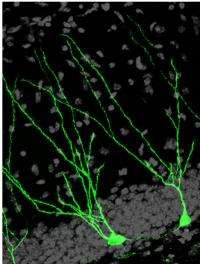
Human brains sprout new neurons -- shown in green -- throughout life, particularly in the hippocampus, the brain's learning and memory center. Credit: Courtesy of Dr. Sebastian Jessberger, Swiss Federal Institute of Technology Zurich

Although the fact that we generate new brain cells throughout life is no longer disputed, their purpose has been the topic of much debate. Now, an international collaboration of researchers made a big leap forward in understanding what all these newborn neurons might actually do. Their study, published in the July 10, 2009, issue of the journal Science, illustrates how these young cells improve our ability to navigate our environment.

"We believe that new brain cells help us to distinguish between memories that are closely related in space," says senior author Fred H. Gage, Ph.D., a professor in the Laboratory for Genetics at the Salk Institute and the Vi and John Adler Chair for Research on Age-Related Neurodegenerative Diseases, who co-directed the study with Timothy J. Bussey, Ph.D., a senior lecturer in the Department of Experimental Psychology at the University of Cambridge, UK, and Roger A. Barker, PhD., honorary consultant in Neurology at Addenbrookes Hospital and Lecturer at the University of Cambridge.

When the first clues emerged that adult human brains continually sprout new neurons, one of the central tenets of neuroscience—we are born with all the we'll ever have—was about to be overturned. Although it is never easy to shift a paradigm, a decade later the question is no longer whether neurogenesis exists but rather what all these new cells are actually good for.

"Adding new neurons could be a very problematic process if they don't integrate properly into the existing neural circuitry," says Gage. "There must be a clear benefit to outweigh the potential risk."
Newborn brain cells show the way
Enlarge

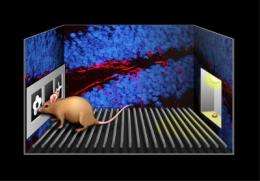
This image depicts a Paired Associates Learning (PAL) task, in which mice have to choose a specific object in its correct location on a touch screen to obtain a reward. Adult mice deficient in adult neurogenesis showed a specific impairment in pattern separation, identifying a dentate gyrus-specific function for newborn neurons in the adult brain. Adult born neurons are shown in red the background. Credit: Courtesy of Jamie Simon, Salk Institute for Biological Studies

The most active area of neurogenesis lies within the hippocampus, a small seahorse-shaped area located deep within the brain. It processes and distributes memory to appropriate storage sections in the brain after readying the information for efficient recall. "Every day, we have countless experiences that involve time, emotion, intent, olfaction and many other dimensions," says Gage. "All the information comes from the cortex and is channeled through the hippocampus. There, they are packaged together before they are passed back out to the cortex where they are stored."

Previous studies by a number of laboratories including Gage's had shown that new neurons somehow contribute to hippocampus-dependent learning and memory but the exact function remained unclear.

The dentate gyrus is the first relay station in the hippocampus for information coming from the cortex. While passing through, incoming signals are split up and distributed among 10 times as many cells. This process, called pattern separation, is thought to help the brain separate individual events that are part of incoming memories. "Since the dentate gyrus also happens to be the place where neurogenesis is occurring, we originally thought that adding new neurons could help with the pattern separation," says Gage.

This hypothesis allowed graduate student Claire Clelland, who divided her time between the La Jolla and the Cambridge labs, to design experiments that would specifically challenge this function of the dentate gyrus using different behavioral tasks and two distinct strategies to selectively shut down neurogenesis in the dentate gyrus.

In the first set of experiments, mice had to learn the location of a food reward that was presented relative to the location of an earlier reward within an eight-armed radial maze. "Mice without neurogenesis had no trouble finding the new location as long as it was far enough from the original location," says Clelland, "but couldn't differentiate between the two when they were close to each other."

A touch screen experiment confirmed the inability of neurogenesis-deficient mice to discriminate between locations in close proximity to each other but also revealed that these mice had no problem recalling spatial information in general. "Neurogenesis helps us to make finer distinctions and appears to play a very specific role in forming spatial memories," says Clelland. Adds Gage, "There is value in knowing something about the relationship between separate events and the closer they get the more important this information becomes."

But pattern separation might not be the only role that new neurons have in adult brain function: a computer model simulating the neuronal circuits in the dentate gyrus based on all available biological information suggested an additional function. "To our surprise, it turned out that newborn neurons actually form a link between individual elements of episodes occurring closely in time," says Gage.

Given this, he and his team are now planning experiments to see whether new neurons are also critical for coding temporal or contextual relationships.

Source: Salk Institute (news : web)


print this article email this article download pdf blog this article bookmark this article     Stumble it Digg this share on Facebook retweet share on Reddit add to delicious
Rate this story - 4.6 /5 (5 votes)

Rank Filter

Move the slider to adjust rank threshold, so that you can hide some of the comments.


Display comments: newest first

  • HenisDov - Jul 21, 2009
    • Rank: not rated yet
    On The Origin And Tasks Of Brain Cells
    "what all these new cells are good for"


    A. From "Newborn brain cells"
    http://www.eureka...0609.php

    "big leap forward in understanding what all these newborn neurons might actually do. Their study, published in the July 10, 2009, issue of the journal Science, illustrates how these young cells improve our ability to navigate our environment. We believe that new brain cells help us to distinguish between memories that are closely related in space,"

    "question is no longer whether neurogenesis exists but rather what all these new cells are actually good for"


    B. From "Life And Darwinism, Tomorrow's Comprehension"
    http://www.the-sc...112.page

    From my postings way back in 2005, which cites genetic evidence/demonstration of the workings of human cultural evolution:

    - From Science, 2 Sept 2005: "Page's team compared human and chimp Ys to see whether either lineage has lost functional genes since they split.

    The researchers found that the chimp had indeed suffered the slings and arrows of evolutionary fortune. Of the 16 functional genes in this part of the human Y, chimps had lost the function of five due to mutations. In contrast, humans had all 11 functional genes also seen on the chimp Y. "The human Y chromosome hasn't lost a gene in 6 million years," says Page. "It seems like the demise of the hypothesis of the demise of the Y," says geneticist Andrew Clark of Cornell University in Ithaca, New York.

    Chimp's genome has been continuing survival by physiologically adapting to changing environments.

    - But look at this: From Science, Vol 309, 16 Sept 2005, Evolving Sequence and Expression:"An analysis of the evolution of both gene sequences and expression patterns in humans and chimpanzees...shows that...surprisingly, genes expressed in the brain have changed more on the human lineage than on the chimpanzee lineage, not only in terms of gene expression but also in terms of amino acid sequences".

    Surprisingly...???

    Human's genome continued survival mainly by modifying-controling its environment.


    C. From "More On The Lifehood Of Genes"
    http://www.the-sc...122.page

    "Genes to Genomes to Monocellular Organisms to Multicellular Organisms"
    http://www.articl...144.html

    Now we can appreciate the fractal nature of life's evolution. It is ever-continuous ever-enhanced ever-complexed cooperation. Now we can understand why, and grosso modo how, the organs and processes and signals found in multicelled organisms have their historical origins in the life-cultures of monocells communities. And this includes modifying shape of monocells community in response to changed circumstances, functions of serotonin and melatonin and, yes, the evolution of neural cells and the neural systems with their intricate outer-membrane shapes and functions and their high energy consumption requirements.

    And this includes also production of fresh genostem cells in monocells communities, in response to arising community needs. And this includes also a variety of means and mechanisms within cells community involved from sensing a need of fresh genostemcells through producing them and directing them to target locations where they are needed and committing them to the specific tasks in response to the new need.


    D. Life is REALY simpler than they tell us in endless variations in AcademEnglish...


    Dov Henis
    (Comments From The 22nd Century)
    Updated Life's Manifest May 2009
    http://www.physfo...ic=14988&st=480&#entry412704
    http://www.the-sc...age#2321

July 9, 2009 all stories

Comments: 1

4.6 /5 (5 votes)
  • Stumble this up

  • Digg this

  • share this

  • hide
  • Related Stories

  • Newborn brain cells 'time-stamp' memories
    created Jan 28, 2009 | popularity not rated yet | comments 0
  • Newborn brain cells modulate learning and memory
    created Jan 30, 2008 | popularity not rated yet | comments 0
  • Life and Death in the Hippocampus: What Young Neurons Need to Survive
    created Aug 14, 2006 | popularity not rated yet | comments 0
  • Reprogramming Adult Stem Cells in the Brain
    created Jun 30, 2008 | popularity not rated yet | comments 0
  • New research shows why too much memory may be a bad thing
    created Mar 29, 2007 | popularity not rated yet | comments 0


  • hide
  • Relevant PhysicsForums posts

  • Obsessive Compulsive Disorder
    created Nov 20, 2009
  • West's zone 2 starling resistor respiratory physiology
    created Nov 18, 2009
  • 50-0-50 rule
    created Nov 18, 2009
  • What is the evidence in support of the anti-vaccine movement?
    created Nov 17, 2009
  • Chemical Burns
    created Nov 16, 2009
  • How to prevent another stroke?
    created Nov 11, 2009
  • More from Physics Forums - Medical Sciences

Other News

Swine flu vaccine effective despite mutations: experts

Medicine & Health / Diseases

created 3 hours ago | popularity 1 / 5 (1) | comments 0

Swine flu vaccines are still effective despite reported cases of mutations in the A(H1N1) virus, health experts in Europe and North America said Saturday.


GOP: Health test recommendations could affect care (AP)

GOP: Health test recommendations could affect care

Medicine & Health / Health

created 13 hours ago | popularity not rated yet | comments 0

(AP) -- Republicans are seizing on this week's recommendations for fewer Pap smears and mammograms to fuel concern about government-rationed medical care - and to try to chip away support by women for President ...


Study raises concerns about outdoor second-hand smoke

Medicine & Health / Health

created Nov 18, 2009 | popularity 2 / 5 (4) | comments 21

Indoor smoking bans have forced smokers at bars and restaurants onto outdoor patios, but a new University of Georgia study in collaboration with the Centers for Disease Control and Prevention suggests that these outdoor smoking ...


smoking, cigarette

Vaccine being developed to help smokers quit

Medicine & Health / Medications

created Nov 20, 2009 | popularity 4.1 / 5 (7) | comments 7

(PhysOrg.com) -- Glaxo-SmithKline has joined forces with Nabi Pharmaceuticals to produce a vaccine to help smokers give up their addiction permanently.


Pilot study relates phthalate exposure to less-masculine play by boys

Medicine & Health / Research

created Nov 16, 2009 | popularity 4.8 / 5 (8) | comments 9

A study of 145 preschool children reports, for the first time, that when the concentrations of two common phthalates in mothers' prenatal urine are elevated their sons are less likely to play with male-typical toys and games, ...