Methane-eating microbes can use iron and manganese oxides to 'breathe'
Iron and manganese compounds, in addition to sulfate, may play an important role in converting methane to carbon dioxide and eventually carbonates in the Earth's oceans, according to a team of researchers looking at anaerobic sediments. These same compounds may have been key to methane reduction in the early, oxygenless days of the planet's atmosphere.
"We used to believe that microbes only consumed methane in marine anaerobic sediment if sulfate was present," said Emily Beal, graduate student in geoscience, Penn State. "But other electron acceptors, such as iron and manganese, are more energetically favorable than sulfate."
Microbes or groups of microbes -- consortia -- that use sulfates to convert methane for energy exist in marine sediments. Recently other researchers have identified microbes that use forms of nitrogen in fresh water environments to convert methane.
"People had speculated that iron and manganese could be used, but no one had shown that it occurred by incubating live organisms," said Beal.
Beal, working with Christopher H. House, associate professor of geoscience, Penn State, and Victoria J. Orphan, assistant professor of geobiology, California Institute of Technology, incubated a variety of marine sediments to determine if there were microbes that could convert methane to carbon dioxide without using any sulfur compounds. They report their results in today's (July 10) issue of Science.
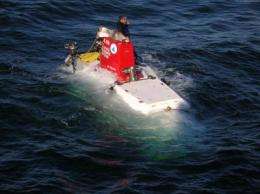
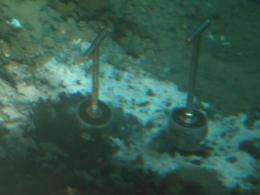
Using samples of marine sediment taken 20 miles off the California coast and about 1,800 feet deep near methane seeps in the Pacific, Beal incubated a variety of sediment systems including as controls, an autoclaved sterile sample, a sample with sulfate as a control and a sample that was sulfate, iron oxide and manganese oxide free, but live. She also incubated samples that were sulfate free but contained iron oxide or manganese oxide. She placed methane gas that contained the non-radioactive carbon-13 isotope in the empty space in the flasks above the sediment and tested any resulting carbon dioxide produced by the samples. All the carbon dioxide had the carbon-13 isotope and so came from the methane samples.
The sterile control showed no activity, while the live control without sulfate showed minute activity. The sulfate control showed the most activity as expected, but both the iron and manganese oxide-laced samples showed activity, although less activity than the sulfate.
"We do not think that iron and manganese are more important than sulfate reduction today, but they are not trivial components," said House, who is director of Penn State's Astrobiology Research Center. "They are probably a big part of the carbon cycle today."
One reason they are important is that some of the carbon dioxide produced reacts with both the manganese and iron to form carbonates that precipitate and sequester carbon in the oceans. Even if the carbon dioxide escaped into the atmosphere, it is a less problematic greenhouse gas than methane.
On the early Earth, where oxygen was absent from the atmosphere, sulfates were scarce. Without sulfates, iron and manganese oxides may have been essential in converting methane to carbon dioxide.
"Sulfate comes mostly from oxidative weathering of rocks," said Beal. "Oxygen is needed for this to occur."
While manganese and iron oxides are made in today's oxygen atmosphere, they where also formed by photochemical reactions in a low oxygen atmosphere. These oxides were probably more abundant in the early Earth's oceans than sulfates.
While Beal has categorized the more than a dozen microorganisms living in the sediments she used, she does not know which of these microbes is responsible for consuming methane. It might be one bacteria or archaea species, or it may be a consortium of microbes. She is trying to identify the organisms responsible.
Source: Pennsylvania State University (news : web)


