Research may hold key to maintaining embryonic stem cells in lab
In a new study that could transform embryonic stem cell (ES cell) research, scientists at UT Southwestern Medical Center have discovered why mouse ES cells can be easily grown in a laboratory while other mammalian ES cells are difficult, if not impossible, to maintain.
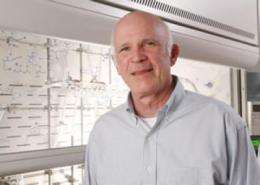
If the findings in mice can be applied to other animals, scientists could have an entirely new palette of research tools to work with, said Dr. Steven McKnight, chairman of biochemistry at UT Southwestern and senior author of the study appearing in the July 9 issue of Science Express.
"This might change the way medical research is done. But it's still a big 'if,'" he said.
According to the research, the activation of a gene called TDH in mouse ES cells results in the cells entering a unique metabolic state that is similar to that of rapidly growing bacterial cells. The gene controls the production of the threonine dehydrogenase (TDH) enzyme in mouse ES cells. This enzyme breaks down an amino acid called threonine into two products. One of the two products goes on to control a cellular process called one carbon metabolism; the other provides ES cells with an essential metabolic fuel.
Both of the threonine breakdown products are necessary to keep the ES cells growing and dividing rapidly in a petri dish without differentiating into specific tissues.
The various substances currently used by scientists to keep mouse ES cells alive in the laboratory were found by trying many different combinations until something worked, Dr. McKnight said. But until now, it wasn't known that these culture conditions keyed into keeping the TDH gene actively expressed.
"Scientists added this and that until they got the right 'soup,' one that works in the mouse ES cells to somehow activate the TDH gene," he said, adding that exactly how that gene is regulated is still unknown.
Other mammalian species have a functional version of the TDH gene, suggesting the possibility that the process could also be activated in them.
"You would think that the 'mouse soup' would then work for all species, but it doesn't. Researchers have been trying for 20 years to get the right formula for maintaining ES cells from other species. With few exceptions, however, they still haven't gotten it right," Dr. McKnight said.
The research was funded by a National Institutes of Health Director's Pioneer Award, which Dr. McKnight received in 2004. The program encourages investigators to take on creative, unexplored avenues of research that carry a relatively high potential for failure but that also possess a greater chance for truly groundbreaking discoveries.
"By applying a highly innovative technique to manipulate the TDH gene, McKnight's work could be an important breakthrough with a profound impact on future research," said Dr. Raynard S. Kington, acting director of the NIH. "This research, which was partially funded by our Pioneer Award program, shows the value of supporting exceptionally creative approaches to major challenges in biomedical and behavioral research."
Embryonic stem cells are "blank slate" cells - derived from embryos - that go on to develop into any of the more than 200 types of cells in the adult body.
Because mouse ES cells are easily maintained in the lab, they can be manipulated genetically to produce adult mice in which various genes are either modified or eliminated. So-called "knockout mice" allow scientists to study the genetic aspects of many diseases and conditions, including cancer, Alzheimer's, Parkinson's and paralysis.
In the living mouse, and in other species, ES cells exist for only a short time. In that time, they need to grow rapidly in order to accumulate enough cells to begin the process of differentiating into all the body's cell types. Dr. McKnight hypothesizes that the TDH gene tightly controls this process in the animal, allowing the ES cells to grow, but then it shuts off when it's time to differentiate.
"If we can tweak conditions and determine how to keep the gene turned on in other animals, we might be able to grow and maintain ES cells for study in many species. It's still speculative at this point whether it will work, but if it does, then this may prove to represent a transformational discovery," Dr. McKnight said.
Interestingly, although humans carry a form of the TDH gene, it contains three inactivating mutations. As such, human ES cells do not produce the TDH enzyme.
"In the human embryo, something else is taking the place of this TDH-mediated form of rapid cell growth," Dr. McKnight said. "Human ES cells may exist in a unique metabolic state, but it would not appear to involve threonine breakdown."
Human ES cells grow slowly and are difficult to maintain in the laboratory, which is a huge impediment to this field of study, Dr. McKnight said.
"If scientists could repair the mutated human TDH gene and replace it into human ES cells, could they make those cells grow faster in culture? I don't know whether this will work or not - it's highly speculative. But if so, it would be profound," he said.
Source: UT Southwestern Medical Center (news : web)


