Tremors on southern San Andreas Fault may mean increased quake risk
(PhysOrg.com) -- Increases in mysterious underground tremors observed in several active earthquake fault zones around the world could signal a build-up of stress at locked segments of the faults and presumably an increased likelihood of a major quake, according to a new University of California, Berkeley, study.
Seismologist Robert M. Nadeau and graduate student Aurélie Guilhem of UC Berkeley draw these conclusions from a study of tremors along a heavily instrumented segment of the San Andreas Fault near Parkfield, Calif. The research is reported in the July 10 issue of Science.
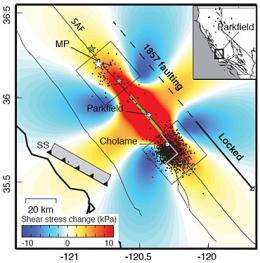
They found that after the 6.5-magnitude San Simeon quake in 2003 and the 6.0-magnitude Parkfield quake in 2004, underground stress increased at the end of a locked segment of the San Andreas Fault near Cholame, Calif., at the same time as tremors became more frequent. The tremors have continued to this day at a rate significantly higher than the rate before the two quakes.
The researchers conclude that the increased rate of tremors may indicate that stress is accumulating more rapidly than in the past along this segment of the San Andreas Fault, which is at risk of breaking like it did in 1857 to produce the great 7.8 magnitude Fort Tejon earthquake. Strong quakes have also occurred just to the northwest along the Parkfield segment of the San Andreas about every 20 to 30 years.
"We've shown that earthquakes can stimulate tremors next to a locked zone, but we don't yet have evidence that this tells us anything about future quakes," Nadeau said. "But if earthquakes trigger tremors, the pressure that stimulates tremors may also stimulate earthquakes."
While earthquakes are brief events originating, typically, no deeper than 15 kilometers (10 miles) underground in California, tremors are an ongoing, low-level rumbling from perhaps 15 to 30 kilometers (10-20 miles) below the surface. They are common near volcanoes as a result of underground fluid movement, but were a surprise when discovered in 2002 at a subduction zone in Japan, a region where a piece of ocean floor is sliding under a continent.
Tremors were subsequently detected at the Cascadia subduction zone in Washington, Oregon and British Columbia, where several Pacific Ocean plates dive under the North American continental plate. In 2005, Nadeau identified mysterious "noise" detected by the Parkfield borehole seismometers as tremor activity, and has focused on them ever since. Unlike the Japanese and Cascadia tremor sites, however, the Parkfield area is a strike/slip fault, where the Pacific plate is moving horizontally against the North American plate.
"The Parkfield tremors are smaller versions of the Cascadia and Japanese tremors," Nadeau said. "Most last between three and 21 minutes, while some Cascadia tremors go on for days."
Because in nearly all known instances the tremors originate from the edge of a locked zone - a segment of a fault that hasn't moved in years and is at high risk of a major earthquake - seismologists have thought that increases in their activity may forewarn of stress build-up just before an earthquake.
The new report strengthens that association, Nadeau said.
For the new study, Nadeau and Guilhem pinpointed the location of nearly 2,200 tremors recorded between 2001 and 2009 by borehole seismometers implanted along the San Andreas Fault as part of UC Berkeley's High-Resolution Seismic Network. During this period, two nearby earthquakes occurred: one in San Simeon, 60 kilometers from Parkfield, on Dec. 22, 2003, and one in Parkfield on the San Andreas Fault on Sept. 28, 2004.
Before the San Simeon quake, tremor activity was low beneath the Parkfield and Cholame segments of the San Andreas Fault, but it doubled in frequency afterward and was six times more frequent after the Parkfield quake. Most of the activity occurred along a 25-kilometer (16-mile) segment of the San Andreas Fault south of Parkfield, around the town of Cholame. Fewer than 10 percent of the tremors occurred at an equal distance above Parkfield, near Monarch Peak. While Cholame is at the northern end of a long-locked and hazardous segment of the San Andreas Fault, Monarch Peak is not. However, Nadeau noted, Monarch Peak is an area of relative complexity on the San Andreas Fault and also ruptured in 1857 in the Fort Tejon 7.8 earthquake.
The tremor activity remains about twice as high today as before the San Simeon quake, while periodic peaks of activity have emerged that started to repeat about every 50 days and are now repeating about every 100-110 days.
"What's surprising is that the activity has not gone down to its old level," Nadeau said. The continued activity is worrisome because of the history of major quakes along this segment of the fault, and the long-ago Fort Tejon quake, which ruptured southward from Monarch Peak along 350 kilometers (220 miles) of the San Andreas Fault.
A flurry of pre-tremors was detected a few days before the Parkfield quake, which makes Nadeau hopeful of seeing similar tremors preceding future quakes.
He noted that the source of tremors is still somewhat of a mystery. Some scientists think fluids moving underground generate the tremors, just as movement of underground magma, water and gas causes volcanic tremors. Nadeau leans more toward an alternative theory, that non-volcanic tremors are generated in a deep region of hot soft rock, somewhat like Silly Putty, that, except for a few hard rocks embedded like peanut brittle, normally flows without generating earthquakes. The fracturing of the brittle inclusions, however, may be generating swarms of many small quakes that combine into a faint rumble.
"If tremors are composed of a lot of little earthquakes, each should have a primary and secondary wave just like large quakes," but they would overlap and produce a rumble, said Guilhem.
The stimulation of tremors by shear (tearing) stress rather than by compressional (opening and closing) stress is more consistent with deformation in the fault zone than with underground fluid movement, Nadeau said. The researchers' mapping of the underground tremors also shows that the tremors are not restricted to the plane of the fault, suggesting that faults spread out as they dive into the deeper crust.
Whatever their cause, tremors "are not relieving a lot of stress or making the fault less hazardous, they just indicate a changes in stress next to locked faults," said Nadeau.
Seismologists around the world are searching for tremors along other fault systems, Guilhem noted, although tremors can be hard to detect because of noise from oceans as well as from civilization. Brief tremor activity has been observed on a few faults, triggered by huge quakes far away, and these may be areas to focus on. Tremors were triggered on Northern California's Calaveras Fault by Alaska's Denali quake of 2002, Nadeau said.
Source: University of California - Berkeley (news : web)


