Synthetic Tree Captures Carbon 1,000 Faster Than Real Trees
July 9, 2009 by Lisa Zyga
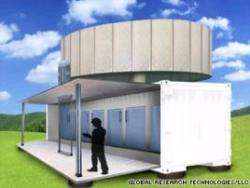
A synthetic tree could collect carbon coming from small, distributed sources, which is usually very difficult to collect. Credit: Global Research Technologies.
(PhysOrg.com) -- Scientists have designed a synthetic tree that traps carbon dioxide from the air in an attempt to combat growing emissions. The device looks less like a tree and more like a small building, but it can collect carbon about 1,000 times faster than a real tree. One synthetic tree could absorb one ton of carbon dioxide per day, an amount equivalent to that produced by about 20 cars, on average. After being trapped in a chamber, the carbon would be compressed and stored in liquid form for sequestration.
Professor Klaus Lackner of Columbia University has been working on the concept since 1998, and recently met with U.S. Energy Secretary Steven Chu to discuss moving forward with the project. Through his company Global Research Technologies, based in Tucson, Lackner has built an early model and hopes to have a fully working prototype within three years.
As Lackner explains, the technology is similar to that used at coal plants to capture carbon from flue stacks, but can be used anywhere. Lackner notes that half of carbon emissions come from small sources, including cars and airplanes, and is usually nearly impossible to collect. But since the carbon dioxide in the air is actually very concentrated, the device required to collect it can be fairly small.
Lackner's goal is to make the synthetic tree highly efficient for its size. Compared to the amount of carbon dioxide that a large windmill can avoid generating, for example, a synthetic tree of equal size could collect several hundred times the amount of carbon dioxide that the windmill avoids.
Each synthetic tree would cost about $30,000 to build, with most of the cost due to the technology used to release the carbon dioxide from the sorbent. In addition, since the device requires energy to operate, it also generates some carbon itself if plugged into the power grid. Lackner calculated that, for every 1000 kg of carbon dioxide the synthetic tree collects, it emits 200 kg, so that 800 kg are considered true collection.
via: CNet News
© 2009 PhysOrg.com


I'd like to know more about this. Is it safe? Is it clean? How much more energy is expended to make this useful?
How about instead of cleaning the carbon out of the air created by burning petroleum, we work to stop burning it?
I can see this as a bandaid until the we take care of the source of the problem.
Most of those will by nature be either in urban areas or right next to major transit routes. Even in the case of many transport routes, short of ploughing under half a farm field that is being used to feed our population, where do you suggest planting these 1000 trees?
HTF do you call .036% of the atmosphere, "very concentrated"?
Therefore the Norvegian extraction plant separates the gases and pumps the carbon dioxide back into a depleted field. Since the oil and gas have remained underground for millions of years it is quite safe to pump carbon dioxide back. The supercritical carbon dioxide will then slowly react with minerals, and become a solid mineral reaction product.
There are many potential variations on this sequestration idea, including injecting the gas underneath sea-floor basalt layers.
Why bury it when we can use CO2. Plant some sugar canes and make some sugar! (sweet idea no? :P)
eat the sugar or burn the sugar and make some graphite yea! pencils!
so 6000000 / .8 = 7,500,000 synthetic trees
@ 30,000 a tree thats $225,000,000,000 USD
ahhh ... maybe we could get a bigger tree for our money :-)
I still believe that the main point in this concept is to help to free polluted urban areas from dangerously high levels of CO2 where reasonable tree planting may be impossible.
Consider this:
The govenement gives a credit of about 1000 dollars for a Hybrid car.
The trees cost 30 000 dollars and replace 20 car's emisions.
So, It is 1500 dollars per car that would cost to convert them totally CO2 no emision.
add 500 dollars to the price of the car. and you would got a totally free emission car?
The price sounds much more lower said as this.
The price could be proportionated to the CO2 emmisions of the car, for exemple a big hummer would have 2000 to pay to avoid any emisions and a little golf would be 1000.
Theses are Just exemples.
Other thing:
Please listen the movie: planet earth
You will see that we do not have much time left before we need to reduce the emissions.
Since theses threes will not only reduce the actual emissions, it will cancel the emissons of the past if we reduce our ecological foot print at the same time.
This is a very important advancement and need to be considered, and reaserched even more
Here is a link for it:
http://www.youtub...ENMKaeCU
treat the disease (non-sustainable development) not the symptom
if you sever an artery you don't soak up the blood and throw away the rag and consider the problem solved, you stop the bleeding and sew up the cut
this type of thought and practice just enables us to stay addicted to fossil fuels, which is the true danger
wake the fuck up
"for every 1000 kg of carbon dioxide the synthetic tree collects, it emits 200 kg, so that 800 kg are considered true collection"
prove this "efficiency", and let's not forget the energy costs of manufacturing them and yearly maintenance energy costs
what a white-washed crock of shit
In reality, about half of man-made CO2 is taken out by nature, so the actual number is around 4 G-tons, or 13.75 million fake trees. At $30,000 a piece, it would cost about $413 billion to "plant" them; then it would cost additional $137 billion in electricity a year to run them. (As for the anticipated saving through mass production, forget about it: about 2/3 of the cost will be in real estate and building construction, not in the equipment--in fact, $30,000 figure looks suspiciously low).
By the time the cost of maintenance and personnel are included, we are probably looking at $150 to $165 billion a year to run the scheme. This assumes that the federal government owns the whole forest of those "fake" trees. If they are owned by for-profit entities, we are going to see a number in the neighborhood of $200 billion a year or more.
Expensive? Well, perhaps, but it would be nowhere near what it would be under the monstrosity called Waxman-Markey "climate" bill. If this CO2 sequestration scheme actually works then it will take care of the whole world's emissions, not just the US at the cost of about $200 billion a year to the developed world after the initial half a trillion dollar investment cost (the US cost should be about half of the aforementioned numbers).
Even for a non-believer in AGW, CO2 sequestration would be far more palatable than a worldwide cap and trade scheme that the UN and EU are pushing which will surely cost many times more a year and far less effective than this CO2 sequestration scheme.
The natural alternative to this is to plant about 14 billion real trees, which probably would add about 5% or so to the Earth's existing arboreal population of 150 to 300 billion trees (assuming the arboreal plants to be about half of the Earth's total plant mass with 100 G-tons of CO2 consumption rate a year). But planting 14 billion trees by human hands is probably an unrealizable chore that should be left to Mother Nature. After all, an increase of additional 10 to 20 ppm of CO2 in the atmosphere should certainly be able to grow Earth's arboreal mass by at least 5%.
The best course of action then? Do precisely NOTHING!
Incidentally, how many starving people in the world would $137 billion a year save? More than all of them. Now, this is something we need to do EVERYTHING right now.
Hook one of these units up to an algae system, and dump the algae from that into a biofuels processor. Automate the whole process and plop them down along highways for an easy biofuels infrastructure.
The basic assumptions of the whole Global Warming (GW) movement is that GW exists, that man is responsible for it and that man can do something about it. All these assumptions are provably wrong.
The following fundamentals are clearly illustrated using Department of Energy data with tables and graphs at http://www.geocra...ata.html
95% of GW is due to water vapor.
5% is due to green house gasses (GHG).
Only 0.28% is due to man-made GHG.
The US generates less than 20% of global man-made GHG.
The Cap and Tax bill (HR 2454) calls for reducing US man-made GHG by 17 % by 2020.
If HR 2454 is successfully implemented, the US would reduce its man-made contribution to Global Warming by 17% of 20% of 0.28% or 0.00952%
If by 2050 the United States reduced its carbon dioxide emissions by 83%, it would reduce global warming by less than three-thousandths of a ºC per year.
The Global Warming hoax is based on ten years of ten year old data using obsolete/compromised ground station readings.
Satellite data shows:
The world is cooling.
The oceans are cooling.
The seas are not rising.
Both polar ice caps are growing.
More than 90 percent of the world%u2019s glaciers are growing.
Also:
Snow seasons are getting longer.
The frequency and intensity of hurricanes and cyclones are declining.
Coral reefs are recovering from bleaching.
Polar bear populations are increasing.
Companies, government agencies and foreign governments stand to make billions form the Cap and Tax bill. For instance GE is no line to sell its wind turbines, solar panels and cells, Hybrid locomotive engines, etc. GE is also pushing the Health Coverage bill because it has software to sell the US to compile and maintain every citizens%u2019 medical info and health history file. (Watch for the advertisements on NBC.)
That's what I have been trying to figure out. I finally gave up trying when I realized that the math does not compute! :)
Have you ever even seen real snow my friend? Here in Montreal our snow is coming later and leaving earlier each year. This statement is based upon 45 years of observation on my part, seeing as I actually live here, and all. Ask any Canadian farmer, they are planting at least 2-wks earlier (weather permitting of course) than just 20-yrs ago.
You conspiracy theorists are getting boring. We can now see the effects of warming, maybe not globally, but definitely regionally. And although we probably can't do anything about it, we obviously have to adapt to it if we are to survive. Just saying something isn't real doesn't make it go away!
By re-reading the article for what it actually said. These are to be sited at emitting sources. As for what to do with the captured carbon -- for now, store it. In 10-20 years we'll be building structures out of carbon just like nature does.
This is a science site not an outlet for Greenpeace.
Global warming (and Cooling for that matter) has been in effect from around ...lets see..... 6 BILLION BC.
Australia was not a desert all the time... it had vegetation which died way before we even got round to frying out 1st steak.
This is why the rhetoric needs to change regarding global warming and climate change. We are NEVER going to "kill the earth" with CO2 or any other greenhouse gas or emission, or really with anything at all short of blanketing the earth with nuclear bombs, even then life would re-emerge eventually. Infact, higher CO2 and a warmer planet would undoubtedly lead to higher biodiversity, especially in plants. Ultimately, the only reason people care is because it can affect our ability to feed and water our populations, or live comfortably in a given area. That's why carbon-offsetting is such a waste. It's completely off the mark in what needs to be accomplished i.e. develop infrastructure and policy -a way of living- that makes any given population unit more indefinitely self-sufficient, less import/export -extreme energy consumption- reliant, accomplishing this will accomplish the same thing carbon offsetting sets out to do and far more towards preserving the health of the earth, and it will make our world-society more stable.
These "artificial trees" [puke] do nothing to make our world-society more sustainable, indeed it only increases wasteful consumption and enables us to justify remaining more addicted to fossil fuels longer, which is the real crisis (when it turns economic). It's pseudo/feaux-environmentalism at it's worst and people who believe it's "the way to go" really need to do a lot more looking into the principles and goals of what we're trying to do.
READ about it. THINK about it.
And by the way, the largest factor in the temperature and climate of the planet always has been and always will be the sun and the physical earth, what man has done/is doing is a very small (likely not very significant) fraction of the story and always will be. Focus on the real problem behind mankind's survival into the future: indefinite energy availability and the economics related to that, and you will also be solving the worlds environmental problems. The above article is just more, woeful short-sightedness.
Current coal and oil infrastructure can be converted to burn paper and other wood pulp products at a similar energy density for very little cost.
Convert all the coal and oil plants of the world.
Start planting trees.
When the trees mature, cut them down and plant new trees.
Rinse and repeat.
Or, go nuclear, clean, cheap*, easy.
*cheap if you do away with the ridiculous anti nuclear legislation currently plaguing the US.