Heat-Transfer Material Could Allow More Powerful Radar Electronics
July 9, 2009 by Rick Robinson Heat-Transfer Material Could Allow More Powerful Radar Electronics

Enlarge

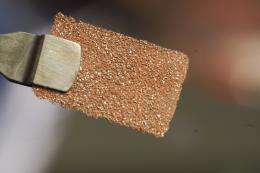
A novel material made of surface-enhanced high-purity diamond microparticles, shown here, could help cool high-power defense electronics up to a hundred times more efficiently than current technologies. (Georgia Tech Photo: Gary Meek).

(PhysOrg.com) -- Open any computer and you're sure to see at least one massive cooling device, complete with metal fins and a noisy fan. Today's high-power processing chips generate lots of heat -- and those chips can fry quickly without some serious cooling.

Researchers at the Georgia Tech Research Institute (GTRI) are developing a for transferring heat away from ultra-high-power defense electronics. The exotic material, a composite of diamond and copper, is one of the materials under development as part of a new concept called a “Thermal Ground Plane” that aims to remove heat up to 100 times more effectively than present thermal-conducting schemes.

Such a performance leap could be vital to cooling next-generation radars, said Jason Nadler, a GTRI research engineer. Nadler is investigating ways to bring new materials and techniques to bear on the problem.

"Many areas of electronics are running up against the same issue: you just can’t move the heat away fast enough to let the devices be reliable,” Nadler said. “As we rely increasingly on very high-power devices, the methods of getting heat away from them have to become more efficient.”

Georgia Tech is working with the Raytheon Co. on a project that seeks to raise capabilities to 20,000 watts per meter Kelvin (a measure of thermal-conductivity efficiency). That’s a tall order, considering that the current conductivity champion, for radar applications, is a copper material with performance of approximately 200 to 300 watts per meter Kelvin.

The three-phase, four-year project is sponsored by the Microsystems Technology Office of the Defense Advanced Research Projects Agency (DARPA).

This improved cooling capability could benefit future high-power transmit-receive (T/R) module packages. Because of their higher power, those transmit-receive modules will also have higher cooling needs that may require a Thermal Ground Plane—a sort of heat-dissipating sandwich about one millimeter thick that would be part of the T/R module’s packaging.

"A Thermal Ground Plane is basically a materials system,” Nadler explained. “The most thermally conductive natural material, pure diamond, has a conductivity of about 2,000 watts per meter Kelvin. We’re aiming for 20,000, and to do that we have to look at the problem from a materials systems standpoint.”

Nadler’s material is one of those under development to serve as the heart of the Thermal Ground Plane. The conductivity of that material would be improved with the addition of a liquid coolant able to carry heat away from the T/R module devices in the same way that sweat cools a body. A metal heat sink would help the liquid coolant dissipate the heat by condensing the vapor back to a fluid.

Using a liquid coolant takes advantage of phase changes—the conversion of matter between liquid and vapor states. The diamond-copper material would conduct heat to the liquid coolant and optimize cooling through wicking and evaporation. Then, the heat would be rejected as the vapor is re-condensed to a liquid on the side attached to the metal heat sink.

"The trick is to use evaporation, condensation and intrinsic thermal conductivity together, in series, in a continuous system,” Nadler said. “The whole device is a closed loop.”

Challenges remain, however, including some specific materials issues. To form the desired materials, diamond and copper must be integrated into a porous structure that can best transfer heat and facilitate efficient evaporation.

But diamond and copper don’t bond well, due in part to their different coefficients of thermal expansion and chemical incompatibility. Diamond doesn’t expand much when heated, while copper expands moderately. That difference leads to a thermal-expansion mismatch, which can fracture the interface between the two materials when they’re heated.

In addition, the porous internal structure of the diamond-copper material must have exactly the right size and shape to maximize its own intrinsic heat conductivity. Yet its internal structure must also be designed in ways that can help draw the liquid coolant toward the source to facilitate evaporation.

Nadler explained that liquid coolant flow can be maximized by fine tuning such mechanisms as the capillarity of the diamond-copper material. Capillarity refers to a given structure’s ability to draw in a substance, especially a liquid, the way a sponge absorbs water or a medical technician pulls a drop of blood up into a narrow glass tube.

To be effective, the size of a capillary structure must be precisely controlled; if it’s too large or too small, the wicking phenomenon won’t occur. The GTRI team must size the diamond-copper material’s internal structure to maximize capillarity.

"We’re finding ways to change the cellular structure of the diamond-copper material at the nanoscale and the microscale,” Nadler said. “We’re doing this by making complex open-celled structures—basically tiny foams with exactly the right properties.”

Provided by Georgia Institute of Technology


print this article email this article download pdf blog this article bookmark this article     Stumble it Digg this share on Facebook retweet share on Reddit add to delicious
Rate this story - 4.5 /5 (6 votes)

Rank Filter

Move the slider to adjust rank threshold, so that you can hide some of the comments.


Display comments: newest first

  • ormondotvos - Jul 09, 2009
    • Rank: not rated yet
    Copper/diamond wicking foam heat exchanger. Cool.

    Can you design a health care system?
  • PPihkala - Jul 09, 2009
    • Rank: not rated yet
    How about graphene or carbon nanotube materials used instead of diamond? They should have good thermal conductivity.
  • Birger - Jul 10, 2009
    • Rank: not rated yet
    If these composites can be produced at lower cost, I can see a future for them in conducting waste heat away from various kinds of engines.
    -How about incorporating them in the wall of reactor vessels of fission reactors? Unless they are prone to degrading because of the neuton flux, they would help provide a backup cooling system to prevent a failed reactor to overheat to the point of melting, even if the emergency water cooling system is out of order.
    And what about active cooling of spacecraft re-entry heat shields? It would make the brittle ceramic heat shielding of the space shuttle quite obsolete.
    -Hypersonic scramjet engines might also benefit from materials with improved thermal conductivity.
  • jselin - Jul 10, 2009
    • Rank: not rated yet
    How about graphene or carbon nanotube materials used instead of diamond? They should have good thermal conductivity.


    I proposed that exact idea for the same application and didn't get funded. [shrug]

July 9, 2009 all stories

Comments: 4

4.5 /5 (6 votes)
  • Stumble this up

  • Digg this

  • share this

  • hide
  • Related Stories

  • Keeping the heat down
    created Apr 06, 2009 | popularity not rated yet | comments 0
  • Future Computer Chips Could Be Cooled With Nanofluid
    created Apr 20, 2006 | popularity not rated yet | comments 0
  • Graphene Takes the Heat
    created Feb 20, 2008 | popularity not rated yet | comments 0
  • Nanotubes could improve thermal management in electronics
    created Mar 29, 2007 | popularity not rated yet | comments 0
  • Baked Slug: New Method to Test Fireproofing Material
    created Oct 02, 2008 | popularity not rated yet | comments 0


  • hide
  • Relevant PhysicsForums posts

  • Concentrating Household Ammonia
    created 4 hours ago
  • Structure of Dinitroacetylene
    created 5 hours ago
  • How do they melt carbon?
    created Nov 06, 2009
  • Urgent help needed for question on electrolysis & comparing Eo values
    created Nov 05, 2009
  • Ionic vs. Covalent
    created Nov 05, 2009
  • Gas that turn into liquid have a boiling point?
    created Nov 04, 2009
  • More from Physics Forums - Chemistry

Other News

Toward home-brewed electricity with 'personalized solar energy'

Toward home-brewed electricity with 'personalized solar energy'

Chemistry / Materials Science

created Nov 04, 2009 | popularity 3.4 / 5 (9) | comments 4

New scientific discoveries are moving society toward the era of "personalized solar energy," in which the focus of electricity production shifts from huge central generating stations to individuals in their ...


Scientists Reproduce a Building Block of Life in Laboratory

Scientists Reproduce a Building Block of Life in Laboratory

Chemistry / Biochemistry

created Nov 06, 2009 | popularity 4.8 / 5 (21) | comments 0

(PhysOrg.com) -- NASA scientists studying the origin of life have reproduced uracil, a key component of our hereditary material, in the laboratory.


Newly Discovered Fat Molecule: An Undersea Killer with an Upside

Newly Discovered Fat Molecule: An Undersea Killer with an Upside

Chemistry / Biochemistry

created Nov 05, 2009 | popularity 4.9 / 5 (8) | comments 0

(PhysOrg.com) -- A chemical culprit responsible for the rapid, mysterious death of phytoplankton in the North Atlantic Ocean has been found by collaborating scientists at Rutgers University and the Woods Hole ...


CU-Boulder map of human bacterial diversity shows wide interpersonal differences

Map of Human Bacterial Diversity Shows Wide Interpersonal Differences

Chemistry / Biochemistry

created Nov 05, 2009 | popularity 4.7 / 5 (11) | comments 0

(PhysOrg.com) -- A University of Colorado at Boulder team has developed the first atlas of bacterial diversity across the human body, charting wide variations in microbe populations that live in different ...


Mimicking nature, scientists can now extend redox potentials

Mimicking nature, scientists can now extend redox potentials

Chemistry / Biochemistry

created Nov 04, 2009 | popularity 4.8 / 5 (5) | comments 0

(PhysOrg.com) -- New insight into how nature handles some fundamental processes is guiding researchers in the design of tailor-made proteins for applications such as artificial photosynthetic centers, long-range ...