Living fossils hold record of 'supermassive' kick
July 9, 2009 Living fossils hold record of 'supermassive' kick

Enlarge

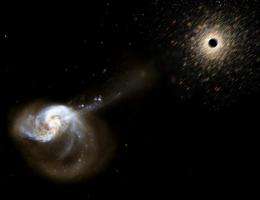
This artist's conception shows a rogue black hole that has been kicked out from the center of two merging galaxies. The black hole is surrounded by a cluster of stars that were ripped from the galaxies. New calculations by David Merritt, from Rochester Institute of Technology, Jeremy Schnittman, from Johns Hopkins University, and Stefanie Komossa, from the Max-Planck-Institut for Extraterrestrial Physics in Germany suggest that hundreds of massive black holes, left over from the epoch of galaxy formation, are waiting to be detected in the nearby universe. Credit: Space Telescope Science Institute

The tight cluster of stars surrounding a supermassive black hole after it has been violently kicked out of a galaxy represents a new kind of astronomical object and a fossil record of the kick.

A paper published in the July 10 issue of the Astrophysical Journal discusses the theoretical properties of "hypercompact stellar systems" and suggests that hundreds of these faint star clusters might be detected at optical wavelengths in our immediate cosmic environment. Some of these objects may already have been picked up in astronomical surveys, reports David Merritt, from Rochester Institute of Technology, Jeremy Schnittman, from Johns Hopkins University, and Stefanie Komossa, from the Max-Planck-Institut for Extraterrestrial Physics in Germany.

Hypercompact stellar systems result when a supermassive black hole is violently ejected from a galaxy, following a merger with another supermassive black hole. The evicted black hole rips stars from the galaxy as it is thrown out. The stars closest to the black hole move in tandem with the massive object and become a permanent record of the velocity at which the kick occurred.

"You can measure how big the kick was by measuring how fast the stars are moving around the black hole," says Merritt, professor of physics at RIT. "Only stars orbiting faster than the kick velocity remain attached to the black hole after the kick. These stars carry with them a kind of fossil record of the kick, even after the black hole has slowed down. In principle, you can reconstruct the properties of the kick, which is nice because there would be no other way to do it."

"Finding these objects would be like discovering DNA from a long-extinct species," adds Komossa.

The best place to find hypercompact stellar systems, the authors argued, is in cluster of like the nearby Coma and Virgo clusters. These dense regions of space contain thousands of galaxies that have been merging for a long time. Merging galaxies result in merging , which is a prerequisite for the kicks.

"Even if the black hole gets kicked out of one galaxy, it's still going to be gravitationally bound to the whole cluster of galaxies," Merritt says. "The total gravity of all the galaxies is acting on that black hole. If it was ever produced, it's still going to be there somewhere in that cluster."

Merritt and his co-authors think that scientists may have already seen hypercompact stellar systems and not realized it. These objects would be easy to mistake for common star systems like globular clusters. The key signature making hypercompact stellar systems unique is a high internal velocity. This is detectable only by measuring the velocities of stars moving around the black hole, a difficult measurement that would require a long time exposure on a large telescope.

From time to time, a hypercompact stellar system will make its presence known in a much more dramatic way, when one of the stars is tidally disrupted by the . In this case, gravity stretches the star and sucks it into the black hole. The star is torn apart, causing a beacon-like flare that signals a black hole. The possibility of detecting one of these "recoil flares" was first discussed in an August 2008 paper by co-authors Merritt and Komossa.

"The only contact of these floating black holes with the rest of the universe is through their armada of stars," Merritt says, "with an occasional display of stellar fireworks to signal 'here we are.'"

Source: Rochester Institute of Technology (news : web)


print this article email this article download pdf blog this article bookmark this article     Stumble it Digg this share on Facebook retweet share on Reddit add to delicious
Rate this story - 4.7 /5 (15 votes)

Rank Filter

Move the slider to adjust rank threshold, so that you can hide some of the comments.


Display comments: newest first

  • PPihkala - Jul 09, 2009
    • Rank: 2.5 / 5 (2)
    Likely candidate for the dark matter we know is out there?
  • omatumr - Jul 09, 2009
    • Rank: 1 / 5 (5)
    WHAT ENERGY SOURCE "KICKS'" BLACK HOLES?

    Is this confirmation of the paper submitted to the Hirschegg Workshop 06: Astrophysics and Nuclear Structure, Hirschegg, Austria, 15-21 Jan 2006?

    http://arxiv.org/.../0511379

    With kind regards,
    Oliver K. Manuel
    http://www.omatumr.com
  • vidar_lund - Jul 10, 2009
    • Rank: 5 / 5 (3)
    Likely candidate for the dark matter we know is out there?


    No, the mass from these stray black holes amounts to practically nothing in the big picture. Typically a galaxy will produce a black hole that is only a tiny fraction of its' total mass. One of the biggest known black holes at the core of the massive galaxy M87 is several billion solar masses but this is still only a small fraction of the entire mass of M87.
  • deatopmg - Jul 10, 2009
    • Rank: 2 / 5 (4)
    @PPihkala I think you may have left something out;
    "Likely candidate for the dark matter we know (is a patch that keeps our paradigm from falling apart) is out there?"
  • nonoice - Jul 10, 2009
    • Rank: 4.2 / 5 (5)
    WHAT ENERGY SOURCE "KICKS'" BLACK HOLES?


    Is this confirmation of the paper submitted to the Hirschegg Workshop 06: Astrophysics and Nuclear Structure, Hirschegg, Austria, 15-21 Jan 2006?


    http://arxiv.org/.../0511379


    Are you spamming your own papers again?
    This is again one of your own non cited papers.
    Try writing a paper that is actually accepted for publication and that gets references.


  • Noumenon - Jul 10, 2009
    • Rank: 4.5 / 5 (4)
    You voided your own argument by citing it. (lol)
  • Soylent - Jul 11, 2009
    • Rank: 5 / 5 (2)
    WHAT ENERGY SOURCE "KICKS'" BLACK HOLES?


    Gravitational potential energy.
  • omatumr - Jul 11, 2009
    • Rank: 1 / 5 (4)
    GRAVITATIONAL POTENTIAL ENERGY?

    How does that happen?

    Energetic cosmic events are associated with compact objects at the center of stars and galaxies. That is why we suspect that they are powered by repulsive interactions between neutrons.

    With kind regards,
    Oliver K. Manuel
    http://www.omatumr.com
  • omatumr - Jul 11, 2009
    • Rank: 1 / 5 (4)
    WHAT ENERGY SOURCE "KICKS'" BLACK HOLES?

    Is this confirmation of the paper submitted to the Hirschegg Workshop 06: Astrophysics and Nuclear Structure, Hirschegg, Austria, 15-21 Jan 2006?

    http://arxiv.org/.../0511379


    Try writing a paper that is actually accepted for publication and that gets references.


    Thanks, nonoice.

    1. "EARTH'S HEAT SOURCE - THE SUN," Energy and Environment: SPECIAL ISSUE: Natural drivers of weather and climate, volume 20 (2009) 131-144.
    http://arxiv.org/pdf/0905.0704

    2. "The Sun is a plasma diffuser that sorts atoms by mass," Physics of Atomic Nuclei 69 (20006) 1847-1856; Yadernaya Fizika 69, number 11, (Nov 2006); PAC: 96.20.Dt DOI: 10.1134/S106377880611007X
    http://arxiv.org/.../0609509

    3. "Isotopes tell origin and operation of the Sun," AIP Conference Proceedings, volume 822 (2006) 206-225; DOI:10.1063/1.2189138
    PACS: 96.60.Fs, 96.60.Jw, 96.60.Vg, 97.10.Bt
    http://xxx.lanl.g.../0510001

    http://www.thenak...=957.475

July 9, 2009 all stories

Comments: 9

4.7 /5 (15 votes)
  • Stumble this up

  • Digg this

  • share this

  • hide
  • Related Stories

  • RIT study predicts how fast a black hole can be booted from a galaxy
    created May 30, 2007 | popularity not rated yet | comments 0
  • Star Cluster Holds Midweight Black Hole, VLA Indicates
    created May 28, 2007 | popularity not rated yet | comments 0
  • Supercomputer Installed at RIT Among the World’s Fastest
    created Jul 12, 2005 | popularity not rated yet | comments 0
  • Huge Black Holes Stifle Star Formation
    created Aug 23, 2006 | popularity not rated yet | comments 0
  • Astronomers detect black hole in tiny 'dwarf' galaxy
    created Jan 07, 2007 | popularity not rated yet | comments 0


  • hide
  • Relevant PhysicsForums posts

  • Sideral question
    created 21 hours ago
  • Doppler shifted blackbody spectrum
    created 23 hours ago
  • Earth v. Moon
    created Nov 21, 2009
  • help me with coordinates and orbits
    created Nov 21, 2009
  • More from Physics Forums - General Astronomy

Other News

Baby can wait as expectant dad finishes spacewalk (AP)

Baby can wait as expectant dad finishes spacewalk

Space & Earth / Space Exploration

created 12 hours ago | popularity 3 / 5 (2) | comments 0

(AP) -- A spacewalking astronaut put aside the impending birth of his daughter and blazed through his first-ever venture outside the International Space Station on Saturday.


Unseasonably hot and dry weather combined with strong winds to fan scores of blazes in the country's southeastern states

Australia issues 'catastrophic' alerts as fires rage

Space & Earth / Environment

created 18 hours ago | popularity 4 / 5 (3) | comments 0

Australia has issued "catastrophic" alerts after record-breaking temperatures and wild lightning storms sparked more than 100 fires across the country, officials said Saturday.


Commuters wait on the platform shrouded by fog in London

Climate change not man-made, say majority of Britons: poll

Space & Earth / Environment

created Nov 15, 2009 | popularity 3.3 / 5 (15) | comments 46

Less than half of Britons believes that human activity is to blame for global warming, according to a poll carried out for The Times newspaper and published on Saturday.


Mysteriously warm times in Antarctica

Mysteriously warm times in Antarctica

Space & Earth / Earth Sciences

created Nov 18, 2009 | popularity 4.2 / 5 (21) | comments 28

(PhysOrg.com) -- A new study of Antarctica's past climate reveals that temperatures during the warm periods between ice ages (interglacials) may have been higher than previously thought. The latest analysis ...


UN: Fight climate change with free condoms (AP)

UN: Fight climate change with free condoms

Space & Earth / Environment

created Nov 18, 2009 | popularity 3.1 / 5 (11) | comments 24

(AP) -- The battle against global warming could be helped if the world slowed population growth by making free condoms and family planning advice more widely available, the U.N. Population Fund said Wednesday.