Nanopillars Promise Cheap, Efficient, Flexible Solar Cells
July 9, 2009
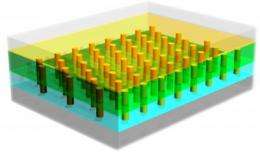
An aluminum substrate forms a template for a forest of cadmium sulfide nanopillars and also serves as a bottom electrode. Embedded in clear cadmium telluride and equipped with a top electrode of copper and gold, the result is an inexpensive and efficient 3-D solar cell. Credit: Lawrence Berkeley National Laboratory
(PhysOrg.com) -- Researchers at the U.S. Department of Energy's Lawrence Berkeley National Laboratory and the University of California at Berkeley have demonstrated a way to fabricate efficient solar cells from low-cost and flexible materials. The new design grows optically active semiconductors in arrays of nanoscale pillars, each a single crystal, with dimensions measured in billionths of a meter.
"To take advantage of abundant solar energy we have to find ways to mass-produce efficient photovoltaics," says Ali Javey, a faculty scientist in Berkeley Lab's Materials Sciences Division and a professor of electrical engineering and computer science at UC Berkeley. "Single-crystalline semiconductors offer a lot of promise, but standard ways of making them aren't economical."
A solar cell's basic job is to convert light energy into charge-carrying electrons and "holes" (the absence of an electron), which flow to electrodes to produce a current. Unlike a typical two-dimensional solar cell, a nanopillar array offers much more surface for collecting light. Computer simulations have indicated that, compared to flat surfaces, nanopillar semiconductor arrays should be more sensitive to light, have a greatly enhanced ability to separate electrons from holes, and be a more efficient collector of these charge carriers.
"Unfortunately, early attempts to make photovoltaic cells based on pillar-shaped semiconductors grown from the bottom-up yielded disappointing results. Light-to-electricity efficiencies were less than one to two percent," says Javey. "Epitaxial growth on single crystalline substrates was often used, which is costly. The nanopillar dimensions weren't well controlled, pillar density and alignment was poor, and the quality of the interface between the semiconductors was poor."
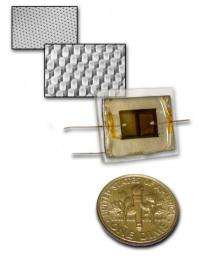
The aluminum substrate shown at top rear is patterned with pores seeded with anodized gold, spaced at intervals of about half a micron (millionth of a meter). At middle rear, the single-crystal cadmium sulfide nanopillars are about 200 nanometers in diameter (billionths of a meter). The test device in the foreground is shown next to a dime for scale. Credit: Lawrence Berkeley National Laboratory
Javey devised a new, controlled way to use a method called the "vapor-liquid-solid" process to make large-scale modules of dense, highly ordered arrays of single-crystal nanopillars. Inside a quartz furnace his group grew pillars of electron-rich cadmium sulfide on aluminum foil, in which geometrically distributed pores made by anodization served as a template.In the same furnace they submerged the nanopillars, once grown, in a thin layer of hole-rich cadmium telluride, which acted as a window to collect the light. The two materials in contact with each other form a solar cell in which the electrons flow through the nanopillars to the aluminum contact below, and the holes are conducted to thin copper-gold electrodes placed on the surface of the window above.
The efficiency of the test device was measured at six percent, which while less than the 10 to 18 percent range of mass-produced commercial cells is higher than most photovoltaic devices based on nanostructured materials - even though the nontransparent copper-gold electrodes on top of the Javey group's test device cut its efficiency by 50 percent. In future, top contact transparency can easily be improved.
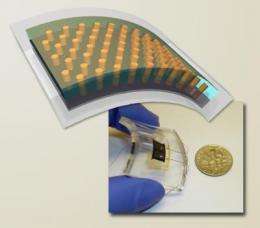
A flexible solar cell is achieved by removing the aluminum substrate, substituting an indium bottom electrode, and embedding the 3-D array in clear plastic. Credit: Lawrence Berkeley National Laboratory
Other factors that greatly affect the efficiency of a 3-D nanopillar-array solar cell include its density and the exposed length of the pillars in contact with the window material. These dimensions are easily optimized in future generations of the device.Concerned with practical applications as well as theoretical performance, the researchers made a flexible solar cell of the same design by etching away the aluminum substrate and substituting a thin layer of indium for the bottom electrode. They sheathed the whole solar cell in clear plastic (polydimethylsiloxane) to make a bendable device, which could be flexed with only marginal effect on performance - and no degradation of performance after repeated bending.
"There are lots of ways to improve 3-D nanopillar photovoltaics for higher performance, and ways to simplify the fabrication process as well, but the method is already hugely promising as a way to lower the cost of efficient solar cells," says Javey. "There's the ability to grow single-crystalline structures directly on large aluminum sheets. And the 3-D configuration means the requirements for quality and purity of the input materials are less stringent and less costly. Nanopillar arrays are a new path to versatile solar modules."
More information: "Three-dimensional nanopillar-array photovoltaics on low-cost and flexible substrates," by Zhiyong Fan, Haleh Razavi, Jae-won Do, Aimee Moriwaki, Onur Ergen, Yu-Lun Chueh, Paul W. Leu, Johnny C. Ho, Toshitake Takahashi, Lothar A. Reichertz, Steven Neale, Kyoungsik Yu, Ming Wu, Joel W. Ager, and Ali Javey, appears in the August issue of Nature Materials and is available in advance online publication at http://www.nature. … mat2493.html .
-
A first in integrated nanowire sensor circuitry
Aug 04, 2008 |
not rated yet |
0
-
Nanowires may boost solar cell efficiency, engineers say
May 14, 2008 |
not rated yet |
0
-
Organic semiconductors make cheap, flexible photovoltaics and LEDs
Sep 07, 2006 |
not rated yet |
0
-
NREL Solar Cell Sets World Efficiency Record at 40.8 Percent
Aug 13, 2008 |
not rated yet |
0
-
Sharp to Begin Mass-Production of Thin-Film Photovoltaic Modules
Jul 08, 2005 |
not rated yet |
0
-
Engineers build first sub-10-nm carbon nanotube transistor
Feb 01, 2012 |
4.9 / 5 (30) |
30
-
Something old, something new: Evolution and the structural divergence of duplicate genes
Jan 31, 2012 |
4.6 / 5 (7) |
1
-
The hidden nanoworld of ice crystals: Revealing the dynamic behavior of quasi-liquid layers
Jan 30, 2012 |
5 / 5 (3) |
1
-
Stock market network reveals investor clustering
Jan 27, 2012 |
3.9 / 5 (23) |
8
-
Of microchemistry and molecules: Electronic microfluidic device synthesizes biocompatible probes
Jan 26, 2012 |
5 / 5 (1) |
0
-
Corrosion Tests on Magnesium
9 hours ago
-
polyethylene copper nanocomposite
15 hours ago
-
Output of xrd analysis
Feb 08, 2012
-
Transport phenomena problem based on problems 18.B11 and 19B.6 from Bird, stewart, lw
Feb 06, 2012
-
Help with material selection - Car Piston
Feb 05, 2012
-
Name of the steel alloy?!!?
Feb 02, 2012
- More from Physics Forums - Materials & Chemical Engineering
More news stories
'Dark plasmons' transmit energy
Microscopic channels of gold nanoparticles have the ability to transmit electromagnetic energy that starts as light and propagates via "dark plasmons," according to researchers at Rice University.
5 hours ago |
5 / 5 (3) |
0
|
Nanotube therapy takes aim at breast cancer stem cells
Wake Forest Baptist Medical Center researchers have again proven that injecting multiwalled carbon nanotubes (MWCNTs) into tumors and heating them with a quick, 30-second laser treatment can kill them.
Nanotechnology / Bio & Medicine
10 hours ago |
5 / 5 (1) |
0
|
Inspired by steel, nanomanufacturing gets wear-resistant carbide tip
(PhysOrg.com) -- Scientists at the University of Pennsylvania, the University of Wisconsin-Madison and IBM Research - Zurich have fabricated an ultrasharp silicon carbide tip possessing such high strength ...
15 hours ago |
5 / 5 (2) |
1
|
New technology platform for molecule-based electronics
Researchers at the Nano-Science Center at the University of Copenhagen have developed a new nano-technology platform for the development of molecule-based electronic components using the wonder material graphene. At the same ...
Nanotechnology / Nanomaterials
12 hours ago |
5 / 5 (2) |
0
Australians risking skin cancer to avoid nanoparticles
More than three in five Australians are concerned enough about the health implications of nanoparticles in sunscreens to want to know more about their impact. And while the initial scientific information released suggests ...
Nanotechnology / Bio & Medicine
13 hours ago |
5 / 5 (1) |
0
Hydrogen from acidic water: Researchers develop potential low cost alternative to platinum for splitting water
A technique for creating a new molecule that structurally and chemically replicates the active part of the widely used industrial catalyst molybdenite has been developed by researchers with the Lawrence Berkeley ...
Ultraviolet protection molecule in plants yields its secrets
Lying around in the sun all day is hazardous not just for humans but also for plants, which have no means of escape. Ultraviolet (UV) radiation from the sun can damage proteins and DNA inside cells, leading ...
FDA-approved drug rapidly clears amyloid from the brain, reverses Alzheimer's symptoms in mice
Neuroscientists at Case Western Reserve University School of Medicine have made a dramatic breakthrough in their efforts to find a cure for Alzheimer's disease. The researchers' findings, published in the journal Science, show t ...
Anyone can learn to be more inventive, cognitive researcher says
There will always be a wild and unpredictable quality to creativity and invention, says Anthony McCaffrey, a cognitive psychology researcher at the University of Massachusetts Amherst, because an "Aha moment" is rare and ...
Cell biologists describes mechanism by which some people may be more susceptible to colon cancer
An international research team led by cell biologists at the University of California, Riverside has uncovered a new insight into colon cancer, the third leading cause of cancer-related deaths in the United ...
New method makes culture of complex tissue possible in any lab
Scientists at the University of California, San Diego have developed a new method for making scaffolds for culturing tissue in three-dimensional arrangements that mimic those in the body. This advance, published online in ...


Jul 09, 2009
Rank: 5 / 5 (3)
Jul 10, 2009
Rank: 4.3 / 5 (3)
According to the article the panel uses a very thin layer of copper and gold instead of ITO as the transparent(top) electrode(which reduces efficiency by half). Pressumably they do this because ITO is very fragile.
The indium used in this panel is for the bottom electrode, which doesn't need to be transparent, just flexible. I don't think there's any strict reason they must use indium; it's probably what they were used to working with and had on hand, so they tried it.
There have been attempts to replace ITO transparent electrodes with thin sheets of carbon nanotubes. The biggest obstacle appears to be price and the development of an industrial process to apply the layer.
The use of tellurium is more worrysome. The only metals with lower abundance in the Earth's crust than the tellurium are ruthenium, rhodium and iridium. World production of tellurium is 200-400 tonnes per year. Most of that is as a by product in copper anode-slimes; as there are no dedicated tellurium mines and no good tellurium ores, this production is unlikely to grow significantly.
Unfortunately, the same people who will oppose the use of cadmium in any amount for any consumer electronics tend to have a massive blind spot for solar panels, so don't count on it.
Jul 10, 2009
Rank: not rated yet
I agree, that the use of very rare earth elements for this is not a sound way for mass production.
However, they need this to create the necessary band gap energies to be able to absorb the AM1.5 spectrum effectively.
There's a wealth of information in http://en.wikiped...ar_cell.
also relevent to this article: http://en.wikiped...oltaics.
Once R&D can tailor the bandgap (for a third generation cell) with "common" materials then solar panels could come down in price. In practise, there is always going to be 'toxic' elements required in any cell, unless perhaps there can be progress in a new material or technique (as yet to be discovered) to create the necessary photon absorbing bandgaps.
The major barrier to industrialising solar panels is producing silicon in the first place. Although silicon is the most abundant element on Earth, unfortunately, producing solar panel grade (or indeed computer grade) silicon is always a difficult process.
Jul 10, 2009
Rank: not rated yet
Then if someone invents a dirt cheap high tech photovoltaic (PV) then you keep the reflectors and just replace the steam turbine with the PV cells.
Jul 10, 2009
Rank: 1 / 5 (1)
The situation is at least as desperate as the situation during WWII that drove innovation and actual manufacturing of said innovations to insane levels of speed in factual and actual full application.
Why the hell we can't do exactly that, now - is beyond all reason.
Jul 10, 2009
Rank: not rated yet
http://en.wikiped...r_tower?
Jul 15, 2009
Rank: not rated yet
Yes.
That would be an industrial level installation.
There is a cool Israely company doing a smaller residential/commercial scale version. I think they utilize recycled plastic for the reflectors coated with foil.
Jul 15, 2009
Rank: not rated yet
Well said - if somewhat pointedly.
Declare war on oil and go solar.
Imagine the effect of $1 trillion "bailout" into mass production of solar factories that crank out solar reflectors, PV cells and steam turbines, electric generators.
Step 1. Acquire all old auto plants in Michigan by federal iminant domain orders.
Step 2. Hire all those unemployed auto engineers/construction workers etc and task them with production. Pay them 50% of the going wage - hey it beats welfare! The workers are split into 3 teams/industrial parks to encourage competition.
Step 3. Federal research grants to boost innovation and entrepeneurs.
Step 4. Set up a steering group of nobel laureats/visionary engineers in charge of the project. Only pay them on results and double market rate.
Step 5. Set up a 6 month deadline for having factories 50% running and 12 month for 100%.
Step 6. On success of step 5 pay employees 12 months pay bonus (we only pay them 50% to begin with so that means they get full pay).
Step 7. Broadcast the entire project realtime on the web to foster national pride.
Step 8 implement the federally produced solar plants in sun drenched Arizona government lands.
The cheap electric prices plumet creating an economic shift away from oil/coal.