Simulations Illuminate Universe's First Twin Stars (w/ Video)
July 9, 2009 Simulations Illuminate Universe's First Twin Stars

Enlarge

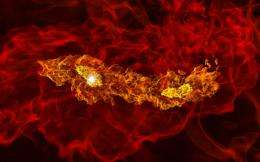
This computer-simulated image shows the formation of two high density regions (yellow) in the early universe, approximately 200 million years after the Big Bang. The cores are separated by about 800 times the distance between the Earth and the Sun, and are expected to evolve into a binary—or "twin"—star system. (Image courtesy of Ralf Kaehler, Matthew Turk and Tom Abel.)

(PhysOrg.com) -- The earliest stars in the universe formed not only as individuals, but sometimes also as twins, according to a paper published today in Science Express. By creating robust simulations of the early universe, astrophysicists Matthew Turk and Tom Abel of the Kavli Institute for Particle Astrophysics and Cosmology, located at the Department of Energy’s SLAC National Accelerator Laboratory, and Brian O'Shea of Michigan State University have gained the most detailed understanding to date of the formation of the first stars.

"We used to think that these stars formed by themselves, but now we see from our that sometimes they have siblings," said Turk. "These stars provide the seeds of next generation star formation, so by understanding them we can better understand how other stars and formed."

To make this discovery, the researchers created an extremely detailed computer simulation of early star formation. Into this virtual they sprinkled primordial gas and dark matter as it existed soon after the Big Bang, data they obtained from observations of the cosmic microwave background. This mostly uniform radiation—a faint glow of spread across the entire sky—contains subtle variations that reflect the beginning of all structure in the universe.

FLV player

Simulation courtesy of Ralf Kaehler, Matthew Turk and Tom Abel

Turk, Abel and O'Shea ran five data-intensive simulations, each of which covered a 400 quadrillion cubic mile volume of the universe and took about three weeks to run on 64 processors. The simulations focused on the first Population III stars: massive, hot stars thought to have formed a mere several hundred million years after the Big Bang.

As the researchers watched their simulated universe evolve, waves of gas and dark matter swirled through the hot, dense universe. As the universe cooled, gravity began to draw the matter together into clumps. In areas rich with matter, stars began to form. And, in one out of the researchers' five simulations, a single cloud of dust and formed into "twin" stars: one with a mass equivalent to about 10 suns, and one with a mass equivalent to about 6.3 suns. Both of them were still growing at the end of the calculation and will likely grow to many times that mass.

"We ran five of these calculations starting from the beginning of the universe, and to our surprise one of them was special," said Abel. "This opens a whole new realm of research possibilities. These stars could evolve into two black holes, which could have created gravitational waves we could detect with an instrument like the Laser Interferometer Gravitational Wave Observatory and, if they fall into bigger black holes, for the Laser Interferometer Space Antenna. Or one of the stars could evolve into a black hole that could create gamma-ray bursts that we could detect with the Swift mission and the Fermi Gamma-ray Space Telescope."

Turk added: "This will help us fine-tune our models for how structure in the universe formed and evolved. Understanding the very early helps us understand what we see today. It even helps explain how and when some of the atoms now on earth and in our bodies were first formed."

Provided by SLAC National Accelerator Laboratory (news : web)


print this article email this article download pdf blog this article bookmark this article     Stumble it Digg this share on Facebook retweet share on Reddit add to delicious
Rate this story - 4.5 /5 (2 votes)

Rank Filter

Move the slider to adjust rank threshold, so that you can hide some of the comments.


Display comments: newest first

  • denijane - Jul 10, 2009
    • Rank: 5 / 5 (1)
    How do you model something whose equations of state you don't know? I refer to dark matter in early universe.
  • JukriS - Jul 12, 2009
    • Rank: 1 / 5 (1)
    Just remember. Entropy working also inside nucleus of atoms all a time.

    Inside nucleus of atoms is only energy who exploding all a time!

    Nucleus of atoms exploding/expanding all a time and emit/radiate waves of energy who have a nature of electrons and particles who also expanding/exploding and emit expanding waves of energy!

    Electrons just move to the next exploding nucleus of atoms and get this exploding faster and faster. That the way exploding nucleus of atoms push themselfs far away same way what nucelus expanding all a time!

    Electrons give some change of pressure for waves of energy who push out from exploding nucleus and then born new electrons etc...

    http://www.onesim....com/296

July 9, 2009 all stories

Comments: 2

4.5 /5 (2 votes)
  • Stumble this up

  • Digg this

  • share this

  • hide
  • Related Stories

  • Dust and gas in the early universe
    created Jul 31, 2008 | popularity not rated yet | comments 0
  • Oldest stars may shed light on dark matter
    created Sep 13, 2007 | popularity not rated yet | comments 0
  • Cosmologists 'see' the cosmic dawn
    created Feb 11, 2009 | popularity not rated yet | comments 0
  • Growing Supermassive Black Holes from Seeds
    created Jan 12, 2006 | popularity not rated yet | comments 0
  • Hey, WIMPs: Beware of Dwarf
    created Apr 03, 2007 | popularity not rated yet | comments 0


  • hide
  • Relevant PhysicsForums posts

Other News

Stars Fueled by Dark Matter Could Hold Secrets to the Universe

Stars Fueled by Dark Matter Could Hold Secrets to the Universe

Physics / General Physics

created Nov 03, 2009 | popularity 4.5 / 5 (47) | comments 40

(PhysOrg.com) -- The first stars in the universe may have been very different from the stars we see today, yet they may hold clues to understanding some of the mysterious features of the universe. These "dark ...


Second Law of Thermodynamics May Explain Economic Evolution

Second Law of Thermodynamics May Explain Economic Evolution

Physics / General Physics

created Nov 02, 2009 | popularity 4.3 / 5 (29) | comments 27

(PhysOrg.com) -- Terms such as the "invisible hand," laissez-faire policy, and free-market principles suggest that economic growth and decline in capitalist societies seem to be somehow self-regulated. Now, ...


High-performance plasmas may make reliable, efficient fusion power a reality

High-performance plasmas may make reliable, efficient fusion power a reality

Physics / Plasma Physics

created Nov 02, 2009 | popularity 4.7 / 5 (36) | comments 31

In the quest to produce nuclear fusion energy, researchers from the DIII-D National Fusion Facility have recently confirmed long-standing theoretical predictions that performance, efficiency and reliability ...


'Teapot effect' solved

Solving Teapot Effect

Physics / General Physics

created Nov 02, 2009 | popularity 5 / 5 (9) | comments 10

(PhysOrg.com) -- A team of scientists from France have worked out why teapots dribble at low flow rates, and how to stop them. The effect is called the "teapot effect", and solving it could finally put an ...


Laser accelerated protons to the highest energies so far

Researchers use trident laser to accelerate protons to record energies

Physics / General Physics

created Nov 02, 2009 | popularity 4.3 / 5 (3) | comments 10

An international team of physicists at Los Alamos National Laboratory has succeeded in using intense laser light to accelerate protons to energies never before achieved. Using this technique, scientists can ...