New Advance in Revolutionary 'Bullet Fingerprinting' Technique
July 12, 2009 New advance in revolutionary 'bullet fingerprinting' technique

Enlarge

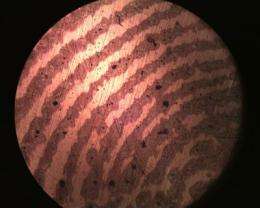
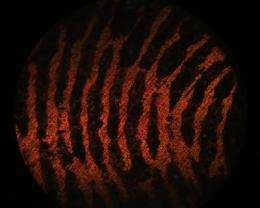
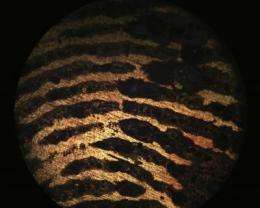
This is an optical microscope image of a fingerprint on brass. Credit: University of Leicester

(PhysOrg.com) -- 'Bullet fingerprinting' technology developed at the University of Leicester in collaboration with Northamptonshire Police is now being advanced in new ways.

Dr John Bond, from Northamptonshire Police Scientific Support Unit and an Honorary Research Fellow at the University of Leicester’s Forensic Research Centre developed- in collaboration with University scientists - a method to ‘visualise fingerprints’ even after the print itself has been removed.

The revolutionary technique was named last year as one of Time Magazine’s top 50 inventions of the year.

Now continuing work exploring this forensic technique in the Department of Chemistry at the University of Leicester is uncovering new ways of recovering from metal surfaces.

New advance in revolutionary 'bullet fingerprinting' technique
Enlarge

This is an optical microscope image of a fingerprint on brass. Credit: University of Leicester

Researcher Alex Goddard has uncovered a natural technique that he believes is so simple, which can explain why it has been overlooked until now.

The technique involves studying the chemical and physical interactions occurring between the metal and the fingerprint sweat deposit. Using advanced surface imaging techniques, such as an , nanoscale observations of fingerprinted brass samples can identify optimum conditions to promote the natural enhancement of the fingerprint, vastly improving their recovery rate. It has also proven that components of the sweat deposit survive washing and wiping of the surface.

Goddard explains, “Once a finger has touched the metal surface, a residue remains behind, this starts to react with the metal and an image of the fingerprint can be developed by use of elevated temperature and humidity, with the resultant image becoming a permanent feature on the surface of the metal.”

“Currently, fingerprint recovery from bullets is very low; less than 1 percent. This uses a natural process and even if it only leads to small increase in success rate, then that would be significant.
New advance in revolutionary 'bullet fingerprinting' technique
Enlarge

This is an optical microscope image of a fingerprint on brass. Credit: University of Leicester

“Previous recovery methods include applying powder to the material which can actually damage the evidence. This new technique promotes a naturally occurring process which does not involve adding anything to, or damaging, the evidence. Instead, it employs heat and humidity to promote the enhancement of the fingerprint image, there are also indications that it could be used after other techniques have failed, perhaps as a last resort.”

Dr John Bond said: "I am delighted that this research in the Chemistry Department is producing really interesting and useful results. This is an important area of and Northamptonshire Police is proud to be associated with the University. I look forward to further developments".

Alex Goddard recently presented his findings at the University of Leicester’s Postgraduate Research Festival.

Provided by University of Leicester (news : web)


print this article email this article download pdf blog this article bookmark this article     Stumble it Digg this share on Facebook retweet share on Reddit add to delicious
Rate this story - 2.5 /5 (2 votes)

Rank Filter

Move the slider to adjust rank threshold, so that you can hide some of the comments.


Display comments: newest first

  • ArtflDgr - Jul 13, 2009
    • Rank: not rated yet
    add a bit of oxygen to the mix... duh..

    finger prints mask areas and prevent or change rate of tarnish. so pick your oxydizers...

    that means that fuming hcl in the bottom of the prep area (like with cyano acrylic), will oxydize the metal which when oppened will then be replaced by oxygen making the mtal turn black.


  • Walid - Jul 13, 2009
    • Rank: not rated yet
    can this be carried out on ancient brass ornaments
  • ArtflDgr - Jul 13, 2009
    • Rank: not rated yet
    no...

    and here is why..

    over time they have been polished.. if not, then they have years of finger prints over finger prints.

    this would make any print quite noisy.

    however, what do you think the outcome will be once this hits the press and some idiot thinks a bit?

    again, like most of these things they are too dependent on ignorance. so they mostly just get teh bad criminals, while the better ones are not bothered with.


July 12, 2009 all stories

Comments: 3

2.5 /5 (2 votes)
  • Stumble this up

  • Digg this

  • share this

  • hide
  • Related Stories

  • New Fingerprint Breakthrough by Forensic Scientists
    created Jun 02, 2008 | popularity not rated yet | comments 0
  • Fingerprint analysis technique could be used to identify bombmakers
    created Aug 26, 2008 | popularity not rated yet | comments 0
  • New study will make criminals sweat
    created Sep 16, 2008 | popularity not rated yet | comments 0
  • Fingerprint find in decade-old double murder probe
    created Sep 04, 2008 | popularity not rated yet | comments 0
  • Novel Forensic Technique To Be Applied To Decade-Old Murder Probe
    created Jan 15, 2009 | popularity not rated yet | comments 0


  • hide
  • Relevant PhysicsForums posts

  • Goddard
    created 4 hours ago
  • Rate Laws
    created 6 hours ago
  • why oxygen, cannot act as a pi-donor while NO can?
    created 23 hours ago
  • Aspirin
    created Nov 19, 2009
  • antibonding orbitals
    created Nov 19, 2009
  • Affect of adjacent amino acids on pKa values
    created Nov 19, 2009
  • More from Physics Forums - Chemistry

Other News

Accidental discovery produces durable new blue pigment for multiple applications

Accidental discovery produces durable new blue pigment for multiple applications

Chemistry / Biochemistry

created Nov 16, 2009 | popularity 4.5 / 5 (30) | comments 6

An accidental discovery in a laboratory at Oregon State University has apparently solved a quest that over thousands of years has absorbed the energies of ancient Egyptians, the Han dynasty in China, Mayan ...


One word: bioplastics

One word: bioplastics

Chemistry / Materials Science

created Nov 17, 2009 | popularity 4.5 / 5 (11) | comments 4

(PhysOrg.com) -- Every year, more than 250 billion pounds of plastic are produced worldwide. Much of it ends up in the world's oceans, a fact that troubles MIT biology professor Anthony Sinskey.


New on-off 'switch' triggers and reverses paralysis in animals with a beam of light

New on-off 'switch' triggers and reverses paralysis in animals with a beam of light (w/ Video)

Chemistry / Biochemistry

created Nov 18, 2009 | popularity 4.8 / 5 (5) | comments 3

In an advance with overtones of Star Trek phasers and other sci-fi ray guns, scientists in Canada are reporting development of an internal on-off "switch" that paralyzes animals when exposed to a beam of ultraviolet ...


New research provides blueprint for molecular basis of global warming

New research provides blueprint for molecular basis of global warming

Chemistry / Materials Science

created Nov 17, 2009 | popularity 4 / 5 (4) | comments 3

A new study indicates that major chemicals most often cited as leading causes of climate change, such as carbon dioxide and methane, are outclassed in their warming potential by compounds receiving less attention.


Ethanol

Microbes to Take Over Ethanol Production?

Chemistry / Biochemistry

created Nov 20, 2009 | popularity 3.8 / 5 (5) | comments 0

(PhysOrg.com) -- Not too long ago, it seemed that ethanol production was the wave of the future. The use of trash, wood chips or different types of plants -- usually grass or corn -- to make ethanol was considered ...