Eastern Aral Sea has shrunk by 80% since 2006: ESA
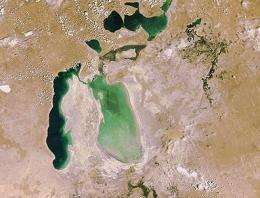
July 10, 2009 Satellite image shows the dramatic retreat of the Aral Sea?s shoreline

Enlarge

Satellite image shows the dramatic retreat of the Aral Sea?s shoreline. The eastern lobe of the disaster-struck Aral Sea seems to have shrunk by four-fifths in just three years, according to the European Space Agency (ESA).

The eastern lobe of the disaster-struck Aral Sea seems to have shrunk by four-fifths in just three years, the European Space Agency (ESA) said on Friday.

It released an overlay of photographs taken by one of its observation satellites, Envisat, on July 1 2006 and July 6 2009.

Once the world's fourth-largest inland body of water but now a byword for ecological calamity, the Aral Sea has been retreating over the last half-century after rivers that fed it were diverted for Soviet cotton irrigation projects.

Around two decades ago, it split into the Small Aral Sea in the north, located in Kazakhstan, and the Large Aral Sea, shared by Kazakhstan and Uzbekistan.

The horseshoe-shaped Large Aral Sea began to split into eastern and western lobes, in 2000.

"The eastern lobe retreated substantially between 2006 and 2009," ESA said in a press release.

"It appears to have lost about 80 percent of its water since the 2006 (image) acquisition, at which time the eastern lobe had a length of about 150 kilometres (93 miles) and a width of about 70 kms (43 miles)."

The Large Aral Sea is expected to dry out completely by 2020, it added.

Efforts are under way to save the far smaller northern part, thanks to the Kok-Aral dike, a project of the World Bank and Kazakhstan government.

Since the barrier was completed in 2005, water level in the northern section has risen by four metres (13 feet).

The desiccation of the Aral is considered by some experts to be the worst man-made ecological catastrophe ever, but one that also has had huge implications for human well-being.

Fishing and other industries that once thrived have been destroyed. Each year, tens of thousands of tons of salt-laced dust blow from the dried-up seabed, much of it contaminated by , affecting health.

(c) 2009 AFP


print this article email this article download pdf blog this article bookmark this article     Stumble it Digg this share on Facebook retweet share on Reddit add to delicious
Rate this story - 4.7 /5 (20 votes)

Rank Filter

Move the slider to adjust rank threshold, so that you can hide some of the comments.


Display comments: newest first

  • deatopmg - Jul 10, 2009
    • Rank: 3.3 / 5 (7)
    Exactly what one would expect from a totalitarian regime, left or right.
  • Dhanne - Jul 11, 2009
    • Rank: 5 / 5 (1)
    This is the proof that humans are mostly idiots.
  • Choice - Jul 12, 2009
    • Rank: not rated yet
    This is where we are all headed unless we start getting smarter. Another example of distant natural resource exploitation by Europeans and of the scourge which is industrial scale agriculture as currently practiced.

July 10, 2009 all stories

Comments: 3

4.7 /5 (20 votes)
  • Stumble this up

  • Digg this

  • share this

  • hide
  • Related Stories


  • hide
  • Relevant PhysicsForums posts

  • cycles
    created 6 hours ago
  • The Origin of the term 'fossil' fuels
    created Nov 05, 2009
  • co2
    created Nov 03, 2009
  • Early Earths Sulfidic Ocean Conditions
    created Oct 30, 2009
  • More from Physics Forums - Earth

Other News

Deep creep means milder, more frequent earthquakes along Southern California's San Jacinto fault

Deep creep means milder, more frequent earthquakes along Southern California's San Jacinto fault

Space & Earth / Earth Sciences

created 5 hours ago | popularity 4.7 / 5 (3) | comments 0

With an average of four mini-earthquakes per day, Southern California's San Jacinto fault constantly adjusts to make it a less likely candidate for a major earthquake than its quiet neighbor to the east, the ...


Success in 'space elevator' competition (AP)

Success in 'space elevator' competition (Update 3)

Space & Earth / Space Exploration

created Nov 05, 2009 | popularity 4.3 / 5 (33) | comments 50

(AP) -- A robot powered by a ground-based laser beam climbed a long cable dangling from a helicopter on Wednesday to qualify for prize money in a $2 million competition to test the potential reality of the ...


'Dropouts' pinpoint earliest galaxies

'Dropouts' pinpoint earliest galaxies

Space & Earth / Astronomy

created Nov 06, 2009 | popularity 4.2 / 5 (10) | comments 12

Astronomers, conducting the broadest survey to date of galaxies from about 800 million years after the Big Bang, have found 22 early galaxies and confirmed the age of one by its characteristic hydrogen signature ...


Space hotel taking bookings for 2012 opening

Space hotel taking bookings for 2012 opening

Space & Earth / Space Exploration

created Nov 05, 2009 | popularity 4.4 / 5 (20) | comments 11

(PhysOrg.com) -- The first orbiting space hotel is on track to open for its first customers in 2012, but hurry, as bookings are filling fast.


In a Galaxy Far, Far Away...

In a Galaxy Far, Far Away...

Space & Earth / Astronomy

created Nov 06, 2009 | popularity 4.8 / 5 (5) | comments 13

(PhysOrg.com) -- Astronomers have published the discovery of the farthest known object in the cosmos: a star that exploded when the universe was only 630 million years old -- only 4.6% of its current age. ...