Tailoring surgical glues for specific applications
July 10, 2009 by Elizabeth A. Thomson Tailoring surgical glues for specific applications

Enlarge

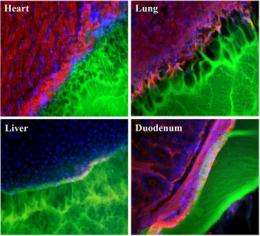
Images showing the interface between a surgical glue (green) and tissue samples (red, blue and black) from the heart, lung, liver, and duodenum. The glue works best with duodenum tissue (note smooth interface), and worst with lung tissue (pockmarked with holes). Courtesy / Edelman lab/MIT

(PhysOrg.com) -- Surgical adhesives, which can be used to seal tissues after an operation or to repair wounds, are becoming increasingly important parts of a doctor's toolkit. However, their one-size-fits-all nature means that existing adhesives, or glues, work well in some cases but not in others.

MIT researchers aim to change that with glues tailored to specific tissues. In a recent issue of , they identified for the first time how one kind of glue material bonds to and how that adhesion varies depending on the tissue involved, from the intestine to the lung. They then showed how by adjusting certain properties of the materials it was possible to create a range of adhesives optimized for specific tissues and applications.

"The delineation of tissue-specific mechanisms for material adhesion leads the way for tailoring materials to individual needs and applications. This exciting work may well change the clinical use and continued evolution of soft-tissue sealants and adhesive materials," said Elazer R. Edelman, principal investigator and MIT's Thomas D. and Virginia W. Cabot Professor of Health Sciences and Technology.

Adhesive sealants could improve patient care and reduce healthcare costs by cutting medical complications after surgery, such as leakage through , and improved wound healing, according to Natalie Artzi, a postdoctoral associate who led the research in Edelman's lab.

Although there is already a billion-dollar market for such adhesives, "they haven't reached their true potential," Artzi said. Existing materials have limitations that often force doctors to compromise between adhesion strength and tissue reaction. For example, said Artzi, for a given tissue, the material may be adhesive but release toxins that could affect healing. Alternatively, the material could be quite tissue compatible, but degrade quickly, becoming non-adhesive. If the glue doesn't work, a doctor must switch to sutures or staples.

The problem, according to the MIT team is that while surgical adhesives rely on intimate interactions between the adhesive and the tissue in question, the properties of the target tissue have been largely ignored in designing adhesives. Instead, "one general formulation is proposed for application to the full range of soft tissues across diverse clinical applications," Artzi and colleagues wrote in their Advanced Materials paper.

The new work characterized a variety of interactions between one kind of glue (hyrogels composed of polyethylene glycol and dextran aldehyde, or PEG: dextran for short) and tissue from a rat's heart, lung, liver and duodenum (the first section of the intestine). The team found, for example, that the glue worked well with tissue from the duodenum, but poorly with that from the lung.

They then went on to "identify the functional groups in the material that are responsible for adhesion with tissue functional groups, and created a model to optimize adhesion for each tissue," Artzi said. In particular the paper explains how variation of chemical reactive groups in the material could be matched to the variability in the density of respective reactive groups on different tissues to regulate tissue-material interaction.

The team will use these findings to "develop a platform of adhesive materials" for specific tissues. Although it could take three to five years before the work translates into a product, "the concept is there," she concluded.

In addition to Edelman and Artzi, co-authors of the paper are Tarek Shazly (co-first author with Artzi and a graduate student in MIT's Department of Materials Science and Engineering), Aaron B. Baker (a postdoctoral associate in Edelman's lab), and Adriana Bon, now at the Universitat Ramon Llull (Spain).

Provided by Massachusetts Institute of Technology (news : web)


print this article email this article download pdf blog this article bookmark this article     Stumble it Digg this share on Facebook retweet share on Reddit add to delicious
Rate this story - 5 /5 (1 vote)

Rank Filter

Move the slider to adjust rank threshold, so that you can hide some of the comments.


Display comments: newest first


July 10, 2009 all stories

Comments: 2

5 /5 (1 vote)
  • Stumble this up

  • Digg this

  • share this

  • hide
  • Related Stories

  • Scientists create gecko-inspired bandage
    created Feb 18, 2008 | popularity not rated yet | comments 0
  • Shellfish and inkjet printers may hold key to faster healing from surgeries
    created Mar 18, 2009 | popularity not rated yet | comments 0
  • Nature’s frugal glues provide insight for optimized adhesives
    created Jan 11, 2007 | popularity not rated yet | comments 0
  • Mending broken hearts with tissue engineering
    created Nov 02, 2008 | popularity not rated yet | comments 0
  • Nanotube adhesive sticks better than a gecko's foot
    created Jun 19, 2007 | popularity not rated yet | comments 0


  • hide
  • Relevant PhysicsForums posts

  • Putting every element in a box
    created 18 hours ago
  • a question in Lewis structure???
    created Nov 25, 2009
  • Paint Technology
    created Nov 24, 2009
  • About pH, Metallic electrodes
    created Nov 24, 2009
  • Rate Laws
    created Nov 21, 2009
  • why oxygen, cannot act as a pi-donor while NO can?
    created Nov 20, 2009
  • More from Physics Forums - Chemistry

Other News

Blocking biofilms: Alzheimer's research sheds light on potential treatments for urinary tract infections

Chemistry / Biochemistry

created 23 hours ago | popularity 5 / 5 (1) | comments 0

(PhysOrg.com) -- Research into Alzheimer's disease seems an unlikely approach to yield a better way to fight urinary tract infections (UTIs), but that's what scientists at Washington University School of Medicine in St. Louis ...


Chemists get custom-designed microscopic particles to self-assemble in liquid crystal

Chemists get custom-designed microscopic particles to self-assemble in liquid crystal

Chemistry / Materials Science

created 23 hours ago | popularity 5 / 5 (5) | comments 0

(PhysOrg.com) -- The scientists anticipate their "LithoParticles" will have significant applications in photonics, optical communications and other areas.


Sandia CR5

Machine Converts CO2 into Gasoline, Diesel, and Jet Fuel

Chemistry / Biochemistry

created Nov 23, 2009 | popularity 4.6 / 5 (30) | comments 19

(PhysOrg.com) -- Researchers at Sandia National Laboratories have built a machine that uses the sun's energy to convert carbon dioxide waste from power plants into transportation fuels such as gasoline, diesel, ...


New hydrogen-storage method discovered

New hydrogen-storage method discovered

Chemistry / Materials Science

created Nov 22, 2009 | popularity 4.3 / 5 (42) | comments 15

Scientists at the Carnegie Institution have found for the first time that high pressure can be used to make a unique hydrogen-storage material. The discovery paves the way for an entirely new way to approach ...


New on-off 'switch' triggers and reverses paralysis in animals with a beam of light

New on-off 'switch' triggers and reverses paralysis in animals with a beam of light (w/ Video)

Chemistry / Biochemistry

created Nov 18, 2009 | popularity 4.8 / 5 (5) | comments 4

In an advance with overtones of Star Trek phasers and other sci-fi ray guns, scientists in Canada are reporting development of an internal on-off "switch" that paralyzes animals when exposed to a beam of ultraviolet ...