Down Under dinosaur burrow discovery provides climate change clues (w/ Video)
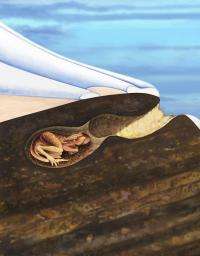
On the heels of his discovery in Montana of the first trace fossil of a dinosaur burrow, Emory University paleontologist Anthony Martin has found evidence of more dinosaur burrows - this time on the other side of the world, in Victoria, Australia. The find, to be published this month in Cretaceous Research, suggests that burrowing behaviors were shared by dinosaurs of different species, in different hemispheres, and spanned millions of years during the Cretaceous Period, when some dinosaurs lived in polar environments.
"This research helps us to better understand long-term geologic change, and how organisms may have adapted as the Earth has undergone periods of global cooling and warming," says Martin, a senior lecturer in environmental studies at Emory. Martin is also an honorary research associate at Monash University in Melbourne.
In 2006, in collaboration with colleagues from Montana State University and Japan, Martin identified the 95-million-year-old skeletal remains of a small adult dinosaur and two juveniles in a fossilized burrow in southwestern Montana. They later named the dinosaur species Oryctodromeus cubicularis, meaning "digging runner of the lair."
The researchers hypothesized that, besides caring for young in their dens, burrowing may have allowed some dinosaurs to survive extreme environments - throwing a wrench in some extinction theories.
'Where luck meets preparation'
A year after the Montana find, Martin traveled to the Victoria coast, which marks the seam where Australia once snuggled against Antarctica. Lower Cretaceous strata of Victoria have yielded the best-documented assemblage of polar dinosaur bones in the world.
During a hike to a remote site known as Knowledge Creek, west of Melbourne, Martin rounded the corner of an outcropping and was astounded to see, right at eye level, the trace fossil of what appeared to be a burrow almost identical to the one he had identified in Montana. "I stared at it for a long time," recalls Martin. "In paleontology, the saying, 'where luck meets preparation' really holds true."
The probable burrow etched into the Early Cretaceous outcrop is about six-feet long and one-foot in diameter. It gently descends in a semi-spiral, ending in an enlarged chamber. Martin later found two similar trace fossils in the same area.
Last period of global warming
The Victoria fossils are about 110 million years old, around the time that Australia split with Antarctica, and dinosaurs roamed in prolonged polar darkness along forested southern Australia river plains. It was one of the last times the Earth experienced global warming, with an average temperature of 68 degrees Fahrenheit - about 10 degrees higher than today.
During the polar winter, though, the temperature could plunge below freezing. Previously, researchers theorized that the small dinosaurs in the region survived harsh weather by sheltering beneath large tree roots or in hollows. Martin's find, however, indicates that they may have dug into the soft banks of rivers flowing out of the rift valley.
The age, size and shape of the likely burrows led Martin to hypothesize that they were made by small ornithopod dinosaurs - herbivores that were prevalent in the region. These ornithopods stood upright on their hind legs and were about the size of a large, modern-day iguana.
"It's fascinating to find evidence connecting a type of behavior between dinosaurs that are probably unrelated, and lived in different hemispheres during different times," Martin says. "It fills in another gap in our understanding of the evolution of dinosaurs, and ways they may have survived extreme environments."
An eye for subtle clues
A specialist in trace fossils - including tracks, scat and burrows - Martin is known for detecting subtle paleontology clues. He also identified the first tracks of a large, carnivorous dinosaur in Victoria, and the first fossil crayfish burrows from the same area.
Martin teaches a seminar at Emory on modern-day animal tracking, a skill that he says aids him in finding signs of prehistoric life. "It's important to do as much field work as possible, because it gives your mind a better library of search images," he says.
Source: Emory University (news : web)


