New technique can fast-track better ionic liquids for biomass pre-treatments
They've been dubbed "grassoline" - second generation biofuels made from inedible plant material, including fast-growing weeds, agricultural waste, sawdust, etc. - and numerous scientific studies have shown them to be prime candidates for replacing gasoline to meet our transportation needs. However, before we can begin to roll down the highways on sustainable, carbon-neutral grassoline, numerous barriers must be overcome, starting with finding ways to break lignocellulosic biomass down into fermentable sugars.
The use of ionic liquids - salts that are liquids rather than crystals at room temperature - to dissolve lignocellulose and later help hydrolyze the resulting liquor into sugars, shows promise as a way of pre-treating biomass for a more efficient conversion into fuels. However, the best ionic liquids in terms of effectiveness are also prohibitively expensive for use on a mass scale. Furthermore, scientists know little beyond the fact that ionic liquids do work. Understanding how ionic liquids are able to dissolve lignocellulosic biomass should pave the way for finding new and better varieties for use in biofuels.
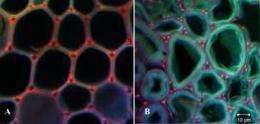
A new technique that is providing some much needed answers has been developed by researchers at the Joint BioEnergy Institute (JBEI), a U.S. Department of Energy Bioenergy Research Center led by the Lawrence Berkeley National Laboratory (Berkeley Lab). Based on the natural auto-fluorescence of plant cell walls, this technique enables researchers for the first time to dynamically track solubilization during an ionic liquid pretreatment of a biomass sample, and to accurately and quickly assess the liquid's performance without the need of labor-intensive and time-consuming chemical and immunological labeling.
"Working with switchgrass and using the ionic liquid known as EmimAc (1-n-ethyl-3-methylimidazolium acetate), which is currently the most effective in terms of pre-treating biomass, we observed a rapid swelling of the secondary plant cell walls within three hours of exposure at relatively mild temperatures (120 degrees Celsius)," says Blake Simmons, a chemical engineer who is Vice President of JBEI's Deconstruction Division and was the principal investigator for this research. "We attributed the swelling to disruption of inter- and intra-molecular hydrogen bonding between cellulose fibrils and lignin. The swelling was followed by complete dissolution of biomass. This is the first study to show the process by which biomass solubilization occurs in an ionic liquid pre-treatment."
Simmons says that once the EmimAc had dissolved the switchgrass biomass into its three components - cellulose and hemicellulose sugars, plus lignin, the woody fiber that gives strength and structure to plant cell walls - the subsequent addition of an anti-solvent, such as water, resulted in the sugars being precipitated out while the lignin remained in solution, a requirement for recovering the sugars. This confirmed that the ionic liquid pre-treatment effectively disrupted the recalcitrance of the switchgrass biomass and helped liberate the fermentable sugars.
"In comparison to untreated biomass, ionic liquid pretreated biomass produces cellulose that is efficiently hydrolyzed with commercial cellulase cocktail and provides sugar yields over a relatively short time interval," Simmons says. "We are now in the process of evaluating other ionic liquids to discover the optimal combination of cost and performance."
The results of this study were reported in the journal Biotechnology and Bioengeering in a paper entitled:
"Visualization of Biomass Solubilization and Cellulose Regeneration During Ionic Liquid Pretreatment of Switchgrass" Co-authoring the paper with Simmons were his JBEI colleague Seema Singh, and Kenneth Vogel, of the Agricultural Research Service. Simmons and Singh also hold appointments with Sandia National Laboratories.
Auto-fluorescence is an intrinsic optical property of biological materials that has often been viewed as a nuisance by scientists trying to image specific biological objects. Living cells contain molecules which fluoresce when excited by the right light and this fluorescence can compete with the signals obtained from the fluorophore dyes or markers used to label biological objects of interest. Simmons and Singh have turned this "nuisance" into an effective tool. Using auto-fluorescence in combination with a variety of microscopy and spectroscopy techniques, they were able to map and visualize cellulose and lignin first in pristine switchgrass and then during treatment with the EmimAc ionic liquid. Their results demonstrate that this label-free visualization and mapping technique can provide a means of rapidly screening a wide range of ionic liquids for pre-treating switchgrass and other biomass material.
"Our approach can be used to evaluate the deconstruction of lignocellulosics in biomass of different chemical compositions, and also to assist in determining the impact of genetically engineered feedstocks," Simmons says. "By
utilizing this technique, the development and selection of pre-treatment conditions for the selective solubilization and fractionation of either polysaccharides or lignin could be tailored for the development of cost-effective biomass pre-treatments with enhanced yields of sugars."
The ultimate goal, Simmons says is to find an ionic liquid that can efficiently pre-treat biomass, then scale its use up into a cost-effective process for biorefineries. Ideally, he and his colleagues would like to identify a single versatile ionic liquid that is capable of producing enriched polysaccharide and lignin output streams irrespective of fuel types. But there is much more basic research ahead.
"Right now ionic liquids are a bench-top technique," Simmons says, "and there are research and engineering obstacles that must be solved before this technology is ready for prime time. But the drivers are clear, and ionic liquids offer processing advantages that no other current commercial pre-treatment technology can provide."
Source: Lawrence Berkeley National Laboratory (news : web)


