Special alloy sleeves urged to block hackers?
July 12, 2009 By TODD LEWAN , AP National Writer
Special alloy sleeves urged to block hackers? (AP)

Enlarge

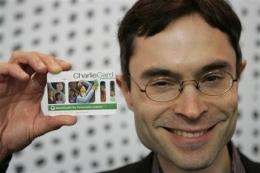
In this, April 22, 2009 photo, Ari Juels, chief scientist and director for RSA Laboratories, holds a Massachusetts public transportation card with an RFID (radio frequency identification) security chip imbedded in it at the RSA Security Conference in San Francisco. (AP Photo/Marcio Jose Sanchez)

(AP) -- To protect against skimming and eavesdropping attacks, federal and state officials recommend that Americans keep their e-passports tightly shut and store their RFID-tagged passport cards and enhanced driver's licenses in "radio-opaque" sleeves.

That's because experiments have shown that the e-passport begins transmitting some data when opened even a half inch, and chipped passport cards and EDLs can be read from varying distances depending on reader techonology.
The cover of the e-passport booklet contains a metallic sheathing that can diminish the distances travel, presumably hindering unwanted interceptions. Alloy envelopes that come with the PASS cards and driver's licenses do the same, the government says.

The State Department asserts that hackers won't find any practical use for data skimmed from RFID chips embedded in the cards, but "if you don't want the cards read, put them in an attenuation sleeve," says John Brennan, a senior policy adviser at the Office of Consular Affairs.

Gigi Zenk, a spokeswoman for the Washington state Department of Licensing, says the envelope her state offers with the enhanced driver's license "ensures that nothing can scan it at all."

But that wasn't what researchers from the University of Washington and RSA Laboratories, a company in Bedford, Mass., found last year while testing the data security of the cards.

The PASS card "is readable under certain circumstances in a crumpled sleeve," though not in a well maintained sleeve, the researchers wrote in a report.

Another test on the enhanced driver's license demonstrated that even when the sleeve was in pristine condition, a clandestine reader could skim data from the license at a distance of a half yard.

Will Americans consistently keep their enhanced driver's licenses in the protective sleeves and maintain those sleeves in perfect shape - even as driver's licenses are pulled out for countless tasks, from registering in hotels to buying alcohol?

The report's answer: "It is uncertain ... "

And when the sleeves come off, "you're essentially saying to the world, 'Come and read what's in my wallet,'" says Marc Rotenberg, executive director of the Electronic Privacy Information Center in Washington, D.C.

By obliging Americans to use these sleeves, he says, the government has, in effect, shifted the burden of privacy protection to the citizen.

Meanwhile, researchers have raised other red flags.

- In 2006, a mobile security company, Flexilis, conducted an experiment in which the transponder of a partially opened e-passport triggered an explosive planted in a trashcan when a dummy carrying the chipped passport approached the bin. A video of the experiment was shown that year at a security conference.

Flexilis has suggested that the government adopt a dual cover shield and specifically designed RFID tag that would make the e-passport remotely unreadable until it is fully opened.

No changes have been made to the U.S. e-passport in response, according to the State Department.
- Some RFID critics wonder: Could government officials read the microchips in an enhanced driver's license or passport card by scanning people via satellite or through a cell phone tower network?

The short answer is no - because the chips in PASS cards and EDLs are "passive," or batteryless, meaning they rely on the energy of readers to power up. Passive tags are designed to beam information out 30 feet.

However, research is moving forward to make batteries tinier and more powerful, says Ari Juels, director of RSA Laboratories. A "semi-passive" tag that could transmit into the atmosphere when triggered by a reader "may be feasible at some point," he says.

Separately, a system called STAR, that adapts deep-space communications technologies to read passive tags from distances greater than 600 feet, was announced last year by a Los Angeles startup called Mojix, Inc. It uses "smart antennas" and "digital beam forming" to process signals in four dimensions - time, space, frequency and polarization. Mojix, founded by a former NASA scientist, promotes the technology for supply chain management and asset tracking.

©2009 The Associated Press. All rights reserved. This material may not be published, broadcast, rewritten or redistributed.

Filter


Move the slider to adjust rank threshold, so that you can hide some of the comments.


Display comments: newest first

marjon
Jul 12, 2009

Rank: 4 / 5 (1)
Try a stainless steel wallet:
http://www.thinkg...ar/9964/
MorituriMax
Jul 12, 2009

Rank: 2 / 5 (1)
I'll be interested if someone comes up with a wallet that acts like a farraday cage.
physpuppy
Jul 12, 2009

Rank: 5 / 5 (3)
I suppose nowadays it's not enough to wear a tinfoil hat - you need a tinfoil wallet as well!

I like the James-Bondish reference in the article to the test where an explosive went off when a particular passport was opened slightly...

In 2006, a mobile security company, Flexilis, conducted an experiment in which the transponder of a partially opened e-passport triggered an explosive planted in a trashcan when a dummy carrying the chipped passport approached the bin. A video of the experiment was shown that year at a security conference.
waltaugust
Jul 12, 2009

Rank: 5 / 5 (1)
The special alloy sleeves they are talking about are made by Identity Stronghold. They make the sleeve for the US Passport cards, many state enhanced drivers licenses as well as passport books and credit cards. Yes even new credit cards have RFID chips that give out your credit card number and expiration date. You can find them at www.idstronghold.com
x646d63
Jul 12, 2009

Rank: 4 / 5 (1)
I'm seriously considering building an "attenuation sleeve" to live in.
frogz
Jul 13, 2009

Rank: not rated yet
RFID's are a bad idea, period.
scpsr1
Jul 13, 2009

Rank: not rated yet
Just don't keep your wallet anywhere near your groin area if you want children.
marjon
Jul 13, 2009

Rank: not rated yet
How many of you concerned about RFID remove your cell phone battery to keep from being tracked?
jabo
Jul 13, 2009

Rank: not rated yet
you can smash those rfid chips with a hammer to disable them and officials can still scan the bar code to get the info. just play dumb when they ask you why your passport doesn't 'work'.
Rank 5 /5 (8 votes)
Relevant PhysicsForums posts
  • Mechanics of Solids ( Final exam question) plz help!
    created1 hour ago
  • RFAC in Fortran
    created4 hours ago
  • dynamics 2/32
    created10 hours ago
  • dynamics
    created10 hours ago
  • Vibration Absorbtion Problem
    created15 hours ago
  • Does anyone make a small high temperature and high pressure pump?
    created21 hours ago
  • More from Physics Forums - General Engineering

More news stories

Researchers discover potential key to lowering energy costs of cell phones and data centers

(PhysOrg.com) -- A systematic analysis of power usage in microprocessors could help lower the energy consumption of both small cellphones and giant data centers, report computer science professors from The University of Texas ...

Technology / Computer Sciences

created 6 minutes ago | popularity not rated yet | comments 0 | with audio podcast

Log onto Facebook, contribute to scientific research

(PhysOrg.com) -- Logging on to Facebook could soon be a way of contributing to important scientific research, as well as finding out what’s going on in your world.

Technology / Internet

created 14 minutes ago | popularity not rated yet | comments 0

Soraa LED light may dim 50-watt halogen rivals

(PhysOrg.com) -- Soraa, a Fremont, California company founded in 2008, this week launched its first product, a light that uses LEDS (light emitting diodes). The "Soraa LED MR16 lamp" is the "perfect" replacement for traditional ...

Technology / Semiconductors

created 44 minutes ago | popularity not rated yet | comments 0 | with audio podcast report

Lenovo 3Q profit up by half, warns of disk supply

(AP) -- Lenovo Group Ltd., the world's second biggest personal computer maker, said Thursday that quarterly profit grew by more than half but warned hard drive costs would remain high amid a global shortage.

Technology / Business

created 1 hour ago | popularity not rated yet | comments 0

Facebook discloses details on bonuses

Facebook's top executives, including CEO Mark Zuckerberg, are eligible for twice-a-year bonuses of up to 45 percent of their base salaries and other earnings, according to a Wednesday regulatory filing.

Technology / Business

created 1 hour ago | popularity 1 / 5 (1) | comments 0


Women who eat fish have lower colon polyp risk

(Medical Xpress) -- Women who eat at least three servings of fish per week have a reduced risk of developing some types of colon polyps according to a new study by Vanderbilt-Ingram Cancer Center investigators.

Study shows calories drive earlier puberty

(Medical Xpress) -- Environmental pollutants, eating habits, lack of exercise and genetic traits have all been raised as possible causes of earlier puberty onset in girls in recent years.

Commonly used vitamin could help produce 'good' cholesterol, researchers find

(Medical Xpress) -- Maintaining healthy cholesterol levels can keep heart disease, heart attack and stroke away. And a commonly used vitamin could help by increasing production of “good” cholesterol in the body, ...

Bonding out: Making companies pay up front for potential environmental disasters

Whether it’s building an oil pipeline, drilling for fuel in the ocean or “fracking” to flush natural gas out of the Earth, we’re often asked to believe the process is safe, when companies want to do something ...

Life in Antarctic lake? It's everywhere else

If scientists find microbes in a frigid lake two miles beneath the thick ice of Antarctica, it will illustrate once again that somehow life finds a way to survive in the strangest and harshest places.

Fruit flies drawn to the sweet smell of youth

Aging takes its toll on sex appeal and now an international team of researchers led by Baylor College of Medicine and the University of Michigan find that in fruit flies, at least, it even diminishes the come-hither ...