Superconductivity: Which one of these is not like the other?
July 13, 2009 Superconductivity: Which one of these is not like the other?

Enlarge

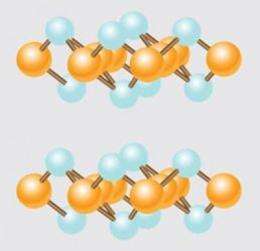
Superconductivity appears to rely on very different mechanisms in two varieties of iron-based superconductors. Credit: American Physical Society [Illustration: Alan Stonebraker]

Superconductivity appears to rely on very different mechanisms in two varieties of iron-based superconductors. The insight comes from research groups that are making bold statements about the correct description of superconductivity in iron-based compounds in two papers about to be published in journals of the American Physical Society.

The 2008 discovery of in iron-based compounds has led to a flood of research in the past year. As the literature mounts on these materials, which superconduct at temperatures as high as 55 K, two key questions are emerging: Is the origin of superconductivity in all of the iron-based compounds the same and are these materials similar to the copper oxide-based high-temperature superconductors (commonly known as cuprates), which physicists have studied for nearly twenty years but are still unable to explain with a complete theory?

These questions are addressed separately in two papers highlighted in the July 13 issue of Physics. A collaboration between scientists at Lawrence Berkeley National Lab, the SLAC National Accelerator Laboratory, Stanford University and institutions in Switzerland, China, Mexico and the Netherlands reports in Physical Review B x-ray experiments indicating that, in iron-based superconductors that contain arsenic or phosphorous (called 'iron pnictides'), the electrons that ultimately pair to form the superconducting state behave differently than those in the cuprates. More specifically, while the electrons in the cuprates are strongly correlated - meaning the energy of one electron is tied to the energy of the others - the electrons in the iron-pnictide superconductors behave more like those of a normal metal in which the electrons do not (to first approximation) interact.

In a paper appearing in , scientists at Princeton, UC Berkeley and Shanghai Jiao Tong University in China present the first photoemission measurements on an iron-based superconductor that contains tellurium, Fe1+xTe. They argue the origin of superconductivity in this type of iron compound, which belongs to a class of materials called the iron-chalcogenides, has a different origin than in the arsenic and phosphorous containing iron-pnictides. In fact, the measurements suggest that in the iron-chalcogenides may be more similar to that of the cuprates.

The statements put forth in these two articles are likely to influence the direction taken by physicists who work on the theory of iron-based . See the Viewpoint article in the July 13 issue of APS Physics to learn more.

More information: http://physics.aps.org/

Source: American Physical Society


Rate this story - 4.4 /5 (7 votes)

Rank Filter

Move the slider to adjust rank threshold, so that you can hide some of the comments.


Display comments: newest first

  • Nik_2213 - Jul 13, 2009
    • Rank: not rated yet
    The more variations, the merrier...

    Perhaps a 'pattern' will emerge.
  • gmurphy - Jul 13, 2009
    • Rank: not rated yet
    my new favourite word : pnictides, ;-), but on a serious note, I agree with with Nik

July 13, 2009 all stories

Comments: 2

4.4 /5 (7 votes)

  • hide
  • Related Stories

  • New theory for latest high-temperature superconductors
    created Aug 13, 2008 | popularity not rated yet | comments 0
  • Physicists offer new theory for iron compounds
    created Mar 12, 2009 | popularity not rated yet | comments 0
  • Scientists prove unconventional superconductivity in new iron arsenide compounds
    created Jan 09, 2009 | popularity not rated yet | comments 0
  • Magnetism Governs Properties of Iron-Based Superconductors
    created Mar 18, 2009 | popularity not rated yet | comments 0
  • Putting the Pressure on Iron-Based Superconductors
    created Mar 05, 2009 | popularity not rated yet | comments 0


  • hide
  • Relevant PhysicsForums posts

  • Interception angle
    created 1hour ago
  • Pressure created by clamping base and cover
    created 1hour ago
  • How to find static friction
    created 7 hours ago
  • Calculating decible increases
    created 14 hours ago
  • More from Physics Forums - General Physics

Other News

Extra large carbon

Extra large carbon

Physics / General Physics

created 14 hours ago | popularity 4.7 / 5 (12) | comments 7 | with audio podcast

An exotic form of carbon has been found to have an extra large nucleus, dwarfing even the nuclei of much heavier elements like copper and zinc, in experiments performed in a particle accelerator in Japan. ...


Scientist explore future of high-energy physics

Scientist explore future of high-energy physics

Physics / General Physics

created 20 hours ago | popularity 4.9 / 5 (12) | comments 8 | with audio podcast

In a 1954 speech to the American Physical Society, the University of Chicago's Enrico Fermi fancifully envisioned a particle accelerator that encircled the globe. Such would be the ultimate theoretical outcome, ...


Leaf veins inspire a new model for distribution networks (w/ Video)

Physics / General Physics

created 17 hours ago | popularity 5 / 5 (3) | comments 0 | with audio podcast

(PhysOrg.com) -- Following the straight and narrow may be good moral advice, but it’s not a great design principle for a distribution network. In new research, a team of biophysicists describe a complex netting of interconnected ...


New magnetic tuning method enhances data storage

New magnetic tuning method enhances data storage

Physics / General Physics

created 21 hours ago | popularity 4.2 / 5 (5) | comments 0 | with audio podcast

Researchers in Chicago and London have developed a method for controlling the properties of magnets that could be used to improve the storage capacity of next-generation computer hard drives.


High-performance microring resonator developed by INRS researchers

Physics / Optics & Photonics

created 13 hours ago | popularity 1.5 / 5 (2) | comments 0

A new, more efficient low-cost microring resonator for high speed telecommunications systems has been developed and tested by Professor Roberto Morandotti's INRS team in collaboration with Canadian, American, and Australian ...