Screens replace greens for South Korean golfers
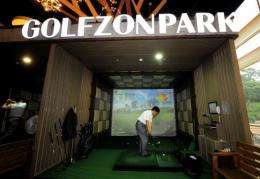
Park Joong-Soon raised his putter triumphantly after sinking a five-metre birdie on the final hole and pocketed his winnings from friends -- all without leaving the comfort of his local cafe.
"I will spend this money tonight on drinking with my friends," Park said contentedly after an 18-hole round at Bawoo Screen Golf in southern Seoul.
Virtual reality golf cafes have boomed in recent years in hi-tech and densely populated South Korea, where real courses are often expensive and overbooked.
Gallup Korea predicts the number of golf cafes will rise to 5,000 at the end of this year from 3,000 a year earlier. The domestic screen-golf market is now estimated to be worth 600 billion won (472 million dollars) a year.
"I never imagined such a boom," said Kim Young-Chan, head of top simulator producer Golfzon which pioneered the market by combining golf with IT technology.
His company estimates there are about 82,000 daily visits to the golf cafes -- some of them repeat visits by avid fans -- compared to about 65,000 who visit real courses daily.
The cafes charge 20,000-30,000 won (16-23 dollars) per person for an 18-hole game, compared to an average 200,000 won on an actual course.
And for Park and others, the experience is not so far from reality.
"I almost feel like I'm actually playing on the fairway thanks to the vivid colours and good image quality," the 57-year-old told AFP, donning his necktie again after finishing his round.
Bawoo's six simulation rooms feature comfortable sofas and projectors showing high-definition virtual reality fairways on four-by-three metre (13-by-10 feet) flexible plastic screens.
"You can come here anytime. The cafe owner provides everything -- balls, clubs, shoes and even soft drinks," said Park, who visits golf cafes once a week after dinner with friends.
"This is a cheap alternative for people like me who can't visit real courses often because of busy work schedules."
A golf craze began in the late 1990s with the international success of Korean stars such as Pak Se Ri, who won two US LPGA majors in her debut season.
Computer golf made its debut here in 2004, in time to take advantage of the enthusiasm. Golfzon's Kim estimates that one million Koreans play it regularly.
The company controls more than 60 percent of the simulator market, with sales tripling from 31 billion won in 2007 to 100.9 billion won last year including exports worth 3.6 million dollars.
"Screen golf is exciting and addictive," Kim enthused.
Golfzon uses aerial photos of famous courses at home and abroad to simulate lifelike bunkers, trees and water hazards on the screen.
Players hit an actual ball into the flexible screen, with infrared sensors analysing the club's speed and the ball's trajectory and spin.
The rubber tee can be adjusted, depending which driver a player uses. The computer tilts a swing mat covered with artificial grass to replicate the incline on the fairway for a second shot.
Kim has also set up an online network to connect golf cafes and organise tournaments.
"Screen golf has its own merits, although it has yet to satisfy low-handicap players," said Park's friend Lee Myong-Yong, who visits real courses at least twice a month as well as golf cafes.
It attracts office workers, young housewives and college students who can't afford the expensive real sport, he said.
Cafe owners say golf cafes also cater to Koreans' fondness for getting together away from their homes.
"Screen golf has created a unique market in our country, where people prefer rooms for chatting and socialising," said Han Woo-Seong, who invested 170 million won to open a golf cafe near downtown Seoul in December 2007.
But the market will soon become saturated without further improvement in technology and content to attract serious players, he said.
Han, 43, earned up to 400,000 won a day last year but revenue nose-dived this year after two more golf cafes opened in his neighbourhood.
"Screen golf has made the sport more popular than before, absorbing many beginners, but it has a long way to go," he said.
Golfzon sees a promising market in some other Asian countries.
"In view of growing demand for simulators abroad, I believe screen golf will become a global trend," Kim said, vowing to nurture the industry as a major hard currency earner for Korea, like cars and microchips.
He dreams of hosting an international online championship involving world stars.
(c) 2009 AFP


