Monkey economy works
(PhysOrg.com) -- A monkey that has acquired the sole power to hand out apples is generously rewarded with grooming sessions by the other monkeys in its group. But as soon as another monkey can hand out apples as well, the market value of the first monkey is halved. The monkeys therefore unerringly obey the law of supply and demand. Dutch-sponsored researchers Ronald Noë, Cécile Fruteau and Eric van Damme demonstrated this in their article that was published online on 7 July by the renowned journal PNAS (Proceedings of the National Academy of Sciences).
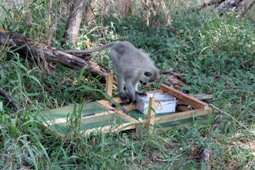
Cécile Fruteau placed food containers with highly-desired pieces of apple in two groups of South African vervet monkeys. For the monkeys there was just one problem: only one in each group could open the food container. This monkey had a low position in the rank order and was therefore scarcely groomed. However, as soon as she acquired the power to hand out apples she was valued more and was groomed a lot by the rest of the group. Yet she could only enjoy that privilege briefly; the researchers placed a second food container that could be opened by another low-ranking female. From that moment onwards the market value of the first monkey was halved, and she was therefore groomed half as often.
Long-term planning
The experiments revealed that the female monkeys that could open the food containers were groomed more than when they exerted no power over the food production. The females concerned also did not have to groom the other monkeys as long. They were therefore paid for their services as food suppliers. Biological market theory predicts that the market value of these female monkeys should vary according to the law of supply and demand. The fact that the grooming time of the first monkey was halved as soon as the second monkey gained the power to distribute apples, confirms this idea; the price of goods - in this case the female monkeys who could open the containers - was instantaneously adjusted to the market.
Immediately after the opening of the food containers, the researchers registered how long the females were groomed for. The next occasion on which the females could open a container was, however, several days later. The fact that the females were still groomed more indicates that the vervet monkeys apply a strategy that works in the long term. The choice of partners is also influenced by long-term attitudes; the monkeys can value one monkey relatively more than the others.
A change in price - grooming for less long if there is another monkey that supplies apples - is only possible if a negotiation process takes place. Many economists assume that such negotiations can only take place if they are concluded with a contract. However, the vervet monkeys do not have the possibility to conclude such binding contracts and yet they still succeed in agreeing to a change in price for a service.
The research of Eric van Damme (Tilburg University) and Ronald Noë (University of Strasbourg) is part of the Evolution and Behaviour research programme of the NWO Division for Social Sciences.
Provided by NWO


