Active genes discovered in the developing mammal brain
A study by scientists at Penn State provides new information about the genes that are involved in a mammal's early brain development, including those that contribute to neurological disorders. The study is the first to use high-throughput sequencing to uncover active genes in developing brains, and it is likely the best evidence thus far for the activity in the brain of such a large number of genes.
The research results one day could lead to the development of drugs or gene therapies that treat neurological disorders such as autism and mental retardation. The research, which was led by Distinguished Professor of Biology Hong Ma and Associate Professor of Biology Gong Chen, will be published online in the Early Edition of the Proceedings of the National Academy of Sciences sometime during the week of 13 July 2009.
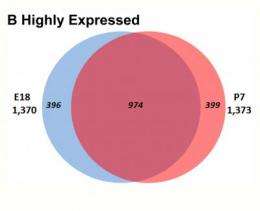
In this study, the team used a high-throughput technique to sequence millions of messenger-RNA molecules, which carry genetic information from DNA molecules to protein molecules. The researchers obtained the RNA from the brains of mice, which are an important model system for studying human biology. They found that over 16,000 genes -- more than half of the mouse's entire set of known genes -- are involved in the brain's development and functions. "The brain represents one of the most, if not the most, complex organs in a mammal's body," said Ma. "So we weren't surprised to find that the number of genes that are active in the brain is so high."
The researchers focused on two critical times during the development of a mouse's brain: embryonic day 18 (E18) and post-natal day 7 (P7). "These two time points represent major milestones during brain formation," said Ma. "Brain development in an 18-day-old embryo involves a significant amount of brain cells, or neurons. In contrast, brain development in a seven-day-old infant involves the formation of numerous connections between these neurons. Our goal was to determine which genes are active during these two critical times."
The scientists examined genes that correspond to the RNA molecules from the cortex of a mouse. "The cortex is the surface portion of the large brain that is responsible for most cognitive and sensory abilities," said Ma. The team found that over 3,700 of the 16,000 genes that they had identified have different levels of activity between the E18 and P7 time points. "This differential activity tells us about the differences in the brain at these two stages," said Ma. "For example, the genes that are active at E18, but not at P7, probably are important during E18. We get some support for this notion when we see that certain genes that already are known to be involved in cell division are actively expressed during E18, while other genes that are known to play a role in building the connections between neurons are much more active at P7."
Some of the genes that the researchers found in mice are known to be matched to the human genes that are
involved in neurological disorders, such as Alzheimer's disease, autism, and some forms of mental retardation. "Our results can help to pinpoint the specific time during brain development when the genes related to certain diseases are active," said Ma. "This knowledge may help other scientists to develop drugs or gene therapies that can treat the diseases. For example, if a particular gene defect causes poorly constructed connections between certain neurons, a drug might be developed that enhances those connections to compensate for the gene defect."
Ma said his future research plans include looking at some of the genes to see whether they are important for the brain to be formed properly. Chen plans to investigate, specifically, how genes function in development disorders of the brain. This research was supported by Penn State, the National Institutes of Health, and the National Science Foundation.
Source: Pennsylvania State University (news : web)


