Researchers find early markers of Alzheimer's disease
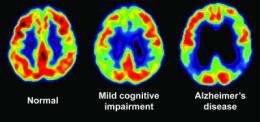
A large study of patients with mild cognitive impairment revealed that results from cognitive tests and brain scans can work as an early warning system for the subsequent development of Alzheimer's disease.
The research found that among 85 participants in the study with mild cognitive impairment, those with low scores on a memory recall test and low glucose metabolism in particular brain regions, as detected through positron emission tomography (PET), had a 15-fold greater risk of developing Alzheimer's disease within two years, compared with the others in the study.
The results, reported by researchers at the University of California, Berkeley, on Tuesday, July 14, at the Alzheimer's Association 2009 International Conference on Alzheimer's Disease in Vienna, Austria, are a major step forward in the march toward earlier diagnoses of the debilitating disease.
"Not all people with mild cognitive impairment go on to develop Alzheimer's, so it would be extremely useful to be able to identify those who are at greater risk of converting using a clinical test or biological measurement," said the study's lead author, Susan Landau, a post-doctoral fellow at UC Berkeley's Helen Wills Neuroscience Institute and the Lawrence Berkeley National Laboratory.
"The field, in general, is moving toward ways to select people during earlier stages of Alzheimer's disease, including those who show no outward signs of cognitive impairment," said Dr. William Jagust, a faculty member of UC Berkeley's Helen Wills Neuroscience Institute and principal investigator of the study. "By the time a patient is diagnosed with Alzheimer's disease, there is usually little one can do to stop or reverse the decline. Researchers are trying to determine whether treating patients before severe symptoms appear will be more effective, and that requires better diagnostic tools than what is currently available."
In the latest study, researchers compared a variety of measurements that had previously shown promise as early detectors of Alzheimer's. The measurements included scores on the Auditory Verbal Learning Test; the volume of the hippocampus, the part of the brain associated with the formation of new memory; the presence of the apolipoprotein E4 gene, which has been linked to increased risk of Alzheimer's; certain proteins found in the cerebrospinal fluid; and glucose metabolism detected in PET brain scans. A low rate of glucose metabolism in a particular brain region is considered a sign of poor neural function, most likely due to the loss of synapses in that area.
"What's really novel about our study is that we evaluated all of these biomarkers in the same subjects, so we could more easily compare the predictive value of any one measure over the others," said Landau. "The Auditory-Verbal Learning Test, which measures memory recall ability, and the PET scans measuring glucose metabolism were the two markers that clearly stood out over the others."
The researchers pointed out that other measurements - in particular, hippocampus volume and the cerebrospinal fluid markers - also showed promise in predicting disease progression. However, when considering all the measurements together, PET scans and memory recall ability were the most consistent predictors. The researchers expect to have more complete information about which measures serve as the best predictors in a year as they continue to gather data for this ongoing study.
An earlier study led by Jagust, a professor with joint appointments at UC Berkeley's School of Public Health and the Lawrence Berkeley National Laboratory, found that PET scans and magnetic resonance imaging (MRI) could detect neurological changes in asymptomatic people who subsequently developed dementia or mental impairment, although it was too soon to say if those people would go on to develop Alzheimer's.
The research is part of the nationwide Alzheimer's Disease Neuroimaging Initiative, a 60-center study funded by the National Institute on Aging. The ultimate goal of the initiative is to find a biomarker for Alzheimer's that would predict individuals who will later develop Alzheimer's disease. Ideally, this marker would be identifiable very early, even in individuals who do not yet show signs of mental impairment.
Jagust heads the initiative's research on PET imaging. The UC Berkeley study includes those patients who had measures for all biomarkers.
Source: University of California - Berkeley (news : web)


