New map hints at Venus's wet, volcanic past (w/ Video)
July 14, 2009 New map hints at Venus's wet, volcanic past

Enlarge

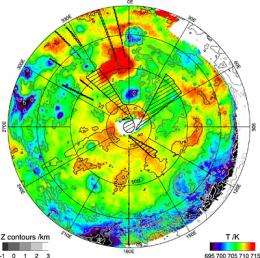
The first temperature map of the planet's southern hemisphere at infrared wavelengths, charted with Venus Express's Visible and Infrared Thermal Imaging Spectrometer, VIRTIS. The new map hints that our neighbouring world may once have been more Earth-like, with a plate tectonics system and an ocean of water. The map comprises over a thousand individual images, recorded between May 2006 and December 2007, from a distance of about 60 000 km. Because Venus is covered in clouds, normal cameras cannot see the surface, but Venus Express used a particular infrared wavelength that can see through them. The new data are consistent with suspicions that the highland plateaus of Venus are ancient continents, once surrounded by ocean and produced by past volcanic activity. The map is centred at the South Pole. The measured temperatures range from 442°C (or 715K), red to 422°C (or 695K) blue; higher temperatures correspond to lower altitudes, while lower temperature correspond to higher altitudes. The temperature difference is key to understanding whether Venus is volcanically active today. However, a 'flux anomaly' may be related to temperature difference and to different surface emissivity. Credits: ESA/VIRTIS/INAF-IASF/Obs. de Paris-LESIA

(PhysOrg.com) -- Venus Express has charted the first map of Venus's southern hemisphere at infrared wavelengths. The new map hints that our neighbouring world may once have been more Earth-like, with both, a plate tectonics system and an ocean of water.

The map comprises over a thousand individual images, recorded between May 2006 and December 2007. Because Venus is covered in clouds, normal cameras cannot see the surface, but Venus Express used a particular that can see through them.

Although radar systems have been used in the past to provide high-resolution maps of Venus's surface, Venus Express is the first orbiting spacecraft to produce a map that hints at the of the rocks. The new data is consistent with suspicions that the highland plateaus of Venus are ancient continents, once surrounded by ocean and produced by past .

You need Flash installed to watch this ideo

This animation is an artist's interpretation of a possible volcano on Venus. In fact, from previous missions to the planet, Venus appears to be among the most geologically active planets in the solar system. Venus Express is able to detect gaseous markers in the lower layers of the atmosphere and variations in its temperature, possible signs of volcanic activity. Local variations in atmospheric temperature and pressure may also indicate the presence of seismic activity. Credit: ESA (Animation by AOES Medialab)

"This is not proof, but it is consistent. All we can really say at the moment is that the plateau rocks look different from elsewhere," says Nils Müller at the Joint Planetary Interior Physics Research Group of the University Münster and DLR Berlin, who headed the mapping efforts.

The rocks look different because of the amount of infrared light they radiate into space, similar to the way a brick wall heats up during the day and gives off its heat at night. Besides, different surfaces radiate different amounts of heat at infrared wavelengths due to a material characteristic known as emissivity, which varies in different materials. The Visible and Infrared Thermal Imaging Spectrometer (VIRTIS) instrument captured this infrared radiation during Venus's night-time orbits around the planet's southern hemisphere.

The eight Russian landers of the 1970s and 1980s touched down away from the highlands and found only basalt-like rock beneath their landing pads. The new map shows that the rocks on the Phoebe and Alpha Regio plateaus are lighter in colour and look old compared to the majority of the planet. On Earth, such light-coloured rocks are usually granite and form continents.

Granite is formed when ancient rocks, made of basalt, are driven down into the planet by shifting continents, a process known as . The water combines with the basalt to form granite and the mixture is reborn through volcanic eruptions.

"If there is granite on Venus, there must have been an ocean and plate tectonics in the past," says Müller.

Müller points out that the only way to know for sure whether the highland plateaus are continents is to send a lander there. Over time, Venus's water has been lost to space, but there might still be volcanic activity. The infrared observations are very sensitive to temperature. But in all images they saw only variations of between 3-20°C, instead of the kind of temperature difference they would expect from active lava flows.

Although Venus Express did not see any evidence of ongoing volcanic activity this time this time around, Müller does not rule it out. "Venus is a big planet, being heated by radioactive elements in its interior. It should have as much volcanic activity as Earth," he says. Indeed, some areas do appear to be composed of darker rock, which hints at relatively recent volcanic flows.

The new map gives astronomers another tool in their quest to understand why is so similar in size to Earth and yet has evolved so differently.

Source: European Space Agency (news : web)


Rate this story - 4.1 /5 (8 votes)


July 14, 2009 all stories

Comments: 0

4.1 /5 (8 votes)

  • hide
  • Related Stories

  • Europe's Venus Express is ready for launch
    created Nov 08, 2005 | popularity not rated yet | comments 0
  • Venus Express reboots the search for active volcanoes on Venus
    created Apr 04, 2008 | popularity not rated yet | comments 0
  • Venus Express sees right down to the hell-hot surface
    created Dec 14, 2006 | popularity not rated yet | comments 0
  • Venus Express searching for life – on Earth
    created Oct 10, 2008 | popularity not rated yet | comments 0
  • Complex meteorology at Venus
    created Oct 13, 2006 | popularity not rated yet | comments 0


  • hide
  • Relevant PhysicsForums posts

  • Spreading Life in the Universe
    created 9 hours ago
  • Force of Gravity in terms of Density
    created Feb 08, 2010
  • what is the relation between gravity and light?
    created Feb 08, 2010
  • Does the Thermoelectric effect apply in sun?
    created Feb 07, 2010
  • More from Physics Forums - General Astronomy

Other News

Rho Ophiuchus cloud

Professor: We have a 'moral obligation' to seed universe with life

Space & Earth / Astronomy

created 19 hours ago | popularity 3.1 / 5 (24) | comments 49 | with audio podcast report

(PhysOrg.com) -- Eventually, the day will come when life on Earth ends. Whether that’s tomorrow or five billion years from now, whether by nuclear war, climate change, or the Sun burning up its fuel, the last ...


Climate 'Tipping Points' May Arrive Without Warning, Says Top Forecaster

Space & Earth / Environment

created 8 hours ago | popularity 3.7 / 5 (6) | comments 5 | with audio podcast

(PhysOrg.com) -- A new University of California, Davis, study by a top ecological forecaster says it is harder than experts thought to predict when sudden shifts in Earth's natural systems will occur -- a worrisome finding ...


A new 3-D map of the interstellar gas within 300 parsecs from the sun

A new 3D map of the interstellar gas within 300 parsecs from the Sun

Space & Earth / Astronomy

created 10 hours ago | popularity 5 / 5 (4) | comments 0 | with audio podcast

(PhysOrg.com) -- Astronomy & Astrophysics is publishing new 3D maps of the interstellar gas in the local area around our Sun. A French-American team of astronomers presents new absorption measurements toward ...


38 percent of world's surface in danger of desertification

38 percent of world's surface in danger of desertification

Space & Earth / Environment

created 4 hours ago | popularity 2.3 / 5 (3) | comments 4

A team of Spanish researchers has measured the degradation of the planet's soil using the Life Cycle Assessment (LCA), a scientific methodology that analyses the environmental impact of human activities, and ...


Russian Soyuz TMA-17 rocket blasts off to the International Space Station

Russia wants to charge more for rides to space: report

Space & Earth / Space Exploration

created 21 hours ago | popularity 5 / 5 (3) | comments 5

Russia, which is set to hold a monopoly on flights to the international space station (ISS), wants to charge more for rides on its Soyuz rocket, the space agency head said Tuesday.