Turbulence responsible for black holes' balancing act
July 14, 2009 Turbulence responsible for black holes' balancing act

Enlarge

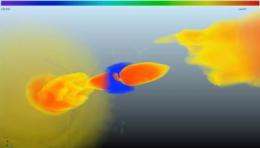
This is a snapshot of gas temperatures in a three-dimensional computer simulation of a cool-core cluster. The blue ring shows the cool gas accreting onto the central black hole disk; the red and yellow jets show the hot gas ejected by this disk. Older bubbles from an earlier outburst are visible on the far left and right sides of the image. Turbulence generated by the jets mixes the hot and cool material together, which stabilizes further accretion and allows the cluster to perform its remarkable balancing act. Credit: E. Scannapieco/ M. Brueggen / ASU Fulton High Performance Computing Initiative

We live in a hierarchical Universe where small structures join into larger ones. Earth is a planet in our Solar System, the Solar System resides in the Milky Way Galaxy, and galaxies combine into groups and clusters. Clusters are the largest structures in the Universe, but sadly our knowledge of them is not proportional to their size. Researchers have long known that the gas in the centers of some galaxy clusters is rapidly cooling and condensing, but were puzzled why this condensed gas did not form into stars. Until recently, no model existed that successfully explained how this was possible.

Evan Scannapieco, a theoretical astrophysicist, has spent much of his career studying the evolution of galaxies and clusters. "There are two types of clusters: cool-core clusters and non-cool core clusters," he explains. "Non-cool core clusters haven't been around long enough to cool, whereas cool-core clusters are rapidly cooling, although by our standards they are still very hot."

Scannapieco is an assistant professor in Arizona State University's School of Earth and in the College of Liberal Arts and Sciences.

X-ray telescopes have revolutionized our understanding of the activity occurring within cool-core clusters. Although these clusters can contain hundreds or even thousands of , they are mostly made up of a diffuse, but very hot gas known as the intracluster medium. This intergalactic gas is only visible to X-ray telescopes, which are able to map out its temperature and structure. These observations show that the diffuse gas is rapidly cooling into the centers of cool-core clusters.

At the core of each of these clusters is a black hole, billions of times more massive than the Sun. Some of the cooling medium makes its way down to a dense disk surrounding this black hole, some of it goes into the black hole itself, and some of it is shot outward. X-ray images clearly show jet-like bursts of ejected material, which occur in regular cycles.

But why were these outbursts so regular, and why did the cooling gas never drop to colder temperatures that lead to the formation of stars? Some unknown mechanism was creating an impressive balancing act.

"It looked like the jets coming from were somehow responsible for stopping the cooling," says Scannapieco, "but until now no one was able to determine exactly how."

Scannapieco and Marcus Brüggen, a professor at Jacobs University in Bremen, Germany, used the powerful supercomputers at ASU to develop their own three-dimensional simulation of the galaxy cluster surrounding one of the Universe's biggest black holes. By adapting an approach developed by Guy Dimonte at Los Alamos National Laboratory and Robert Tipton at Lawrence Livermore National Laboratory, Scannapieco and Brüggen added the component of turbulence to the simulations, which was never accounted for in the past.

That was the key ingredient.

Turbulence works in partnership with the black hole to maintain the balance. Without the turbulence, the jets coming from around black hole would grow stronger and stronger, and the gas would cool catastrophically into a swarm of new stars. When turbulence is accounted for, the black hole not only balances the cooling, but goes through regular cycles of activity.

"When you have turbulent flow, you have random motions on all scales," explains Brüggen. "Each jet of material ejected from the disk creates turbulence that mixes everything together."

Scannapieco and Brüggen's results, to be published in the journal Monthly Notices of the Royal Astronomical Society, reveal that turbulence acts to effectively mix the heated region with its surroundings so that the cool gas can't make it down to the black hole, thus preventing star formation.

Every time some cool gas reaches the black hole, it is shot out in a jet. This generates turbulence that mixes the hot gas with the cold gas. This mixture becomes so hot that it doesn't accrete onto the black hole. The jet stops and there is nothing to drive the turbulence so it fades away. At that point, the hot gas no longer mixes with the cold gas, so the center of the cluster cools, and more gas makes its way down to the black hole.

Before long, another jet forms and the gas is once again mixed together.

"We improved our simulations so that they could capture those tiny turbulent motions," explains Scannapieco. "Even though we can't see them, we can estimate what they would do. The time it takes for the turbulence to decay away is exactly the same amount of time observed between the outbursts."

Source: Arizona State University (news : web)


print this article email this article download pdf blog this article bookmark this article     Stumble it Digg this share on Facebook retweet share on Reddit add to delicious
Rate this story - 4.5 /5 (11 votes)

Rank Filter

Move the slider to adjust rank threshold, so that you can hide some of the comments.


Display comments: newest first

  • earls - Jul 14, 2009
    • Rank: 4 / 5 (1)
    The gas becomes so hot it can escape the gravitational grasp of a black hole? Or at least abate it beyond the event horizon?
  • nkalanaga - Jul 14, 2009
    • Rank: 5 / 5 (1)
    As long as the gas is outside the event horizon, yes, it can escape if it's hot enough.
  • smiffy - Jul 15, 2009
    • Rank: 3.7 / 5 (3)
    How does the gas get so hot in the first place? And apparently in a place that's removed from frictional effects in the accretion disk?
  • Velanarris - Jul 15, 2009
    • Rank: 5 / 5 (1)
    How does the gas get so hot in the first place? And apparently in a place that's removed from frictional effects in the accretion disk?

    Creation of the Universe would be the culprit.

    We're talking energies and temperatures that boggle the mind here, it's only rational that it would take long lengths of time to reach a "cold" state.
  • omatumr - Jul 15, 2009
    • Rank: 1 / 5 (3)
    SNAPSHOT OF COMPUTER SIMULATED TEMPERATURES?

    That may be good exercise for imaginations, but I doubt that it will advance our understanding of the cosmos.

    With kind regards,
    Oliver K. Manuel
  • yyz - Jul 15, 2009
    • Rank: 5 / 5 (1)
    Just like your papers that you constantly link to at this site, "I doubt that it will advance our understanding of the cosmos".
  • BuckeyeKeel - Jul 15, 2009
    • Rank: 1 / 5 (3)
    "....they are mostly made up of a diffuse, but very hot gas known as the intracluster medium."

    ::cough:: Plasma, anyone? If you wanna go the ether route, that's cool too. But no matter how you put it-the "medium" between clusters of galaxies is the "medium" that composes 99.9% of the universe, and that, my friends, is Plasma. Wonder why they don't publish/pursue any research into identifying this "intracluster medium", which they can only see via XRay-yet they can map it out? ;)
  • Velanarris - Jul 15, 2009
    • Rank: 3 / 5 (2)
    "....they are mostly made up of a diffuse, but very hot gas known as the intracluster medium."

    ::cough:: Plasma, anyone? If you wanna go the ether route, that's cool too. But no matter how you put it-the "medium" between clusters of galaxies is the "medium" that composes 99.9% of the universe, and that, my friends, is Plasma. Wonder why they don't publish/pursue any research into identifying this "intracluster medium", which they can only see via XRay-yet they can map it out? ;)


    Completely incorrect. Plasma is not only hot and gaseous, but highly dense compared to gas.

    It's the relative density in addition to energy density in a given space that defines plasma or gas.
  • omatumr - Jul 18, 2009
    • Rank: 1 / 5 (3)
    GASES COLLAPSE TO FORM STARS?

    Researchers that "were puzzled" why this "gas did not form into stars" may want to re-consider the idea that gases accrete into the gravitational sink of an existing compact object, just as the Sun did 5 Gyr ago.

    With kind regards,
    Oliver K. Manuel
  • smiffy - Jul 19, 2009
    • Rank: not rated yet
    Completely incorrect. Plasma is not only hot and gaseous, but highly dense compared to gas.

    It's the relative density in addition to energy density in a given space that defines plasma or gas.
    Completely incorrect. Plasma has nothing to do with density or temperature, it's about ionisation. From Wikipedia -

    "Plasmas are by far the most common phase of matter in the universe, both by mass and by volume. All the stars are made of plasma, and even the space between the stars is filled with a plasma, albeit a very sparse one (See astrophysical plasma, interstellar medium and intergalactic space)"

    "outer space is not completely empty (i.e. a perfect vacuum), but contains a low density of particles, predominantly hydrogen plasma"

    http://en.wikiped..._plasmas
    http://en.wikiped...ic_space
  • Velanarris - Jul 19, 2009
    • Rank: not rated yet
    Keep reading your source.

    Electron density must be of sufficient size to properly determine plasma.

    Regardless of how sparse the area is plasma still has to maintain ionic density or else it is simply charged gas.
  • JukriS - Jul 19, 2009
    • Rank: 1 / 5 (2)
    Hot/density particles emit energy slow.

    If you look, there is some cool material, it is just meaning, this material dont emit so much energy.

    Even Balck holes are very hot/density, but because Black holes energy is so density, black holes dont have so much skin and thats why black holes explod slow and also black holes emit energy slow. Black holes emit very hot/density particle and this particle dont interactive with nucleus of atoms and thats why you cant see black holes and thats why black holes are looks to "cool".

    Nucleus of atoms just expand/explod all a time and emit waves of energy that have a nature of electrons and particles. Electrons just move to next explod nucleus of atoms and get this explod faster and faster.

    Also particle who move near nucleus of atoms or inside nucleus of atoms, emit waves of energy for nucleus of atoms and thats why nucleus of atoms energy can change all after some time go!

    It is entropy, you know!

    We explod all a time. Heard explod syncronism and other body accelerate way!

    Space dont expand at all!

    Space been there for ever and also energy been there for ever. Energy density can change.

    It is changing of pressure, you know!

    http://onesimplep....com/296

    .
  • smiffy - Jul 20, 2009
    • Rank: not rated yet
    Keep reading your source.

    Electron density must be of sufficient size to properly determine plasma.

    Regardless of how sparse the area is plasma still has to maintain ionic density or else it is simply charged gas.
    Hmm, a lot more complicated than I thought. It seems that there are three kinds of temperature and density involved. The temperature and density of the neutral atoms, ions, and free electrons. The temperatures are different because of their difference in masses and presumably dynamic susceptibilty to heat, and electric and magnetic fields. With electron density and temperature being the main influences on the degree of ionisation.

    I suppose it all depends on which temperature and density is being referred to. However the Wiki article does say that ultracold plasmas with electron temperatures as low as 0.1 K are possible, so it's still not right to say that plasmas have to be hot.

    Also "Plasma densities and temperatures vary widely."
    http://fusedweb.l...ter.html

    So "hot ... highly dense" is not the best of descriptions, especially when not qualified by using the adjective electron.
  • Velanarris - Jul 20, 2009
    • Rank: not rated yet
    By the term "hot" I'm not referring to temperature but rather energy content. So yes, "cold" plasmas exist, but by cold that's referring to the temperature, not necessarily the electronegativity and reactivity of the medium.
  • omatumr - Jul 20, 2009
    • Rank: not rated yet
    GASES COLLAPSE TO FORM STARS?

    Researchers that "were puzzled" why this "gas did not form into stars" may want to re-consider the idea that gases accrete into the gravitational sink of an existing compact object, just as the Sun did 5 Gyr ago.

    With kind regards,
    Oliver K. Manuel


    See today's news item on the birth of the solar system: "New findings on the birth of the solar system" http://www.physor...tronomy/

    With kind regards,
    Oliver K. Manuel
    http://www.omatumr.com

July 14, 2009 all stories

Comments: 15

4.5 /5 (11 votes)
  • Stumble this up

  • Digg this

  • share this

  • hide
  • Related Stories

  • Chandra catches 'piranha' black holes
    created Jul 24, 2007 | popularity not rated yet | comments 0
  • Chandra data reveal rapidly whirling black holes
    created Jan 10, 2008 | popularity not rated yet | comments 0
  • Huge Black Holes Stifle Star Formation
    created Aug 23, 2006 | popularity not rated yet | comments 0
  • Chandra finds black holes are 'green'
    created Apr 24, 2006 | popularity not rated yet | comments 0
  • A new way to weigh giant black holes
    created Jul 16, 2008 | popularity not rated yet | comments 0


  • hide
  • Relevant PhysicsForums posts

  • Sideral question
    created 21 hours ago
  • Doppler shifted blackbody spectrum
    created 23 hours ago
  • Earth v. Moon
    created Nov 21, 2009
  • help me with coordinates and orbits
    created Nov 21, 2009
  • basic 'our universe' question..
    created Nov 20, 2009
  • deriving keplers law
    created Nov 19, 2009
  • More from Physics Forums - General Astronomy

Other News

Baby can wait as expectant dad finishes spacewalk (AP)

Baby can wait as expectant dad finishes spacewalk

Space & Earth / Space Exploration

created 12 hours ago | popularity 3 / 5 (2) | comments 0

(AP) -- A spacewalking astronaut put aside the impending birth of his daughter and blazed through his first-ever venture outside the International Space Station on Saturday.


Unseasonably hot and dry weather combined with strong winds to fan scores of blazes in the country's southeastern states

Australia issues 'catastrophic' alerts as fires rage

Space & Earth / Environment

created 18 hours ago | popularity 4 / 5 (3) | comments 0

Australia has issued "catastrophic" alerts after record-breaking temperatures and wild lightning storms sparked more than 100 fires across the country, officials said Saturday.


Commuters wait on the platform shrouded by fog in London

Climate change not man-made, say majority of Britons: poll

Space & Earth / Environment

created Nov 15, 2009 | popularity 3.3 / 5 (15) | comments 46

Less than half of Britons believes that human activity is to blame for global warming, according to a poll carried out for The Times newspaper and published on Saturday.


Mysteriously warm times in Antarctica

Mysteriously warm times in Antarctica

Space & Earth / Earth Sciences

created Nov 18, 2009 | popularity 4.2 / 5 (21) | comments 28

(PhysOrg.com) -- A new study of Antarctica's past climate reveals that temperatures during the warm periods between ice ages (interglacials) may have been higher than previously thought. The latest analysis ...


UN: Fight climate change with free condoms (AP)

UN: Fight climate change with free condoms

Space & Earth / Environment

created Nov 18, 2009 | popularity 3.1 / 5 (11) | comments 24

(AP) -- The battle against global warming could be helped if the world slowed population growth by making free condoms and family planning advice more widely available, the U.N. Population Fund said Wednesday.