Brain emotion circuit sparks as teen girls size up peers
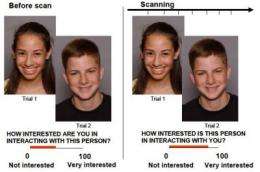
What is going on in teenagers' brains as their drive for peer approval begins to eclipse their family affiliations? Brain scans of teens sizing each other up reveal an emotion circuit activating more in girls as they grow older, but not in boys. The study by Daniel Pine, M.D., of the National Institute of Mental Health (NIMH), part of National Institutes of Health, and colleagues, shows how emotion circuitry diverges in the male and female brain during a developmental stage in which girls are at increased risk for developing mood and anxiety disorders.
"During this time of heightened sensitivity to interpersonal stress and peers' perceptions, girls are becoming increasingly preoccupied with how individual peers view them, while boys tend to become more focused on their status within group pecking orders," explained Pine. "However, in the study, the prospect of interacting with peers activated brain circuitry involved in approaching others, rather than circuitry responsible for withdrawal and fear, which is associated with anxiety and depression."
Pine, Amanda Guyer, Ph.D., Eric Nelson, Ph.D., and colleagues at NIMH and Georgia State University, report on one of the first studies to reveal the workings of the teen brain in a simulated real-world social interaction, in the July, 2009 issue of the journal Child Development.
Thirty-four psychiatrically healthy males and females, aged 9 to 17, were ostensibly participating in a study of teenagers' communications via Internet chat rooms. They were told that after an fMRI (functional magnetic resonance imaging) scan, which visualizes brain activity, they would chat online with another teen from a collaborating study site. Each participant was asked to rate his or her interest in communicating with each of 40 teens presented on a computer screen, so they could be matched with a high interest participant (see picture below).
Two weeks later, the teens viewed the same faces while in an fMRI scanner. But this time they were asked to instead rate how interested they surmised each of the other prospective chatters would be in interacting with them.
Only after they exited the scanner did they learn that, in fact, the faces were of actors, not study participants, and that there would be no Internet chat. The scenario was intended to keep the teens engaged -- maintain a high level of anticipation/motivation -- during the tasks. This helped to ensure that the scanner would detect contrasts in brain circuit responses to high interest versus low interest peers.
Although the faces were selected by the researchers for their happy expressions, their attractiveness was random, so that they appeared to be a mix of typical peers encountered by teens.
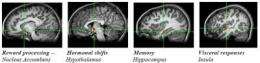
As expected, the teen participants deemed the same faces they initially chose as high interest to be the peers most interested in interacting with them. Older participants tended to choose more faces of the opposite sex than younger ones. When they appraised anticipated interest from peers of high interest compared with low interest, older females showed more brain activity than younger females in circuitry that processes social emotion.
"This developmental shift suggested a change in socio-emotional calculus from avoidance to approach," noted Pine. The circuit is made up of the nucleus accumbens (reward and motivation), hypothalamus (hormonal activation), hippocampus (social memory) and insula (visceral/subjective feelings).
By contrast, males showed little change in the activity of most of these circuit areas with age, except for a decrease in activation of the insula. This may reflect a waning of interpersonal emotional ties over time in teenage males, as they shift their interest to groups, suggest Pine and colleagues.
"In females, absence of activation in areas associated with mood and anxiety disorders, such as the amygdala, suggests that emotional responses to peers may be driven more by a brain network related to approach than to one related to fear and withdrawal," said Pine. "This reflects resilience to psychosocial stress among healthy female adolescents during this vulnerable period."
More information: Probing the neural correlates of anticipated peer evaluation in adolescence. Guyer AE, McClure-Tone EB, Shiffrin ND, Pine DS, Nelson EE. July 2009, Child Development.
Source: National Institute of Mental Health


