How the moon got its stripes
July 15, 2009 Enceladus

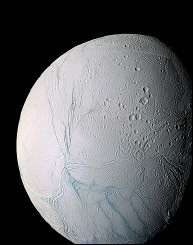
Cassini space probe mosaic image shows Saturn's moon Enceladus in 2006.

A new study has revealed the origins of tiger stripes and a subsurface ocean on Enceladus- one of Saturn's many moons. These geological features are believed to be the result of the moon's unusual chemical composition and not a hot core, shedding light on the evolution of planets and guiding future space exploration.

Dr Dave Stegman, a Centenary Research Fellow in the School of at the University of Melbourne, led the study and says that part of the intrigue with Enceladus is that it was once presumed to be a lifeless, frozen ball until a plume was seen erupting from its surface in 2006.

"NASA's recently revealed Enceladus as a dynamic place, recording geological features such as geysers emerging from the 'tiger stripes' which are thought to be cracks caused by tectonic activity on the south pole of the moon's surface," says Dr Stegman.

The moon is also one of the brightest objects in our solar system because the ice covering its surface reflects almost 100 percent of the sunlight that strikes it. One of Saturn's 53 moons (so far identified) Enceladus reflects so much of the sun's energy that its surface temperature is about -201° C (-330° F).

Grappling with how an inaccessible small moon with a completely frozen interior was capable of displaying geological activity, Dr Stegman and colleagues used computer simulations to virtually explore it.

Ammonia, usually found on Earth as an odorous gas used to make fertilizers, has been indirectly observed to be present in Enceladus and formed the basis of the study which is the first to reveal the origins of the subsurface ocean.

The model reveals that Enceladus initially had a frozen shell composed of a mixture of ammonia and water ice surrounding a rocky core. Over time, as Enceladus interacted with other moons, a small amount of heat was generated above the silicate core which made the ice shell separate into chemically distinct layers. An ammonia-enriched liquid layer formed on top the core while a thin layer of pure water ice formed above that. The work will be published in the August issue of the planetary science journal, Icarus.

"We found that if a layer of pure water ice formed near the core, it would have enough buoyancy to rise upwards, and such a redistribution of mass can generate large tectonic stresses at the surface," says Dr Stegman. "However, the pure ice rising up is also slightly warmer which causes the separation to occur again, this time forming an ammonia-enriched ocean just under the surface. The presence of ammonia, which acts as an anti-freeze, then helps keep the ocean in its liquid state."

"These simulations are an important step in understanding how planets evolve and provide questions to focus future space exploration and observations. It will hopefully progress our understanding of how and why planets and moons are different to each other."

Source: University of Melbourne (news : web)


print this article email this article download pdf blog this article bookmark this article     Stumble it Digg this share on Facebook retweet share on Reddit add to delicious
Rate this story - 4.3 /5 (7 votes)

Rank Filter

Move the slider to adjust rank threshold, so that you can hide some of the comments.


Display comments: newest first

  • yyz - Jul 15, 2009
    • Rank: 5 / 5 (1)
    I thought that some of Enceladus' internal heating was due to a tidal resonance with the moon Dione. Does this work in concert with the proposed mechanism for a subsurface liquid ocean?
  • Doug_Huffman - Jul 15, 2009
    • Rank: 3 / 5 (2)
    "The moon" is Luna. If they meant Enceladus then they should'a wrote Enceladus. Enchilada would have been just as misleading as "the moon."
  • omatumr - Jul 16, 2009
    • Rank: 1 / 5 (3)
    ACTINIDE ELEMENTS MAY CAUSE ENCELADUS ACTIVITY

    Light elements were closely associated with elements and isotopes that are made by rapid neutron capture, the r-process.

    Uranium, thorium, plutonium and all other actinide elements are made exclusively by the r-process. Those are likely sources of excess heat coming from Jupiter and of "geological" activity in Enceladus.

    The link of r-products with lightweight elements was first observed in tiny diamond inclusions of meteorites. The Galileo probe into Jupiter confirmed that the link of r-products with lightweight elements extends across planetary distances: http://tinyurl.com/otnky3

    With kind regards,
    Oliver K. Manuel
    http://www.omatumr.com
  • omatumr - Jul 16, 2009
    • Rank: 1 / 5 (3)
    ACTINIDE ELEMENTS MAY CAUSE ENCELADUS ACTIVITY

    Light elements were closely associated with elements and isotopes that are made by rapid neutron capture, the r-process, at the birth of the solar system.

    Uranium, thorium, plutonium and all other actinide elements are made exclusively by the r-process. Those are likely sources of excess heat coming from Jupiter and of "geological" activity in Enceladus.

    The link of r-products with lightweight elements was first observed in tiny diamond inclusions of meteorites. The Galileo probe into Jupiter confirmed that the link of r-products with lightweight elements extends across planetary distances: http://tinyurl.com/otnky3

    With kind regards,
    Oliver K. Manuel
    http://www.omatumr.com
  • JukriS - Jul 16, 2009
    • Rank: 1 / 5 (2)
    Maybe it is, bacause space expanding?

    Or maybe, because space curving?

    Or, maybe because nucleus of atoms expand/explod all a time and emit/radiate waves of energy, "who" have a nature of electrons and particle?

    If electrons just move to next explod nucleus of atoms and get this explod faster and faster, then we dont have to try explain how nucleus of atoms control electrons. Nucleus of atoms just control waves of energy who coming to nucleus of atoms! With waves of energy, what exploding nucleus of atoms emit/radiate!

    Then we dont have to try explain gravity/drawing force, you know.

    I dont believe, space expand or curv/bend at all!

    There is only energy, that changing all a time to not so density in space, that not expand or curv!

    http://www.onesim...e.com/l2

    http://www.onesim....com/296

    .

July 15, 2009 all stories

Comments: 5

4.3 /5 (7 votes)
  • Stumble this up

  • Digg this

  • share this

  • hide
  • Related Stories

  • Frictional heating explains plumes on Enceladus
    created May 16, 2007 | popularity not rated yet | comments 0
  • Enceladus, a moon of Saturn, is a 'cosmic graffiti artist,' astronomers discover
    created Feb 08, 2007 | popularity not rated yet | comments 0
  • A Hot Start Might Explain Geysers on Enceladus
    created Mar 12, 2007 | popularity not rated yet | comments 0
  • Hot spot on Enceladus causes plumes
    created Dec 10, 2007 | popularity not rated yet | comments 0
  • Scientists propose alternate model for plume on Enceladus
    created Dec 14, 2006 | popularity not rated yet | comments 0


  • hide
  • Relevant PhysicsForums posts

  • Sideral question
    created Nov 21, 2009
  • Doppler shifted blackbody spectrum
    created Nov 21, 2009
  • Earth v. Moon
    created Nov 21, 2009
  • help me with coordinates and orbits
    created Nov 21, 2009
  • More from Physics Forums - General Astronomy

Other News

Baby can wait as expectant dad finishes spacewalk (AP)

Baby can wait as expectant dad finishes spacewalk

Space & Earth / Space Exploration

created 15 hours ago | popularity 3 / 5 (2) | comments 0

(AP) -- A spacewalking astronaut put aside the impending birth of his daughter and blazed through his first-ever venture outside the International Space Station on Saturday.


Unseasonably hot and dry weather combined with strong winds to fan scores of blazes in the country's southeastern states

Australia issues 'catastrophic' alerts as fires rage

Space & Earth / Environment

created 21 hours ago | popularity 4 / 5 (3) | comments 0

Australia has issued "catastrophic" alerts after record-breaking temperatures and wild lightning storms sparked more than 100 fires across the country, officials said Saturday.


Commuters wait on the platform shrouded by fog in London

Climate change not man-made, say majority of Britons: poll

Space & Earth / Environment

created Nov 15, 2009 | popularity 3.3 / 5 (15) | comments 46

Less than half of Britons believes that human activity is to blame for global warming, according to a poll carried out for The Times newspaper and published on Saturday.


Mysteriously warm times in Antarctica

Mysteriously warm times in Antarctica

Space & Earth / Earth Sciences

created Nov 18, 2009 | popularity 4.2 / 5 (21) | comments 28

(PhysOrg.com) -- A new study of Antarctica's past climate reveals that temperatures during the warm periods between ice ages (interglacials) may have been higher than previously thought. The latest analysis ...


UN: Fight climate change with free condoms (AP)

UN: Fight climate change with free condoms

Space & Earth / Environment

created Nov 18, 2009 | popularity 3.1 / 5 (11) | comments 25

(AP) -- The battle against global warming could be helped if the world slowed population growth by making free condoms and family planning advice more widely available, the U.N. Population Fund said Wednesday.