New insect on Balearic Islands
July 15, 2009
New insect on Balearic Islands

Enlarge

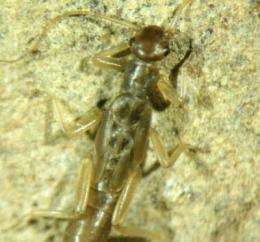
This is Tyrrhenoleuctra antoninoi. Credit: José Manuel Tierno de Figueroa / SINC

After 10 years of biochemical and molecular analysis of the Tyrrhenoleuctra plecoptera that live in the Western Mediterranean, Spanish and Italian scientists have now demonstrated that one of the insect populations of this group is a distinct and, therefore, new species.

The researchers, including a team from the University of Granada (UGR), used biochemical and molecular techniques for a decade to detail the taxonomical and phylogenetic relationships of the insects of the Tyrrhenoleuctra plecoptera genus that are spread across the Western Mediterranean (northern Africa, Iberian Peninsula, Balearic Isles, Corsica and Sardinia). The analyses included three species described using morphological characters as a basis.

"One of the results discovered and published in our studies is that the population of Tyrrhenoleuctra on the Balearic Islands is a clearly distinct taxon and demands acknowledgement of its status as an independent species", José Manuel Tierno de Figueroa, co-author of the study and a researcher in the Department of Animal Biology at the UGR explained SINC.

In order to demonstrate that the insect, called Tyrrhenoleuctra antoninoi, is really a species in its own right the team of scientists, comprising the Spanish researcher and Romolo Fochetti from the Tuscia University of Studies (Italy), wrote a scientific description in the journal Zootaxa, with biochemical (based on studies of enzymatic electrophoresis) and molecular characters (by means of mitochondrial DNA fragment sequencing).

Among the results of the study, Tierno de Figueroa and Fochetti highlighted the fact that insect was genetically distinct and "more closely related to populations on the southern Iberian peninsula and northern Africa than to those found on Corsica and Sardinia". The researchers also highlight that Tyrrhenoleuctra evolve molecularly at a "considerably slower rate than other insects distributed similarly in geographical terms.

Very Different Insects

Populations of insects belonging to the Tyrrhenoleuctra plecoptera genus can be found in temporary fresh water streams, sometimes at sea level, "which is very unusual for this group of insects, which generally live in highly oxygenated water in the medium or high alps", Tierno de Figueroa clarified. The scientists performed biochemical and molecular analyses to also discern these insects' biogeographical implications.

A study carried out on a larger scale had already shown great variation in almost all the characters that experts use to separate species. "Thus, intra-specific variability was as high as inter-specific variability, rendering morphological characters useless for identification purposes", the biologist said.

The new species of plecoptera takes the name of Tyrrhenoleuctra antoninoi in honour of researcher Antonino Sánchez-Ortega, who died in 2002 after devoting the best part of his life to studying these on the Iberian Peninsula.

Source: FECYT - Spanish Foundation for Science and Technology

3.5 /5 (2 votes)  

Rank 3.5 /5 (2 votes)
Relevant PhysicsForums posts
  • Pertubance in a model
    created1 hour ago
  • Cancer drugs and Alzheimer's, Oh my!
    created9 hours ago
  • Squishing cells
    created9 hours ago
  • Any books/articles for evolutionary stable strategy models in humans?
    created21 hours ago
  • Science behind the bore feeling?
    createdFeb 09, 2012
  • Homo Sapien vs. Chimpanzee - Divergence Timeline
    createdFeb 09, 2012
  • More from Physics Forums - Biology

More news stories

An eye for the tsetse fly

(PhysOrg.com) -- Geoffrey M. Attardo was one of those little boys who made pets of the spiders outside his bedroom window, feeding them and watching as they spun intricate webs. Age has not diminished his ...

Biology / Plants & Animals

created 45 minutes ago | popularity not rated yet | comments 0

Cure of ADPKD by selection for spontaneous genetic repair events in Pkd1-mutated iPS cells

A research group including Kyoto University researchers demonstrates that mouse iPS cells, in which genetic correction occurs spontaneously through mitotic recombination, is selectable from the population of genetically mutated ...

Biology / Cell & Microbiology

created 40 minutes ago | popularity not rated yet | comments 0

Miami battling invasion of giant African snails

No one knows how they got there. But an invasion of African giant snails has southern Florida in a panic over potential crop damage, disease and general yuckiness surrounding the slimy gastropods.

Biology / Ecology

created 3 hours ago | popularity not rated yet | comments 1

Protein libraries in a snap

(PhysOrg.com) -- A Rice University undergraduate will depart with not only a degree but also a possible patent for his invention of an efficient way to create protein libraries, an important component of biomolecular ...

Biology / Cell & Microbiology

created 2 hours ago | popularity 5 / 5 (1) | comments 0 | with audio podcast

Fighting crimes against biodiversity: How to catch a killer weed

Invasive species which have the potential to destroy biodiversity and influence global change could be tracked and controlled in the same way as wanted criminals, according to new research from Queen Mary, University of London.

Biology / Ecology

created 4 hours ago | popularity not rated yet | comments 0


A frank discussion of the power law and linking correlation to causation

(PhysOrg.com) -- Michael Stumpf a mathematics professor at Imperial College in London, and Mason Porter a lecturer at Oxford have teamed together to write and publish a perspective piece in Science regarding the in ...

Mars Science Laboratory computer issue resolved

(PhysOrg.com) -- Engineers have found the root cause of a computer reset that occurred two months ago on NASA's Mars Science Laboratory and have determined how to correct it.

Advanced power-grid model finds low-cost, low-carbon future in West

(PhysOrg.com) -- The least expensive way for the Western U.S. to reduce greenhouse gas emissions enough to help prevent the worst consequences of global warming is to replace coal with renewable and other ...

Small modular reactor design could be a 'SUPERSTAR'

(PhysOrg.com) -- Though most of today's nuclear reactors are cooled by water, we've long known that there are alternatives; in fact, the world's first nuclear-powered electricity in 1951 came from a reactor ...

Clam fields found at deep, low-temperature Mariana vents

(PhysOrg.com) -- Scientists have marveled at the unusual life forms thriving at high temperature hydrothermal vents of the deep ocean.

Seeing colors in music, tasting flavors in shapes may happen in life's early months

Famed violinist Itzhak Perlman sees a deep forest green whenever he plays a B-flat on his Stradivarius' G string. The A on the E string is red.