Primitive asteroids in the main asteroid belt may have formed far from the sun (w/ Video)
Many of the objects found today in the asteroid belt located between the orbits of Mars and Jupiter may have formed in the outermost reaches of the solar system, according to an international team of astronomers led by scientists from Southwest Research Institute (SwRI).
The team used numerical simulations to show that some comet-like objects residing in a disk outside the original orbit of the planets were scattered across the solar system and into the outer asteroid belt during a violent phase of planetary evolution.
Usually, the solar system is considered a place of relative permanence, with changes occurring gradually over hundreds of millions to billions of years. New models of planet formation indicate, however, that at specific times, the architecture of the solar system experienced dramatic upheaval.
In particular, it now seems probable that approximately 3.9 billion years ago, the giant planets of our solar system -- Jupiter, Saturn, Uranus and Neptune -- rearranged themselves in a tumultuous spasm. "This last major event of planet formation appears to have affected nearly every nook and cranny of the solar system," says lead author Dr. Hal Levison of SwRI.
Key evidence for this event was first identified in the samples returned from the Moon by the Apollo astronauts. They tell us about an ancient cataclysmic bombardment where large asteroids and comets rained down on the Moon.
Scientists now recognize that this event was not limited solely to the Moon; it also affected the Earth and many other solar system bodies. "The existence of life on Earth, as well as the conditions that made our world habitable for us, are strongly linked to what happened at this distant time," states Dr. David Nesvorny of SwRI.
The same dynamical conditions that devastated the planets also led to the capture of some would-be impactors in the asteroid belt. "In the classic movie 'Casablanca,' everybody comes to Rick's. Apparently throughout the solar system, the cool hangout for small objects is the asteroid belt," says Dr. William Bottke of SwRI.
Once in the asteroid belt, the embedded comet-like objects began to beat up both themselves and the asteroids. "Our model shows that comets are relatively easy to break up when hit by something, at least when compared to typical asteroids. It is unavoidable that some of the debris went on to land on asteroids, the Moon and the Earth. In fact, some of the leftovers may still be arriving today," says Dr. Alessandro Morbidelli of the Observatoire de la Cote d'Azur in Nice, France.
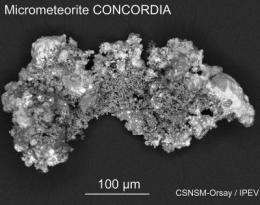
The team believes the surprising similarities between some micrometeorites landing on Earth and comet samples returned by NASA's Stardust mission are no accident. "There has been lots of debate about the nature of micrometeorites reaching the Earth," says Dr. Matthieu Gounelle of the Museum National d'Histoire Naturelle in Paris. "Some believe they are asteroidal, while others argue they are cometary. Our work suggests that in a sense, both camps may be right."
"Some of the meteorites that once resided in the asteroid belt show signs they were hit by 3.5 to 3.9 billion years ago. Our model allows us to make the case they were hit by captured comets or perhaps their fragments," adds Dr. Kleomenis Tsiganis of Aristotle University of Thessaloniki, Greece. "If so, they are telling us the same intriguing story as the lunar samples, namely that the solar system apparently went berserk and reconfigured itself about 4 billion years ago."
Overall, the main asteroid belt contains a surprising diversity of objects ranging from primitive ice/rock mixtures to igneous rocks. The standard model used to explain this assumes that most asteroids formed in place from a primordial disk that experienced radical chemical changes within this zone. This model shows, however, that the observed diversity of the asteroid belt is not a direct reflection of the intrinsic compositional variation of the proto-planetary disk. These results fundamentally change our view of the asteroid belt.
Additional tests of this model will come from studies of meteorites, the asteroid belt, planet formation and the Moon. "The Moon and the asteroid belt may be the best and most accessible places in the solar system to understand this critical part of solar system history," says Levison. "We believe key evidence from these cold airless bodies may help us unlock the biggest 'cold case' of all time."
More information: The article, "The Contamination of the Asteroid Belt by Primordial Trans-Neptunian Objects," by Hal Levison, William Bottke, Alessandro Morbidelli, Matthieu Gounelle, David Nesvorny and Kleomenis Tsiganis, was published in the July 16 issue of Nature.
Source: Southwest Research Institute (news : web)


